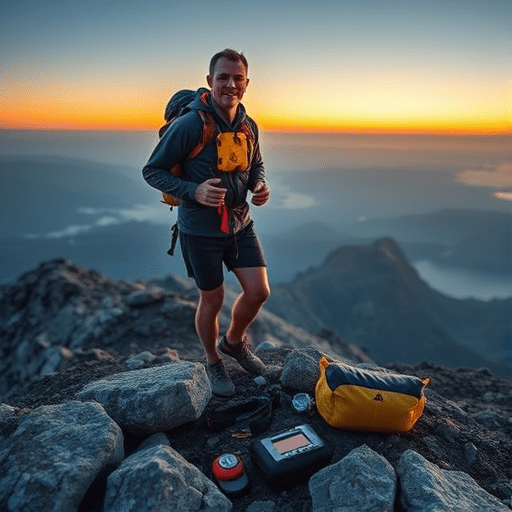
When you’re the only person on the course with your name on the start list, the emergency device on your hip is your entire support crew. The PLB vs. satellite messenger decision for solo race safety is no longer just about GPS breadcrumbs — it comes down to how fast help actually reaches you, how long your device holds power when everything else is dead, and who pays for the rescue once you trigger it. This guide breaks down those three metrics for modern solo racing, where race organizers are rewriting mandatory gear lists and rescue costs are becoming a genuine financial risk for solo competitors.
What You’re Actually Carrying: Two Different Safety Philosophies
A Personal Locator Beacon is a one-way, 406 MHz distress beacon designed for a single job: to send a digital pulse to the Cospas-Sarsat satellite network, which forwards your position to an official Rescue Coordination Center (RCC). No texts, no confirmations, no weather updates. It is a liferaft-level emergency tool that can stay dormant for years and still transmit for 24 hours straight when activated.
A satellite messenger, by contrast, is a two-way communicator that works on commercial satellite networks (Iridium or Globalstar). It sends your SOS not to an RCC directly, but to a private monitoring center, which verifies the message and contacts local SAR authorities. The newest messengers also provide routine tracking, pre-set “I’m okay” pings, weather forecasts, and full keyboard messaging via a phone app. That philosophical difference drives everything else — latency, battery strategy, and the cost model of the overall rescue experience.
Latency: The First Five Minutes After You Press the Button
Latency is the time between pressing the distress button and having a live rescue team dispatched. PLBs are designed to minimize this first-link latency. The 406 MHz signal is detected by geostationary Earth orbit satellites within seconds to a few minutes, and with built-in GNSS position, the RCC often has your exact coordinates before any human voice is exchanged. In a solo race — a nighttime fall into a cold river, a high-speed crash on a remote gravel pass — that direct link is the closest thing to an instant rescue trigger available to a civilian.
However, a PLB gives you zero feedback. Once activated, you don’t know whether the signal was received. That is a significant psychological factor for solo racers who are conscious, injured, and waiting for help that could be hours away.
Satellite messengers introduce more latency at the front end because the SOS message travels to a private coordination center such as Garmin’s IERCC or the GEOS network. The center confirms your account, reads your message, determines your location, and then contacts the appropriate regional RCC. This can take anywhere from a few minutes to fifteen minutes, depending on satellite visibility and signal quality. Low-Earth-orbit constellations have reduced store-and-forward delays, but the monitoring-center call chain remains the primary bottleneck. The tradeoff is that a messenger lets you exchange text in both directions, so you can tell rescue coordinators about hazards, injuries, or that your emergency has been resolved — preventing an unnecessary rescue deployment.
- PLB latency: seconds to a few minutes from button press to RCC; no acknowledgement to you.
- Messenger latency: 1–15 minutes door-to-door; includes a human verification step, but you can communicate during the process.
Battery Life: Race-Pace Power Math
Battery life is where the two devices diverge in ways that are not obvious from a spec sheet. A PLB’s battery is designed for a single, resounding emergency. It retains charge for five to seven years in storage, operates at −20°C, and delivers constant transmission for at least 24 hours after activation. For a solo racer who is unconscious and lying in a ditch, the PLB is the only device that can reliably keep sending a signal through the night. It doesn’t need to be turned on during the race; it doesn’t run out; it simply waits.
Satellite messengers are used continuously for tracking and messaging, which drains the battery at a much faster rate. Typical active tracking consumes 20–40% of the charge per day, depending on the model and ping interval, and most messengers require recharging after 24 to 72 hours in a realistic race scenario. Popular devices like the Garmin inReach family and ZOLEO now offer power-saving modes that shorten tracking intervals — but that increases the latency of position updates, a tradeoff you can choose. The practical consequence is that you need a power bank, solar panel, or a strict daily charging plan to take a messenger into a multi-day race.
This is why the combined approach is increasingly standard among serious solo racers. Carry a PLB as the low-latency, always-on emergency reserve, and run a satellite messenger for race logistics, check-ins, and two-way reassurance. That way, the PLB’s battery sits untouched until the moment it is genuinely needed, while the messenger absorbs the daily load of tracking pings and weather updates.
Rescue Coordination Costs: The Bill Nobody Puts on the Start Line
This is the part of the PLB vs. satellite messenger decision that has changed the most. The actual cost of activating your device can vary wildly based on the device type, the service plan, and your location.
PLB costs. A PLB has no subscription fee, and the Cospas-Sarsat system is government-funded. A genuine distress call does not generally incur a direct charge from the rescue authority, because rescue is treated as a public service. That said, several US states have begun passing legislation that allows counties to bill for search-and-rescue operations, though most exempt cases involving a registered PLB activated in good faith. If a racer triggers a PLB in a false-alarm situation — panic, a mistaken button press, or failure to follow the owner’s manual — they may face an administrative fine, but that remains relatively rare.
Satellite messenger costs. This is where financial exposure grows. Messengers require a subscription, ranging from about $11 to $15 per month for basic plans to $30 to $50 for comprehensive plans with weather and unlimited tracking. More importantly, the private monitoring center that receives your SOS can, in non-life-threatening situations, bill for dispatching local emergency services, arranging an evacuation, or sending a ground team. A solo racer who is injured but stable might trigger an evacuation that results in an invoice for a helicopter, an ambulance, or a multi-hour search party. The industry has responded by bundling search-and-rescue insurance into premium plans, but it’s not universal, and coverage often excludes races on private land or events using non-approved gear. Read the fine print.
Race organizer requirements. Many solo races now require either a PLB or a messenger as a condition of entry, and some have begun mandating both: a messenger for real-time tracking so race HQ knows your position, and a PLB as the ultimate backstop. Check your race rules before buying, because meeting the minimum requirement is not the same as meeting your personal safety needs.
Race Scenarios: Which Tool Earns Its Weight in 2026
- Solo ultra-runner on a marked 100-mile course: A messenger handles pacing, resupply timing, and family check-ins. A PLB stays in the pack and is never treated as a battery-dependent luxury.
- Solo bikepacker in a remote mountain loop: The messenger is the primary tool for route-sharing and two-way communication in non-emergency situations. The PLB is the backup for mechanical failure or altitude sickness when the messenger battery is flat.
- Solo offshore paddler or sailor: PLB wins. Marine-specific PLBs and EPIRBs survive immersion, are intrinsically reliable, and send distress signals to maritime RCCs without a private intermediary. A messenger is useful for weather but must be stored in a waterproof case and tied to a strict power budget.
- Night race in cold or wet conditions: Cold drains lithium-ion messenger batteries much faster than mild conditions. A PLB’s specialized battery chemistry is rated for extreme temperatures, making it the safest cold-weather choice for alpine or winter solo events.
A Decision Framework for the Solo Start Line
If you only buy one device, choose based on your dominant fear. If you fear being unconscious, injured, and unresponsive in cold, dark conditions, the PLB is the better single purchase. If you fear being stranded and needing to negotiate help, coordinate a meet-up, or simply reassure family that you’re okay, the satellite messenger is the more versatile tool. And if the race is truly solo, in terrain where rescue is costly, and your budget allows one serious safety system, carry both. The dual setup is increasingly common among experienced solo racers, and it’s hard to argue with the logic: the PLB covers the worst-case scenario, and the messenger covers everything else.
The PLB vs. satellite messenger choice for solo race safety is not a contest between old and new technology. It is a decision about where you want the risk to live. One device offers absolute reliability in the moment of crisis; the other provides the flexibility to avoid a crisis in the first place. By comparing latency, battery life, and rescue coordination costs before race day, you can build a safety net that fits your course, your budget, and the one thing no racer can buy at a start line: certainty.