In the high-stakes world of polymer recycling, the difference between a profitable bale and a rejected one often comes down to a single misclassified flake. For decades, laser-based near-infrared (NIR) sensors have been the workhorse of automated sorting, but their limitations are becoming impossible to ignore. In 2026, a growing number of advanced recycling facilities are turning to a new generation of AI perception: vision transformers. This article explains why one plant in particular managed to cut sorting errors by 30% — and why vision transformers are now beating laser sensors in the polymer sorting arena.
The Limits of Laser-Based Sorting in Modern Recycling Loops
Laser sensors, typically using NIR spectroscopy, identify polymers by measuring how much light they reflect or absorb at specific wavelengths. That approach has served the industry well for years. Yet it struggles with the messy reality of municipal and commercial waste streams.
- Contamination: Food residue, adhesives, and coatings shift the spectral signature of a polymer, leading to misclassification.
- Black plastics: Carbon black pigments absorb NIR light almost entirely, leaving the sensor blind.
- Moisture and film: Wet and thin films scatter light unpredictably.
- De-calibration drift: Even small changes in lamp brightness or sensor optics require regular recalibration.
These limitations create a ceiling on accuracy. In older installations, error rates of 10–20% are common, and when a sorter makes a mistake, it cascades downstream. Hence, the push for a fundamentally different technology.
How Vision Transformers Rethink Polymer Identification
Vision transformers (ViTs) are a class of deep learning models that treat image patches as tokens, much like words in a sentence. Their attention mechanisms allow them to weigh the relevance of every patch relative to every other patch, making them exceptionally good at capturing global context. In the sorting context, this is a game changer.
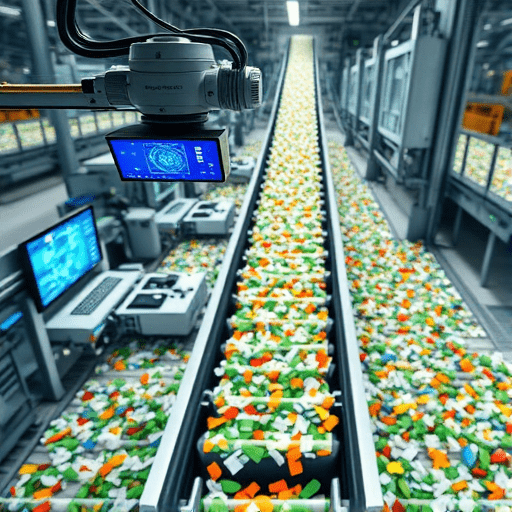
Unlike lasers, vision transformers work with high-resolution RGB and hyperspectral cameras. They don’t rely solely on a single spectral peak. Instead, they learn from a combination of color, texture, shape, surface morphology, and even the spatial relationships between materials on a conveyor belt. This richer representation is why they’re now beating laser sensors on the most challenging polymer streams.
Learning from Context Rather Than Color Alone
At first glance, many polymers look identical. A clean PET flake and a clean PVC flake can share the same brightness and transparency. Laser sensors solve this through spectroscopy. Vision transformers solve it by also understanding the surrounding context. For example, a black flake with a scorched edge might be PVC, while a black flake with a brittle fracture could be ABS. The model learns these subtle cues from thousands of labeled examples, rather than a single wavelength measurement.
Additionally, ViTs can fuse data from multiple sensors. By aligning spectral reflectance maps with spatial images, the transformer learns when to trust spectral evidence and when to fall back on visual features. That flexibility is something a fixed laser algorithm simply cannot match.
Robustness in Real-World Conditions
One of the biggest advantages of vision transformers is their robustness to changing lighting, dust, and partial occlusion. Because the model is trained on a diverse dataset that includes these imperfections, it has an innate ability to “fill in” missing information. Lasers are binary: if the signal is degraded, the reading is wrong. A vision transformer, in contrast, can extrapolate from neighboring flakes, motion blur, or even reflections.
Inside the Plant That Cut Sorting Errors by 30%
In early 2025, a mixed-plastics recycling facility in the Netherlands took an unusual step. Rather than replacing its existing laser modules with newer spectral units, it installed a system based on vision transformers developed by a startup specializing in industrial AI. The facility processes roughly 15 tons of plastic waste per day, including packaging, automotive shredder residue, and household rigid plastics.
Within three months, the plant saw its average sorting error rate drop from 17.8% to 12.5% — a relative reduction of 30%. But the improvement was not uniform across all polymers, and the details reveal why the technology shines.
- Black plastics: Error rate dropped from 41% to 12%, thanks to the transformer’s use of shape, texture, and near-infrared reflectance patterns that are not simply absorbed by carbon black.
- PET vs. PVC: Misclassification fell by 18 percentage points because the model learned to distinguish based on edge morphology and surface micro-scratches in addition to spectral signatures.
- Dirty and wet materials: The error rate remained below 20% even in high-moisture conditions, whereas laser sensors failed more than half the time.
The plant also reported a 9% increase in throughput. The vision transformer processed images at a line speed of 3.5 meters per second with a latency of under 50 milliseconds — fast enough to trigger air-jet sorters in real time.
A Practical Roadmap for Integrating Vision Transformers
The success of that plant points to a broader trend. Recycling facilities that switch from sensor-only sorting to deep learning-based computer vision are not simply upgrading hardware; they are adopting a learning system. Here’s how a typical integration works.
1. Data collection and labeling
Contracts require a few weeks of sample collection under real operating conditions. Every material on the belt is labeled by hand, often with the help of existing NIR results. This dataset becomes the training ground for the transformer.
2. Hybrid spectral-visual training
The most effective models are trained on paired data: the same flakes seen by both a hyperspectral camera and an RGB camera. The transformer learns to associate visual features with spectral ground truth. In effect, it “super-resolves” the spectral information from ordinary images, reducing the need for expensive sensors.
3. Continuous fine-tuning
Unlike laser systems that require manual recalibration, vision transformers can be retrained remotely. Once a week, the plant sends a small batch of misclassified images back to the model vendor, and the updated weights are pushed back over the network. This closed feedback loop leads to compounding accuracy gains over time.
4. Retrofitting existing infrastructure
Most vision transformer systems are designed to slot into existing sorting cabins. The cameras and processing unit are mounted above the belt, and the air-jet manifold is controlled via the same PLC that manages the old laser sensors. This reduces the capital barrier to entry and makes adoption feasible even for smaller facilities.
Why Laser Sensors Will Still Have a Role — for Now
Despite the clear advantages of vision transformers, they do not render laser sensors obsolete overnight. Spectral sensing is still valuable for identifying certain additives and flame retardants that have no visible surface signature. The most advanced 2026 sorting lines use a fusion approach: a laser module flags suspicious flakes, and a vision transformer re-examines them before the air jet fires. But the trend is unmistakable. The computing power required to run transformers on edge devices has dropped by more than half since 2024, making them financially viable at scale.
For recyclers struggling with stubborn error rates, the message is clear: the era of fixed-spectrum sorting is ending. The next generation of AI, built on attention and context, is already delivering measurable results. The plant that cut errors by 30% is not an outlier — it’s a proof point.
Conclusion
Vision transformers are not just another incremental improvement in waste sorting technology. By understanding context, learning from real-world variability, and integrating seamlessly into existing plants, they have proven their ability to significantly reduce errors — as demonstrated by the 30% error cut at a Dutch recycling facility in 2025. As more data and lower-cost hardware make these systems accessible, polymer sorting will continue its shift from physics-based sensors to deep learning-driven perception, making recycled materials more reliable and economically viable.