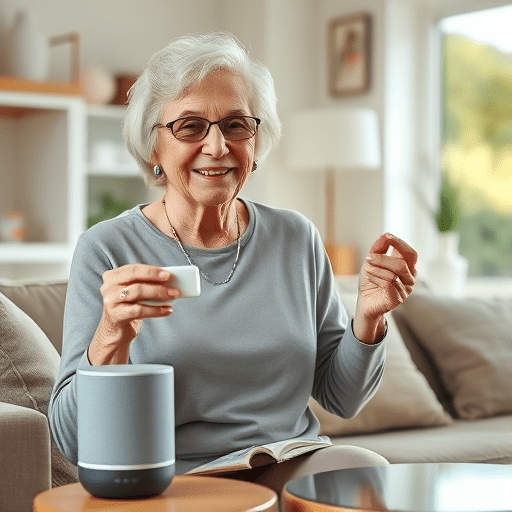
Medication non-adherence has quietly become one of the most expensive and dangerous public health problems. Each year, missed and incorrect doses lead to hospital readmissions, worsened chronic conditions, and billions in avoidable healthcare costs. Pill organizers, smartphone apps, and automated dispensers have all tried to fix this, but they share a central weakness: they ask older adults to adapt to rigid, screen-based systems. Voice-first medication reminders for elderly adherence turn that model upside down. Instead of navigating an app, a senior simply speaks with a familiar voice in the living room, and the reminder becomes a conversation.
By 2026, this category has moved beyond the simple “Time to take your pill” announcement. The next generation of voice assistants reasons, remembers, and even reaches out to a family member when something feels wrong. This article explores why voice-first medication reminders for elderly adherence represent the next adherence tool, what has changed recently, and what caregivers should consider before adopting one.
Why Conventional Adherence Tools Miss the Mark for Older Adults
Existing tools fail because they depend on behaviors that decline with age or stress. Smartphone apps require charging, logins, and a willingness to interact with a small screen; many seniors abandon them within a month. Automated pill dispensers beep the same way for every missed dose, offering no feedback and no adaptation. A one-way alarm is easy to ignore. Older adults managing multiple chronic conditions also carry a heavy cognitive load, tracking five or six medications with different schedules, food restrictions, and refill timelines. Voice reduces that load by turning each reminder into a natural, conversational exchange.
The Interaction Shift: From Alerts to Conversations
The defining change in 2026 is the move from alert-based reminders to conversation-based adherence. A voice-first reminder for a blood pressure drug might sound like this: “Good morning, Eleanor. It’s 8 a.m. Do you want to take your medication now or after breakfast? I also noticed your refill is getting low — I can check whether your pharmacy has it ready.” This works because it is auditory, which suits many seniors; it asks a confirmatory question, generating a verbal response that acts as a check; and it anticipates a future problem, which points to the next wave of voice assistant medication reminders.
Agentic Assistance: Proactive Medication Management in Real Time
In 2025 and 2026, the industry borrowed the term “agentic” to describe assistants that act on their own initiative. An agentic voice assistant does not simply wait for a command. It monitors schedules, reads prescription records, tracks refill dates, and coordinates with other household devices. If the user says, “I have a dentist appointment tomorrow morning,” the assistant can adjust dosing times accordingly. If the pharmacy is closed, it can suggest a later pickup. If the user forgets a dose twice in a row, the assistant flags the pattern and suggests involving a caregiver. This is a profound advance over fixed audio clips.
Wearables, Smart Home Sensors, and a Full Adherence Picture
Voice assistants no longer operate in isolation. They act as the conversational front door to a wider care ecosystem. A smartwatch may detect that the user has just woken up; a smart speaker in the kitchen may sense presence; a smart pill bottle can even report when the cap opens. Combining these inputs enables a context-aware reminder. Instead of announcing a dose at a fixed time, the system waits until the user is seated and then confirms, “I see you have opened the bottle. Please confirm you took one tablet.” This creates a verified event, giving clinicians more reliable adherence data.
Privacy, Trust, and the Sound of Consent
Trust is the biggest adoption barrier among seniors. Vocal monitoring makes many people uneasy, so the best platforms in 2026 process as much speech as possible locally on the device. Basic schedules, wake-word detection, and confirmation dialogues run on edge hardware without streaming to the cloud. Escalation, such as contacting a caregiver or refilling a prescription, uses an encrypted connection. Transparency matters too: users can ask, “What did you hear today?” and receive a plain-language log. A physical mute switch gives seniors the right to silence, which is a design principle, not an afterthought.
Designing for Real Senior Voices and Auditory Fatigue
Voice systems also need to understand how older adults actually speak. Accents, slower pacing, and age-related articulation differences are common, so the assistant must recognize its uncertainty and ask a clarifying question instead of guessing. Auditory fatigue is another issue. If the speaker chimes too often or sounds urgent, seniors ignore it just as they might ignore a flashing router light. Adaptive engines calibrate the cadence for each user, using a gentle chime followed by silence for some, or a warm conversational prompt for others. Restraint is as important as accuracy.
The Caregiver Loop: Closing the Gap Between Home and Clinic
Voice assistants can also break an old information barrier. A family caregiver visiting twice a week usually gets a polite “I’m remembering everything fine,” whether that is true or not. With a voice-first medication reminder system, the caregiver can receive a weekly digest of confirmed doses, missed doses, and behavioral patterns. Some platforms allow a caregiver to record a compassionate voice message that plays after a missed dose, turning the assistant into a relay for family presence. Clinical teams may use verified voice confirmations as supporting data for remote monitoring, though the assistant should not be treated as a diagnostic device.
Overcoming the Remaining Barriers to Adoption
Adoption still faces practical obstacles. A full ecosystem of smart speakers, pill bottles, and wearables is expensive for seniors on fixed incomes, and rural internet interruptions can disrupt cloud features. Offline fallbacks and local processing are therefore essential. There is also an emotional challenge. An assistant that asks, “Did you take your pill?” can sound like an authority figure. The most successful implementations avoid judgment and use empathic phrasing: “Just checking in — did the medicine go okay?” The assistant should feel like a companion, not an overseer.
Voice-first medication reminders for elderly adherence are not a silver bullet, but they offer a genuinely human interface for a demanding daily task. The best systems combine conversational intelligence, edge privacy, caregiver connectivity, and deep respect for autonomy. For families deciding how to support an older adult at home, the choice is no longer between a beeping dispenser and an app. The choice is how to build a caring, conversational loop that includes the older adult as an active participant. The goal is not to replace human attention, but to make it faster, kinder, and more consistent.