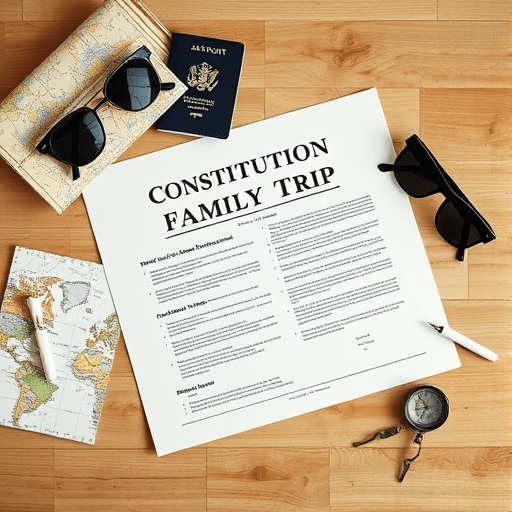
Planning a family vacation without disagreements can feel like an impossible dream. One parent wants a quiet beach, the kids want a theme park, and the other parent wants a city with great food. By the time everyone has voiced an opinion, the planning chat holds forty messages and zero decisions. The problem isn’t that your family is difficult; it’s that you’re negotiating from scratch every single time. The fix is a one-page trip constitution: a short written agreement that captures your family’s shared travel values and decision-making rules before anyone opens a booking app. Once it exists, it powers every choice—and it ends most arguments before they start.
Why Family Vacation Planning Turns Into a Conflict Zone
Most family vacation fights are not really about the destination. They are about unspoken expectations. One person expects a relaxing trip. Another expects an adventure. A third expects to never miss a dinner reservation. When those expectations collide, the argument looks like it’s about “where to eat,” but it’s actually about who gets to define the trip’s purpose.
Families also face decision fatigue. With flights at four different times, hotels in nine neighborhoods, and activity bundles promising everything at once, every option triggers a fresh debate. A trip constitution fixes this by providing a shared filter before the options even arrive.
What Is a Trip Constitution?
A trip constitution is a one-page document, written together, that sets the core principles for a vacation. It is not an itinerary. It won’t tell you which museum to visit on Tuesday. It defines the trip’s primary purpose, each person’s non-negotiables, who decides what, and how the family will handle a disagreement on the road.
Think of it as the operating system your vacation runs on. Once the family agrees to it, every subsequent decision can be evaluated against it. Its secret superpower is that compromise feels less personal when the rules were written together in advance.
Step 1: Write the Preamble—Agree on the “Why”
The preamble answers one question: “Why are we taking this trip?” Each person writes a single sentence describing how they want to feel at the end. A parent might write “reconnected.” A teenager might write “not bored.” A younger child might write “happy.”
Then the family blends these into one shared sentence, like: “We are taking this trip to spend time together, try new things at our own pace, and return more relaxed than when we left.” That sentence becomes the tie-breaker for everything. If an activity would make the trip feel rushed, it conflicts with the preamble. If a bargain would create stress, it does too.
Step 2: List Non-Negotiables and Nice-to-Haves
Everyone writes down their two or three non-negotiables—the things without which the trip would not feel complete. A non-negotiable might be “a day at the beach” or “no fast food for the whole week.” Everything else goes on a shared nice-to-have list.
This distinction matters because it stops the common problem of every person treating every preference as essential. On the trip, non-negotiables come first. Nice-to-haves get included only when they don’t conflict with non-negotiables. One rule eliminates many arguments.
Step 3: Assign Decision Rights
Democracy on vacation often produces gridlock. A trip constitution replaces the endless vote with decision rights. For example:
- The budget person approves spending categories.
- The activity person sets the daily schedule.
- The food person chooses restaurants but respects dietary needs.
The roles are assigned by agreement, not by power. When someone owns a category, they also carry the responsibility to honor everyone’s non-negotiables. And because the roles are written down, no one can be accused of being controlling. It’s in the constitution.
Step 4: Build a Conflict-Resolution Clause
Even with a constitution, disagreements happen. The goal is to handle them without a scene. Two simple rules work well. The first is the “two-option vote”: each person presents one option, and the family votes; if it’s a tie, the person whose non-negotiable is at stake gets the final say. The second rule is “try it for one hour”: when the group is split, try the activity briefly and check in afterward. Small disagreements stop derailing the day.
Step 5: Set Budget and Pacing Rules
Money is the leading source of vacation conflict. The constitution doesn’t need a spreadsheet, just a boundary: “We spend on experiences more than on things” or “meals stay under a set amount per person.” A clear boundary prevents the silent resentment that comes from uneven spending.
Pacing rules matter just as much. A line like “one major activity in the morning, one after lunch, and no plans after six p.m.” protects both the marathoners and the loungers. It also gives the slower-paced members permission to rest without guilt.
How the Constitution Powers Decisions on the Road
The document proves its worth once the trip starts. When someone spots a tempting restaurant, the family checks the food rule. When rain cancels an excursion, they ask which backup best honors the preamble. When two people want opposite things, the conflict clause kicks in.
This is especially valuable with teenagers. Teens resist decisions made for them but embrace rules they helped write. A constitution gives them ownership, and it gives the whole family a calm way to stay aligned.
A Sample Constitution to Steal
Here’s a minimal example for a family of four:
- Preamble: We are taking this trip to enjoy a change of scenery, reconnect, and share a few good meals.
- Non-negotiables: Mom gets a morning walk; Dad gets one brewery visit; Alex gets one water activity; Maya gets one lazy day.
- Decision rights: Mom owns the budget; Dad owns tickets and routes; food choices rotate daily.
- Conflict rule: If we can’t agree quickly, the person with the strongest non-negotiable decides; if still unhappy, we use the two-option vote.
- Pacing rule: One big activity per half-day; no alarms before seven a.m.
- Budget rule: Spend freely on experiences within the total limit; check in before any single purchase above a set amount.
Keep yours this short. If the constitution runs past one page, it has become an itinerary.
Keep It to One Page
The one-page limit is not arbitrary. It forces the family to choose what truly matters, and it makes the document easy to consult during a stressful travel day. Print it, fold it, and keep it with the passports. Or save a photo on everyone’s phone. The medium doesn’t matter—the agreement does.
Planning a family vacation without disagreements isn’t about finding the perfect destination. It’s about creating a decision-making system that respects each person’s priorities and makes trade-offs visible before the trip begins. One page, written together, is enough to transform a string of arguments into a shared project that everyone owns—and that shift changes the entire trip.