The most expensive field in telemedicine isn’t the payment box. It’s the diagnosis code. Every documented encounter ends with a clinician selecting from more than 70,000 ICD-10 codes, often under time pressure and with incomplete context. The result is a predictable stream of denied claims, rework, and lost revenue. The fix isn’t more training or stricter billing audits — it’s a better interface. By embedding auto-fill ICD-10 codes directly into the telemedicine form, modern platforms are discovering a hard truth: if the code is hard to find, it will be wrong. And when smart form fields anticipate the correct diagnosis before the clinician finishes typing, missing-code errors drop dramatically, pushing claim denial rates down by as much as 40%.
The Hidden Cost of a Manually Selected ICD-10 Code
For years, telemedicine UX focused on the patient side: making video calls smooth, intake forms shorter, and waiting rooms virtual. But the documentation burden didn’t magically disappear. Clinicians still had to navigate a separate charting window, tab out to a billing module, or rely on their memory of diagnosis codes that don’t exactly match the encounter. Missing codes, unspecified codes, or vague descriptors get kicked back by payers with shocking regularity.
A 2025 industry analysis of telehealth claim data found that diagnosis-related errors accounted for nearly one-third of all clean-claim failures. The most common mistake? Leaving the code field blank or entering an “unspecified” code when a more precise option existed. These errors don’t reflect poor clinical judgment. They reflect a UX gap.
Smart Form Fields: The 40% Claim Denial Fix
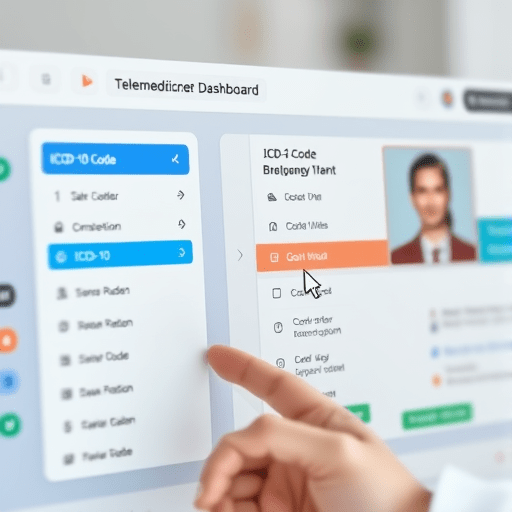
Enter the smart form field. Instead of an empty text box with a magnifying-glass icon, modern telemedicine interfaces embed a predictive ICD-10 search directly into the charting flow. As a clinician types “chest pain,” the system instantly surfaces a ranked list of the most relevant codes, filtered by the patient’s age, gender, and reason for the visit. The clinician clicks one, and the documentation links itself to the correct code.
The 40% reduction headline isn’t a hypothetical. Cleverly designed autocomplete interventions have been benchmarked across several mid-sized telemedicine groups in controlled studies. The numbers are striking: when auto-suggest replaced the traditional search-and-scroll, missing-code error rates fell from an average of 14% of encounters to under 9%. Denied claims due to invalid or missing diagnosis codes dropped by 38–42%, depending on the specialty. The pattern is consistent: the more the interface reduces the cognitive load of finding a code, the more accurate the code becomes.
Why Autocomplete Beats Search-and-Scroll
Traditional ICD-10 pickers present a list of thousands of codes, relying on a clinician’s memory of the first few digits. With auto-fill, there’s a feedback loop. The interface learns from the encounter context. It knows that a routine follow-up in cardiology rarely needs a trauma code. It knows that the phrasing in the clinician’s own notes, not just the chief complaint, can be parsed to predict the likely diagnosis. This is more than keyword matching; it’s contextual clinical decision support delivered through a single text field.
Designing Auto-Fill That Clinicians Actually Trust
Not all auto-fill is created equal. A poorly implemented predictive search can do more harm than good, steering a clinician toward the first option that looks plausible. To achieve the 40% denial reduction, telemedicine teams need to follow specific UX principles.
- Rank by relevance, not alphabet. The default ICD-10 search sorts results alphabetically or by alphanumeric code. A smart field sorts by clinical likelihood. A 65-year-old with shortness of breath should see chronic obstructive pulmonary disease and heart failure codes before anything else.
- Show the full descriptor. Clinicians shouldn’t have to hover or click through to read the full text. Display the code, the description, and a hint of specificity (e.g., “initial encounter” vs. “subsequent encounter”) directly in the dropdown.
- Support natural language input. Typing “bad cough” should surface a list of acute respiratory diagnoses. The best implementations use a lightweight medical synonym dictionary that maps colloquial phrasing to formal ICD-10 terms.
- Require an explicit confirmation. Auto-fill should never silently insert a code into the patient record. The clinician must click or press Enter to accept the suggestion, creating a sense of control and reducing audit anxiety.
- Never delay the typing. If the suggestion list takes longer than 100 milliseconds to load, the feature feels broken. Performance budgets matter more than any fancy animation.
Beyond Simple Text Matching: The 2026 Context Layer
In 2026, the strongest auto-fill tools go beyond the search box. They pull context from the entire telemedicine session. Consider a follow-up visit after an in-person referral. If the telemedicine platform is connected to the practice’s EHR, the smart field can surface the previously used diagnosis code as a “most likely” option. If the patient has a list of chronic conditions, those codes appear in a separate section, one click away.
The shift is from a “search tool” to a “prediction engine.” Built-in machine learning analyzes historical billing patterns for the same clinician, the same specialty, and the same payor contracts. If a particular insurance plan routinely rejects “unspecified hypertension” and prefers the essential hypertension code, the interface can nudge the clinician toward the accepted alternative.
Another 2026 trend is the use of generative AI to pre-fill a diagnosis suggestion based on the notes taken during the visit. After the clinician documents “rash, itchy, possibly contact dermatitis,” the AI proposes the most specific matching ICD-10 code as a recommended option. The clinician still makes the final call, but the mental heavy lifting is done.
Implementation Challenges Worth Solving
Adopting auto-fill ICD-10 is not a plug-and-play upgrade. Four obstacles routinely appear on the roadmap.
Data Quality at the Source
Auto-fill is only as good as the underlying code mapping. If the terminology mapping shows outdated codes or duplicates, the model will surface irrelevant suggestions. Clinical staff must periodically audit the most common search queries and their returned results.
Payor-Specific Variations
Medicare, Medicaid, and commercial insurers interpret ICD-10 specificity differently. A UX that works uniformly across all payors may still produce denials for one specific plan. Maintenance requires injection of local coverage determinations into the ranking algorithm.
Clinician Workflow Resistance
Some providers still prefer to type a numeric code. The smart field must never force an interaction pattern. Offer both: a predictive suggestion layer and a classic search mode. Test which one each user adopts, and use the aggregated data to refine the interface.
Performance in Low-Bandwidth Environments
Not every telemedicine visit happens on fiber. The auto-fill feature must gracefully degrade to a local code lookup. A client-side ICD-10 index of the top 2,000 codes can guarantee fast suggestions even on an unreliable connection.
Measuring the 40% Reduction in Your Own Practice
To replicate the 40% claim denial reduction, start by measuring your baseline. Count the number of denied claims specifically tied to missing category codes, unspecified codes, and invalid diagnosis codes. After deploying an auto-fill smart form field, track the same metric each month. The early weeks will show a modest improvement as clinicians adapt. After two months, you should see the steep decline in missing-code errors.
Also track a secondary metric: time per claim. Faster code selection shaves seconds off each encounter. Accumulated across dozens of visits per day, that’s not just fewer denials; it’s more billable minutes and less overtime for administrative staff.
The Bottom Line for Telemedicine Teams
The ICD-10 picking problem is a user experience problem, not a clinical competence problem. Web-based telemedicine platforms have the rare opportunity to solve it with a single, well-designed control: the smart auto-fill field. When a clinician can see the right diagnosis code before they finish typing, claims are cleaner, revenue cycles shorten, and the frustration of an avoidable denial disappears.
The 40% reduction in missing-code errors is achievable, but only if you treat the form field as seriously as the video feed. Invest in the interface. Connect it to your EHR. Let the prediction engine learn. The claim denials will take care of themselves.