Most stories move forward. Return of the Obra Dinn moves backward from a fixed set of endings. To understand how to tell a story backwards, this 2018 puzzle game remains a perfect case study in clue-based, non-linear storytelling. What looks like a ghost ship full of dead bodies is actually a narrative engine. Every corpse is an ending, every memory is a clue, and the audience must reconstruct the timeline by moving from final moments to causes. In an era of procedural and interactive storytelling, those lessons have become more valuable than ever.
What “Backwards” Actually Means in a Narrative
Reverse storytelling is not the same as playing scenes in reverse. If you simply reorder events, you get a different chronology but not necessarily a compelling story. Obra Dinn anchors every scene to a death. The player sees a character’s final beat: a fall from the rigging, a gunshot in a corridor, a shape swallowed by the sea. That ending is fixed. The tension comes from not knowing the causes that led to the frozen moment. Every answer unlocks new questions, and the story is rebuilt from its own wreckage.
The game’s narrative design treats the past as a forensic object, not a fading timeline. The player’s memory is not a tape recorder but a case file. That shift changes the audience from a passive receiver of events into an active interpreter.
Lesson 1: Clue-Based Storytelling Needs Anchors
Many non-linear stories fail because they treat chronology as a toy. Obra Dinn treats it as a crime scene. Each dead body is a fixed anchor, and the clues around it exist to be weighed, not simply delayed. Every clue is a tiny narrative node. A character’s accent places them near another person. A scar on a hand identifies a sailor who should have died earlier. The absence of a crew member from a scene is itself evidence.
For writers, the rule is simple: every clue should carry two pieces of information. One explains the local moment; the other points elsewhere. Character details are not filler. Environmental state is narrative memory. The position of a body or the state of a door should matter in a later deduction. In reverse storytelling, the writer is not inventing events. They are designing evidence.
Lesson 2: Build a Truth Matrix for Non-Linear Storytelling
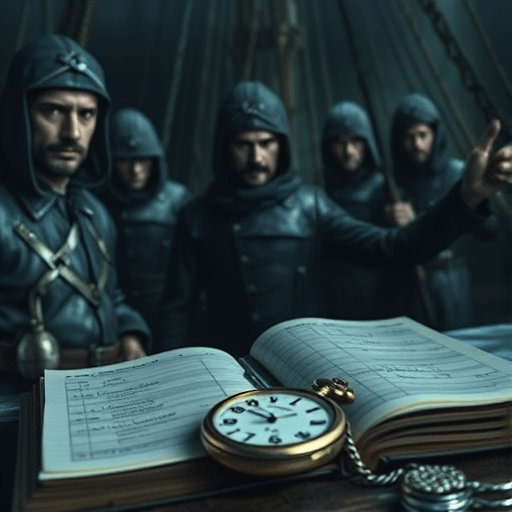
The greatest challenge of non-linear storytelling is consistency. Obra Dinn makes that consistency visible through the logbook. The ledger holds each crew member’s name, role, origin, fate, cause of death, and killer. It is not a timeline; it is a matrix.
Call this a truth matrix: a design document that records every event as fact, independent of how the audience will encounter it. A truth matrix lets the writer know what a clue really means, even when it appears out of order. It also prevents the mistake where a clue later seems to mean something impossible. In clue-based storytelling, the audience will test contradictory explanations. If a character says they were at the wheel, another clue may show the wheelhouse empty. The contradiction is not an error. It is a clue about lies, mistakes, or perspective.
Lesson 3: Verification Is the Reward
A reverse-told story can feel passive because the outcome of each fragment is known. Obra Dinn solves this through confirmation. Players do not find a full story; they find a collection of possible stories. The reward is the moment when a set of fates snaps together and the ledger accepts an answer.
Pacing matters. The game rarely asks the player to solve everything at once. It encourages small deductions, and each verified set of fates creates a moment of closure before the next group of unknowns appears. Writers can use the same “micro-confirmation loop”: when telling a story backwards, give the audience small, satisfying moments of certainty. Without them, a reverse narrative becomes a series of cryptic scenes with no reason to keep assembling.
Lesson 4: Reverse Chronology Is Built on Temporal Snapshots
Time is usually the container for story. In Obra Dinn, time is just another clue. The player accesses the exact moment before death, but the game does not stitch those moments into continuous footage. Each memory is a frozen cross-section of the ship. Small details like weather, lighting, and the position of objects indicate what has just happened.
For a reverse chronology, choose a set of temporal snapshots dense with information. A snapshot can be a death, a room, or an object left in a strange place. The structure becomes a mosaic, not a countdown. The audience does not watch time flow forward; they use time as evidence. In Obra Dinn, the best deductions come from noticing that a character wears a coat from a later chapter or that the sea is calm during what should have been a storm.
Lesson 5: Make the Audience an Archivist
Obra Dinn’s protagonist is not a hero. He is an insurance adjuster. The act of storytelling is performed by the player when they fill out the book of the dead. This is a crucial insight: when telling a story backwards, make the audience an archivist. Give them a representation of what they know, and let the story be assembled in that space.
That archival layer can take many forms. In a novel, it might be case files or letters. In a game, it might be a corkboard, a diary, or a photographic log. In a serialized audio drama, it could be a companion map. The point is to externalize the mental work. When the audience can see what they know, they are better able to confront what is missing. Obra Dinn’s logbook is clean and methodical; the player’s mind is covered in doubt. That tension drives the game.
A 2026 Toolkit for Tellers of Backward Stories
The techniques in Obra Dinn have not aged. As generative dialogue and AI-assisted story generation create more possibilities, the reverse-story model offers a filter for necessity. Every clue must matter. Every event must have enough causal context. Every final page must be earned.
If you are writing a mystery or an interactive fiction, start with a truth matrix. List the fixed outcomes. Decide where the audience enters, what lies they are told, and which gaps they must fill themselves. The Obra Dinn approach works because it hides the story behind deduction, not cutscenes. The player is not watching a detective; they are being asked to think like one.
- Begin with a small set of anchor moments; let them be the only fixed scenes.
- Give each character persistent visible details that can become clues.
- Make every clue point to both a fact and a question.
- Use contradictions deliberately to signal unreliable perspectives.
- Let the audience confirm small pieces before unlocking larger ones.
Conclusion
Return of the Obra Dinn shows that a story told backwards can be clear, emotional, and difficult to put down. Non-linear storytelling does not require a jumble of random scenes. It requires fixed outcomes, a truthful system beneath the chaos, and an audience with the means to write the story back into being. Obra Dinn remains a masterclass in clue-based reverse narrative, and its lessons are all the more useful now.