For tennis coaches at every level, using GPS trackers to manage practice load has evolved from a niche, tour-level experiment into an everyday coaching tool. The days of guessing whether a player is tired are ending. In 2026, the most effective coaches treat practice load as a measurable, trainable variable — one that directly affects player recovery, injury prevention, and on-court performance. This step-by-step guide shows you how to implement wearable load monitoring in your coaching workflow without drowning in data or overcomplicating your sessions.
Why Practice Load Monitoring in Tennis Matters
Tennis is a sport of repeated explosive efforts: sprinting, lunging, changing direction, and absorbing impact through the joints. Traditional coaching intuition often underestimates the cumulative toll of these movements. A player might feel fine after a two-hour baseline drill session, but the wearable data tells a different story — high acceleration loads, sharp decelerations, and a heart-rate profile that suggests deeper fatigue than the player admits.
Load monitoring bridges that gap. By tracking metrics like total distance, high-intensity distance, acceleration events, and training load, you gain an objective picture of what each session demands from a player’s body. That data becomes the foundation for smarter recovery protocols, session adjustments, and long-term physical development.
Step 1: Choose the Right GPS Tracker for Tennis
Not all GPS trackers are created equal, and tennis presents unique challenges. Court play involves rapid direction changes that generic running watches often miss. Look for wearables that offer:
- High sample rates (10 Hz or higher) to capture short, explosive movements accurately
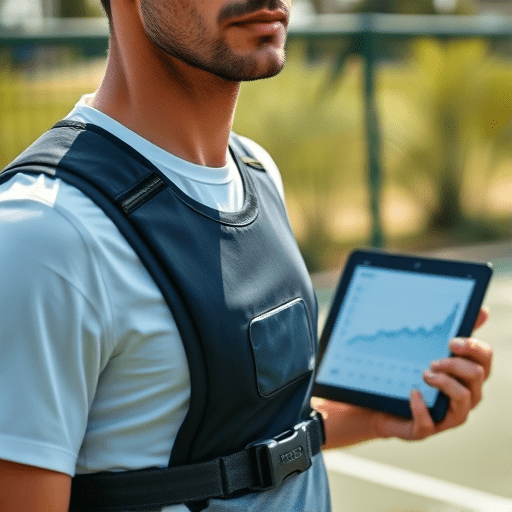
- A lightweight form factor that sits comfortably on the upper back or torso without interfering with serves or groundstrokes
- Integrated accelerometer and gyroscope for detecting acceleration, deceleration, and lateral cutting movements
- Heart-rate monitoring, either through a chest strap or optical sensor built into the garment
- A software dashboard that lets you compare sessions, players, and weekly trends
Popular options in 2026 include GPS vests from Catapult, STATSports, and Kinexon, along with newer armband sensors designed specifically for racquet sports. The right choice depends on your budget, squad size, and whether your courts have reliable satellite coverage.
Step 2: Baseline Each Player Before Setting Targets
Before you can interpret GPS data, you need a baseline. A player’s age, physical capacity, training history, and playing style all influence what a high load means for them. An elite 18-year-old might handle 9,000 meters of court movement in a session, while a club-level junior could be at risk with far less.
To establish a baseline, record at least three to five typical practice sessions without changing anything about your coaching. Track these metrics each time:
- Total distance covered
- High-speed running distance (adjusted for age and level)
- Acceleration and deceleration counts (typically above 3 m/s²)
- Session RPE multiplied by duration to calculate training load
- Time spent in each heart-rate zone
Once you have a baseline, you can identify each player’s normal range and set individual thresholds rather than applying the same numbers to everyone.
Step 3: Define the Load Metrics That Guide Your Decisions
Not every metric matters equally for tennis. Focus on a small, meaningful set that connects directly to recovery and injury risk.
External Load Metrics
- Total distance: a general measure of overall volume
- High-intensity distance: showing how often players near maximum sprint output
- Explosive efforts: counts of accelerations and decelerations, strongly linked to muscle soreness and joint stress
Internal Load Metrics
- Heart rate and time in high zones: reflecting cardiovascular stress
- Training load (RPE × minutes): blending volume and intensity into one digestible number
- Player-reported recovery scores: subjective sleep, soreness, and energy ratings that contextualize GPS data
Keep your dashboard clean. You do not need 30 metrics to make good decisions. Pick five or six, track them consistently, and review them in the same order after every session.
Step 4: Set Practice Load Thresholds and Weekly Limits
Once you have baselines, translate them into thresholds for daily and weekly training load. A common approach in high-performance tennis is to keep a player’s daily training load within 10–15 percent of their two-week rolling average. Sharp spikes — a session more than 20 percent above the previous five-session average — correlate strongly with injury risk.
For example, if a player’s baseline for high-intensity distance is 1,100 meters per session, a single day at 1,500 meters should trigger a red flag. That does not always mean stopping the session. It might mean swapping a competitive match set for a technique-focused drill with longer rest intervals, or reducing heavy acceleration patterns in footwork work.
Weekly limits are equally important. Track cumulative load over a seven-day window. If a player competes in a tournament on the weekend, Monday and Tuesday practice loads should be intentionally lower to allow recovery and readiness rebuilding.
Step 5: Integrate GPS Data With Recovery and Wellness
GPS trackers are powerful, but they are only one layer of load monitoring. The most effective systems pair wearable data with subjective and physiological recovery markers.
Before each session, ask players to rate their sleep quality, muscle soreness, and perceived energy on a simple 1–5 scale. In 2026, many coaching apps combine these ratings with GPS outputs into a single readiness score. When the data says a player’s load is normal but their soreness rating is high, err on the side of caution: adjust the session or begin with a longer warm-up before committing to high-intensity work.
Heart-rate variability is another valuable addition. A GPS tracker with integrated HRV measurement or a paired smartwatch can indicate whether a player’s nervous system is recovered. Low HRV combined with low GPS output is a clear signal that an unscheduled rest day is more valuable than another forehand drill.
This integration also improves communication. When a player asks why they are getting extra rest, you can point to concrete numbers: their deceleration count was 40 percent above normal, and their HRV dropped overnight. That transparency builds trust and teaches players to understand their own bodies.
Step 6: Review the Data, Adjust the Plan, and Communicate
Load monitoring is a closed loop, not a one-time check. Set a routine for reviewing the data:
- Immediately after each session: check for anomalies or spike alerts on the dashboard
- Weekly: compare each player’s average load and recovery scores to previous weeks
- Monthly: evaluate whether practice volume is trending toward your season goals
When a player struggles with recurring injuries or stalled development, pull up their GPS history to spot patterns. Perhaps their high-intensity distance spikes every Thursday before a weekend match. With that insight, you can restructure Thursday practices to moderate intensity, preserving competitive freshness while still building physical capacity.
Communication is the final step. Sit down with each player at least once a month and walk through their individual data. Explain what the numbers mean in plain language, and set collaborative goals — for example, “Let’s improve your acceleration efficiency by adding two short, explosive footwork blocks per session.” Players who understand why the tracker matters are more willing to wear it consistently and report honestly.
Putting It All Together
The purpose of using GPS trackers to manage practice load is not to turn coaching into a data-obsessed exercise. It is to know more, guess less, and make every session count. By choosing the right wearable, baselining your players, focusing on meaningful metrics, setting clear thresholds, integrating recovery markers, and reviewing data regularly, you build a system that protects players and enhances performance throughout the long tennis season. Start small: pick one metric, such as high-intensity distance or explosive efforts, and track it for two weeks. Then expand your dashboard as you become comfortable. Over time, this step-by-step framework becomes a natural part of your coaching rhythm — and your players will feel the difference in their bodies, their recovery, and their results.