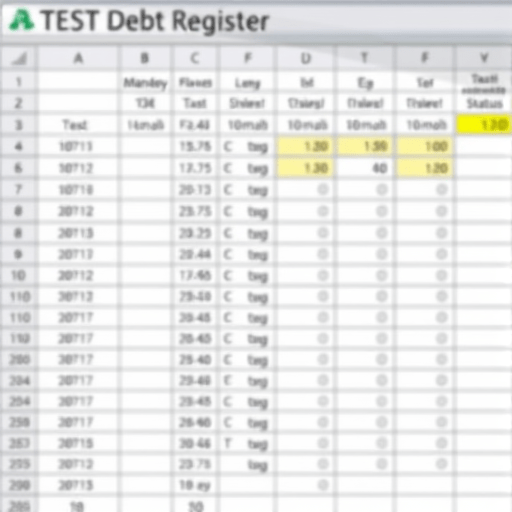
Every QA team that has wrestled with flaky tests understands the pain: a seemingly healthy test suite suddenly turns red for no reason, a developer reruns the job until it passes, and everyone quietly agrees to ignore the intermittent failure. Over time, those ignored flakes become test debt — a compounding liability that slows down delivery and erodes confidence in automated checks. What your team needs is not another dashboard or another “just fix it later” backlog item, but a test debt register: a living document that tracks flaky test frequency, captures root-cause patterns, and gives you a clear, data-driven basis for deciding whether to rewrite a test or quarantine it.
The concept borrows from financial accounting: you cannot manage debt you cannot see. A test debt register makes the invisible visible. Instead of relying on memory or gut feelings, your QA team records every known flaky test, its frequency, its recent history, and the likely reason it breaks. This practice matters more in 2026 than ever before, as CI pipelines grow more complex and teams rely on AI-assisted code generation that can introduce subtle timing and state-management issues in tests.
What Exactly Is a Test Debt Register?
A test debt register is more than a spreadsheet of broken tests. It is a structured repository of test-level liabilities that includes contextual data about each failure. At minimum, every entry should contain the test name, owning team or individual, the date it was first flagged, a link to the relevant CI logs, the frequency of failures over a rolling window, and a short description of the suspected root cause.
The register should be treated as a shared artifact — not a QA-only silo. Developers, test engineers, and engineering managers need read access so they can see which parts of the test suite are becoming unreliable. In an ideal setup, the register is updated directly from CI using automation, but even a manually maintained markdown file or a lightweight issue tracker template can work if the team is disciplined.
Why a Simple List Won’t Cut It: Root-Cause Patterns
Many teams have a list of flaky tests, but they do not have a test debt register. The difference is structure and analysis. A list tells you which tests are failing. A register tells you why they fail and how those reasons cluster across the suite.
Consider two flaky tests with the same failure frequency. One fails because of a race condition between an async API call and a DOM update. The other fails because it depends on an external service that occasionally times out. The first test likely requires a rewrite to mock the API call properly. The second can be quarantined while the team fixes the service or introduces a more resilient wait strategy. Without root-cause patterns, you might rewrite both, waste effort, or quarantine both and lose valuable coverage.
This is where a test debt register becomes a strategic asset. By tagging each entry with a root-cause category — such as “timing/synchronization,” “external dependency,” “test isolation,” “environment/configuration,” “product bug disguised as flake,” or “infrastructure issue” — you can quickly surface patterns. If 70% of your flaky tests share a “test isolation” root cause, the solution is not to rewrite individual tests; it is to fix your test data seeding or parallel execution strategy. The register reveals systemic issues that a simple list of flaky tests hides.
Building a Test Debt Register That Actually Guides Rewrite vs. Quarantine
The ultimate output of a test debt register is a decision: should this test be rewritten, quarantined, or in rare cases, deleted? To make that decision reliably, your register needs to be built around frequency, history, and root-cause confidence.
Step 1: Capture the Right Fields on Every Entry
Start with a simple schema. For each flaky test, include:
- Test identifier: Full test path or a unique ID.
- Owning team: Who to notify when the test fails.
- First detected: Date when the test entered the register.
- Last occurrence: Date of the most recent failure.
- Rolling failure count: Number of failures in the last 10, 20, or 50 runs.
- Failure rate: Percentage across a rolling window, e.g., 5% or 15%.
- Root-cause category: One of a fixed set of tags.
- Suspected root-cause detail: A short free-text explanation.
- Current state: Active, under investigation, quarantined, or fixed.
Do not overcomplicate the schema. The goal is to make it easy for anyone to add a test in under two minutes. If the overhead is too high, the register will die.
Step 2: Track Flaky Test Frequency and Severity Over Time
Frequency is not just a count. A test that failed five times yesterday but has been stable for three weeks is different from a test that fails once per day, every day, for a month. Your register should distinguish between transient blips and chronic flakes.
Use a rolling window — for example, the last 20 CI runs — to calculate a failure rate. Also track consecutive failures and the longest stable streak. A short stable streak after a rewrite is a good sign, but a test that passes for 50 runs and then fails ten times in a row points to a non-deterministic factor that has not been fixed.
In 2026, many CI systems already capture test history and flake detection. The register’s role is not to duplicate that data, but to give it context. When you see a frequency spike, look for a correlation with recent code changes, infrastructure updates, or new test data. Note those observations in the register. This turns raw data into actionable intelligence.
Step 3: Classify Root Causes into Actionable Patterns
Do not accept “flaky” as a root cause. Force a deeper explanation. If you don’t know yet, mark it as “under investigation,” but assign an owner to investigate. Common root-cause categories that work well in practice include:
- Timing/synchronization: The test proceeds before an async operation completes.
- Test isolation: Tests interfere through shared state, files, or databases.
- External service dependency: Network calls to outside systems are unreliable.
- Environment variability: CPU load, memory, or browser rendering differences.
- Order dependence: Passing only when run before or after another test.
- Product bug: The test catches a real intermittent defect in the software.
Tag each entry with exactly one category. Then periodically review the distribution of categories across your register. You will often find that a handful of root causes account for the majority of your test debt. Those patterns will guide your rewrite decisions and expose infrastructure changes that would provide the highest return on investment.
Step 4: Define Clear Rewrite vs. Quarantine Thresholds
The most valuable part of a test debt register is the threshold policy that turns data into a decision. Without thresholds, every flaky test is argued about individually, and teams default to quarantining the most annoying tests rather than the most fixable ones. A clear, agreed-upon policy removes that friction.
For example, you might adopt these rules:
- Rewrite if the failure rate is above 10% over the last 20 runs, the root cause is understood, and the test provides critical coverage.
- Quarantine if the test has failed more than five times in a week but is not critical enough to block the CI pipeline.
- Quarantine if the root cause is unknown and the test has already consumed more than two investigation hours this sprint.
- Rewrite if a product bug is confirmed and the test is the only way to verify the fix.
Your own thresholds will vary based on team size, deployment frequency, and risk tolerance. What matters is that the policy is written down and revisited each quarter. You do not want a register that merely collects data. You want a register that drives action.
Practical Tips for Keeping the Register Alive
Any new process faces the risk of being abandoned after the first sprint. To keep the test debt register useful, integrate it into routines your team already has. Add a standing agenda item in your sprint retro where the team reviews the top five highest-frequency entries. Encourage developers to log a test into the register as part of the definition of done when they see an unexplained flake. Create a simple CI bot or GitHub label that automatically opens a new register entry when a test fails more than twice in a row.
Also, review the register once per month as a whole. Look at the number of newly added tests versus the number of resolved or quarantined tests. If the register keeps growing without any pruning, you are only documenting the problem, not solving it. A healthy register has a manageable size — ideally, fewer than 5% of your total test cases should be listed at any time. If more are listed, your suite has systemic instability, and you should stop adding features to focus on the underlying causes.
One subtle point: a test debt register is not a punishment list. It is a communication tool. When a test is rewritten, note why the original version failed. When a test is quarantined, document the condition that would bring it back into the suite — for instance, “will be re-enabled after we migrate to the new test data factory.” This context helps future teams avoid repeating the same mistakes.
The Bottom Line
A test debt register is one of the highest-leverage practices your QA team can adopt. Instead of reacting to flaky tests as one-off annoyances, you build a system that reveals frequency trends and root-cause patterns across your entire suite. That data gives you the confidence to decide when a test deserves a rewrite to address fundamental instability, and when it should be quarantined to unblock your pipeline without wasting engineering hours. The result is not perfectly stable tests — that is rarely the goal — but a test suite whose risks are visible, measured, and deliberately managed, much like the financial debt it is named after.