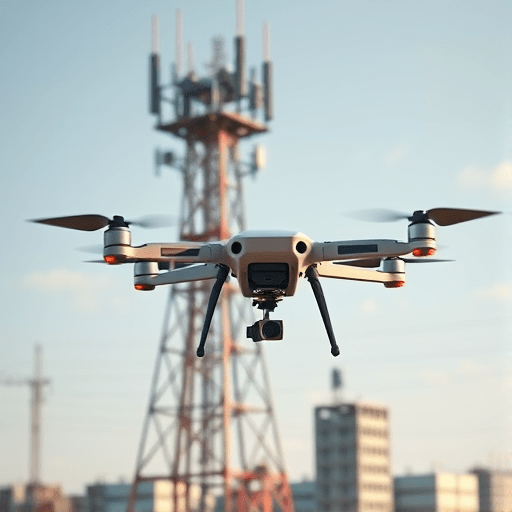
Sub-10ms edge AI is transforming autonomous delivery drones by moving perception and decision-making from distant cloud data centers to compact servers installed alongside 5G gNodeB sites. In this 2026 case study, a regional delivery fleet deployed quantized computer-vision models on gNB co-located infrastructure, reducing end-to-end inference latency while keeping aircraft responsive when connectivity conditions varied.
The deployment illustrates a practical convergence of private 5G, edge computing and model optimization. Instead of sending every camera frame through a core network and into a regional cloud, the drones exchanged lightweight data with a nearby edge host. That host performed the most time-sensitive inference, while a central platform continued to handle fleet-wide analytics, model governance and long-term planning.
Why Cloud-Based Drone Inference Was Not Fast Enough
Autonomous drone operations depend on rapid interpretation of changing scenes. A drone may need to identify a power line, classify a landing-zone obstacle, estimate pedestrian movement or choose an alternate route within fractions of a second. Even a small delay can consume much of the time available for a safe control response.
The fleet originally sent compressed images and telemetry from each aircraft to a centralized inference service. The architecture offered simple model management and abundant computing capacity, but it introduced several sources of latency:
- Propagation delay between the drone, radio access network and distant data center
- Additional routing through the 5G core
- Network congestion during simultaneous fleet operations
- Uploading high-bandwidth video before inference results became available
- Variable backhaul performance at some gNodeB locations
Under favorable conditions, the system produced useful results in approximately 42 milliseconds. That figure was technically impressive but operationally inconsistent. During peak delivery periods, tail latency rose sharply, and temporary packet loss could prevent an aircraft from receiving a recommendation in time.
The objective was not merely to improve average speed. Flight-control and obstacle-avoidance systems are more sensitive to predictable worst-case behavior than to a fast median result. Engineers therefore defined a new target: keep the critical perception-to-decision path below 10 milliseconds at the edge.
Designing a gNB Co-Located Edge AI Architecture
The revised architecture placed inference capacity at sites where drones already maintained strong 5G coverage. Each participating gNodeB was paired with a compact, ruggedized edge server connected through a short, high-speed network path. Local servers hosted quantized versions of the fleet’s most important models.
Aircraft continued to perform high-rate stabilization and motor control onboard. Their safety processors evaluated local sensor data immediately, while selected frames and relevant telemetry were transmitted to the network edge. The edge node then returned classifications, confidence scores and suggested route adjustments through the same local 5G environment.
This division of labor created three distinct processing layers:
- Onboard compute: Flight stabilization, collision protection and immediate fail-safe decisions
- Edge compute: Fast object detection, landing-zone assessment, route analysis and fleet coordination
- Central cloud: Training, historical analysis, model distribution and cross-region optimization
Co-location reduced the distance traveled by inference requests and kept latency-sensitive traffic out of the core network. It also made it possible to process data closer to its source without placing a full data center at every launch site.
Quantized Models Delivered the Speed and Size Gains
Moving the workload was only part of the solution. The original vision models were too large and compute-intensive for a distributed fleet of edge servers. Engineers converted selected floating-point operations from 32-bit precision to 8-bit integer arithmetic, a process commonly described as INT8 quantization.
Quantization reduced model memory requirements and allowed the edge hardware to execute more operations in parallel. Before deployment, the team compared full-precision and quantized versions using the same validation dataset. The exercise focused on three areas:
- Mean average precision for small and distant objects
- False-negative rates in crowded urban scenes
- Performance under low-light, rain and motion-blurred conditions
The optimized models were approximately four times smaller and required substantially less memory bandwidth. Their accuracy declined by less than one percentage point on the validation set, an acceptable trade-off after engineers reviewed errors by object type and operating environment.
To preserve reliability, models were not compressed indiscriminately. The most safety-relevant classifier retained higher numerical precision, while selected noncritical neural-network layers accepted more aggressive quantization. This tiered approach helped the fleet balance aircraft safety, inference speed and hardware cost.
How the Drone Fleet Reached Consistent Sub-10ms Inference
The team measured the complete path from the moment an image became available for processing to the receipt of an inference response. Initial tests at a single gNodeB produced a median latency of 6.8 milliseconds and a 95th-percentile result of 8.3 milliseconds. The service-level target required the 95th percentile to remain below 10 milliseconds.
That result did not come from model optimization alone. Engineers also changed the way data moved through the network.
They Kept Traffic on a Local Data Path
Inference traffic was routed through a user-plane function located near the access network rather than traversing the full 5G core. This local breakout reduced signaling and transport delays while preserving centralized policy enforcement.
They Limited the Size of Each Inference Request
The drones transmitted cropped regions of interest instead of full-resolution video. Onboard preprocessing reduced the payload while preserving details such as thin wires, small animals and partially obscured signs. The edge host received only the information needed for the active perception task.
They Reserved Edge Capacity for Critical Workloads
Each server supported several drones, so workloads were prioritized. Safety-related detection requests received capacity before lower-priority analytics such as recording quality scoring. Batch processing was scheduled during periods of lower demand, helping maintain predictable latency during lunch-hour delivery peaks.
Measured Results Across the Delivery Network
After rollout to 18 gNodeB sites, the fleet recorded a median edge inference time of 6.5 milliseconds. Ninety-five percent of requests completed within 9.1 milliseconds, while the 99th percentile remained below 12.6 milliseconds. These results reflected real operating traffic rather than controlled laboratory testing.
The operational effects were more important than the raw numbers:
- More consistent obstacle detection during simultaneous drone launches
- Faster rerouting when landing areas became temporarily unavailable
- Reduced dependence on variable wide-area backhaul
- Lower bandwidth consumption because only selected image regions were transmitted
- Continued onboard fail-safe operation during short network interruptions
The fleet also reported a 17 percent reduction in unnecessary route deviations. The improvement was attributed to fresher scene classifications and shorter communication delays, not to a change in the drones’ physical performance.
Energy use at the edge sites increased modestly, but consolidating several workloads on each server kept infrastructure costs below those of maintaining a separate inference appliance for every drone. Centralized orchestration also allowed technicians to monitor model versions, hardware health and network performance from one control plane.
Testing for Failure, Not Just Speed
A fast inference system can still be unsafe if it fails unpredictably. Before launch, the fleet tested packet loss, gNodeB handoffs, server restarts and congested radio conditions. The edge platform maintained a local model cache and continued serving recent versions of the quantized models when its cloud connection was interrupted.
Each drone’s onboard controller treated edge recommendations as supplemental information rather than an unconditional command. If a response was late, malformed or outside an acceptable confidence range, the aircraft followed its local rules. This separation ensured that communication latency could not directly create an unsafe control action.
Model updates were also released in stages. Engineers first evaluated a candidate against archived and synthetic flight data, deployed it to a limited number of edge nodes and monitored rollback signals. The staged process reduced the risk associated with distributing a new model across the entire network.
The Main Lessons for Scalable Edge AI
The case demonstrates that sub-10ms inference depends on optimizing the entire path. A smaller model helps, but it cannot compensate for a distant cloud route or a congested network. Combining quantization, local breakout, carefully scoped data and workload prioritization produced a system that remained fast under changing conditions.
The strongest results also came from treating edge intelligence as part of the safety architecture. Models were evaluated against difficult weather and motion conditions, important operations retained adequate precision, and onboard systems remained responsible for immediate stabilization. The edge did not replace aircraft autonomy; it supplied fresher contextual awareness.
Future fleet expansions are expected to add dynamic model placement based on weather, radio load and predicted delivery density. Continued advances in efficient neural-network architectures and edge accelerators may further reduce latency, although the fundamental design principle is likely to remain: perform time-sensitive decisions as close as possible to the machines that need them.
Conclusion
By combining quantized models, 5G local breakout and gNB co-located servers, the delivery fleet reduced critical edge inference latency to below 10 milliseconds at the 95th percentile. The deployment improved routing consistency, used bandwidth more efficiently and strengthened the network’s ability to support autonomous drone operations without making cloud connectivity the only path to timely intelligence.