Cycling and swimming seem to belong to different bodies. One is seated, pedal-driven, and weight-bearing; the other is weightless, rhythm-driven, and fluid. Yet anyone who rides in carbon-soled shoes and later kicks laps in fins may notice a familiar twinge in the lower leg. That is not an accident. The same mechanical pattern appears in both sports: the ankle is locked into a narrow range of motion, and the calf muscles are asked to absorb every bit of force. This article explains why stiff bike shoes and swim fins both cause calf strains, and how adjusting cleat position and fin strap tension can protect your calves.
The Shared Biomechanical Link: A Locked Ankle Changes Everything
Your calf is more than a pair of muscles behind your shin. It is the primary engine for pointing your foot, controlling shock absorption, and stabilizing the ankle. The gastrocnemius and soleus muscles work together to flex the ankle downward in a movement called plantarflexion. They are also responsible for eccentric deceleration—slowing the foot as it moves through a range of motion.
When the ankle is free to move, the calf lengthens and shortens naturally with each step, pedal stroke, or kick. But when a stiff shoe sole or a rigid fin blade holds the foot at a fixed angle, the calf must generate force with little or no eccentric relief. The muscle becomes the sole shock absorber. Over time, this repeated, shortened loading creates the perfect conditions for a strain: tiny tears, cramping, and chronic tightness.
Bike shoes and swim fins also share another feature: they lengthen the lever arm from the foot to the surface of force. In cycling, the sole transfers power through the pedal. In swimming, the fin transfers kick power to the water. If the foot is not aligned properly within that lever, the calf ends up doing work it was never designed to do. That is why the injury pattern often appears at the crossover point—during the weekend ride or the post-ride swim—rather than in a single session.
Why Stiff Cycling Shoes Overload the Calf
Stiff-soled cycling shoes are built for one reason: power transfer. The sole does not flex, so the foot becomes a solid lever from the heel to the pedal. This efficiency comes at a cost. With no flexion in the shoe, the ankle must provide all the subtle adjustment. If your cleat is misplaced, the calf compensates with every pedal stroke.
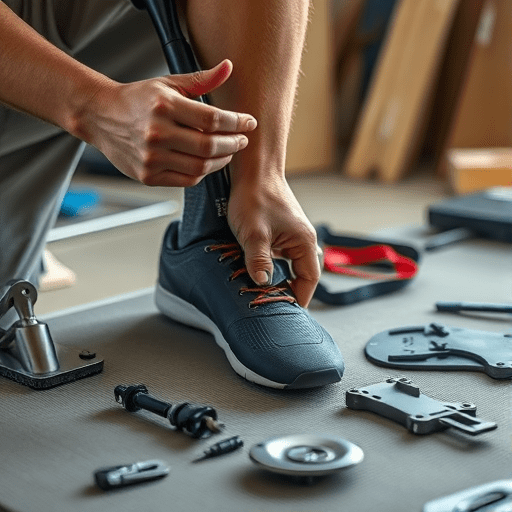
Cleat fore-aft position is the first thing to check. The cleat should sit under the first metatarsal head, the bony bump behind your big toe. When the cleat is too far forward, your foot tilts where the pedal meets the sole, and the calf has to work harder to stabilize your ankle through the downward phase. When the cleat sits too far back, your foot can slide into a flatter position that also changes the ankle angle. A difference of just two or three millimeters can be decisive.
Cleat float matters just as much. Float is the amount of side-to-side rotation built into the cleat. If you ride with zero-float pedals or heavily worn cleats, your heel is locked in one angle. Every pedal stroke forces the calf to rotate against that fixed limit. Increasing float by a few degrees allows your ankle and knee to follow their natural paths. Many cyclists mistake calf pain for a saddle height problem when the real issue is a cleat that does not allow the foot to move.
- Cleat fore/aft: Center the cleat under the ball of your foot, then test small shifts after every ride.
- Cleat rotation: Set the cleat so your natural foot position points the heel slightly inward or outward, not forced straight.
- Cleat float: Choose a cleat with at least a few degrees of float if you are prone to calf tightness.
Why Swim Fins Trigger the Same Calf Strain
Swim fins create a different but equally damaging effect. When you push water with a fin, the blade creates resistance against your foot. To keep the fin from dropping or fluttering, your calf muscles must stay active for the entire kick. This continuous tension is especially hard on the soleus, the deeper calf muscle that controls ankle position while your knee bends.
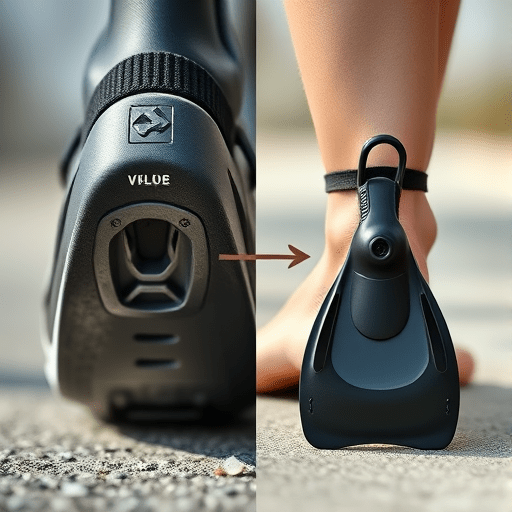
The problem is made worse by fin straps. A tight strap around your heel or instep limits ankle dorsiflexion—the movement that points the foot upward toward your shin. In swimming, you need a tiny amount of dorsiflexion at the top of the kick to load the quads and avoid excessive toe-pointing. If the strap is so tight that your ankle cannot move, the calf is forced to work from a shortened, plantarflexed position. The muscle stays partially contracted during the recovery phase, reducing blood flow and increasing the chance of cramping.
Fin stiffness also contributes. Long, stiff blades feel fast but demand more calf force to bend the blade through the water. Flexible, shorter fins are better for endurance and calf protection. But the cheapest fix is often the strap itself. A fin that is snug enough to stay on but loose enough to allow ankle movement can significantly reduce calf strain.
- Fin strap tension: Tighten just enough to keep the fin from slipping, not enough to cut off natural ankle movement.
- Strap placement: Position the heel strap across the heel bone, not directly over the Achilles tendon.
- Fin blade length: If your calves are tight, switch to a shorter fin for conditioning sessions and save long-blade fins for sprint work.
Five Practical Adjustments to Protect Your Calves
Here are the most effective adjustments you can make today, without changing your training volume or fitness plan.
- Move your cleats slightly backward. If calf strain appears during or after cycling, try moving the cleat back two to three millimeters. This shifts some pressure toward your heel and reduces the amount of ankle extension needed during the pedal stroke. Test for several rides before making further changes.
- Increase cleat float. Replace a zero-float cleat with a model that offers several degrees of float. This simple change can relieve tension on the calf and the Achilles tendon.
- Loosen your fin straps one hole. Before your next kick set, deliberately loosen both straps by one adjustment stop. Your foot should feel stable but not squeezed. If the fin stays on during a few gentle kicks, it is secure enough.
- Move the fin strap away from your Achilles tendon. Some fins place the strap near the Achilles, where it presses on the tendon during plantarflexion. Position the strap lower, around the heel, or use a fin with a wider, cushioned strap system.
- Rotate between two pairs of fins. If you have long fins and short fins, use the shorter pair for warm-ups and recovery sets. This gives your calves a break while still allowing you to practice your kick.
Listen to Your Calves Before a Strain Becomes Serious
Calf discomfort in the saddle or in the water is not a normal training response when it happens repeatedly. Watch for warning signs: a dull ache during the first few minutes of a ride, a cramping sensation during kick sets, or tenderness on the inner lower calf after the session. These symptoms often mean the muscle is being held in an unnatural position and is beginning to overwork.
When the strain is a sharper, sudden pain, stop and use the normal recovery protocol: rest, elevation, and light compression. But for the slower buildup of tightness and pulling, gear adjustments are often the best prevention. Your body is telling you that the ankle joint is not as free as it needs to be.
Calf strains in cyclists and swimmers are rarely a sign of weak muscles. They are usually a sign that the ankle is being locked into a range of motion it was not designed to sustain. By moving a cleat back a few millimeters, adding float, or loosening a fin strap, you can protect your calves and keep training across sports without the same recurring ache. The right adjustment is not a bandage—it is a re-alignment of the entire kinetic chain.