Every application reaches a moment when its data model no longer matches its requirements. Fields get renamed, relationships become nested, and the once-orderly schema starts to feel like a constraint. For teams running both relational and document databases, this moment is doubly complicated. Schema migration strategies for evolving apps can’t rely on ALTER TABLE alone; they must also accommodate the flexible, schema-less nature of NoSQL collections — all without dropping a single production request.
This article walks through how to design a versioning layer that treats SQL and NoSQL as two dialects of the same language, and how to move data between them with confidence.
The Polyglot Migration Problem
In a typical microservices architecture, you might use PostgreSQL for transactional records and MongoDB for product catalogs or user activity. When a field changes, the relational side requires a formal migration: a new column, a default value, an index. The document side, by contrast, accepts anything you throw at it — which is precisely why it’s dangerous. The database won’t complain, but your application code will. Old documents suddenly lack fields that new code expects, and the mismatch surfaces as runtime errors instead of migration failures.
Traditional migration tools assume a single relational target. Rails migrations, Flyway, and Liquibase handle SQL well but treat NoSQL as an afterthought. Meanwhile, document-database migration tools like migrate-mongo focus on data transformation but ignore the SQL side. The gap between these worlds is where production incidents happen.
Designing a Versioning Layer for Both Models
Instead of maintaining separate migration pipelines, build a versioning layer: a thin, database-agnostic service that knows the current schema version for every entity, computes the delta, and applies transformations in the correct order. Think of it as a router that directs each entity to the right migration path based on its stored version.
At a minimum, this layer should include three components:
- A schema version registry — a central table or collection mapping each entity or collection to its current version number.
- Migration manifests — declarative definitions of what changes between version n and n+1, expressed for both SQL DDL and NoSQL transformations.
- Version-aware serialization — a strategy for embedding the schema version in every document and row, so the application knows how to interpret the data at read time.
The registry is the source of truth. Every migration increments a global version counter, and the manifests describe the deltas. If a microservice reads an entity with a lower version than expected, the versioning layer knows exactly which transformations to apply.
Core Design Patterns for Cross-Model Migrations
Expand and Contract (Parallel Change)
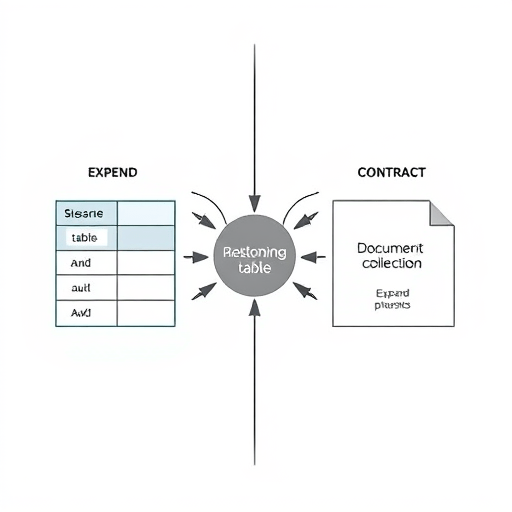
The most reliable pattern for evolving schemas — relational or document — is expand and contract. First, expand both models to accept the new field or structure while keeping the old one. Update the application to write both values. Run a backfill to populate the new field for existing data. Once you have confidence, contract by removing the old field and updating read paths.
This pattern works beautifully across SQL and NoSQL because it never requires a breaking change. The relational table gets an optional column; the document collection gets a new field with a default value. During the transition, both versions coexist, and the versioning layer simply preserves the mapping.
Dual-Write with an Outbox
Sometimes a migration involves splitting a relational table into embedded sub-documents, or denormalizing a document into normalized rows. These cross-model moves can’t be done by a single script because new data arrives while the migration runs. The solution is a dual-write pattern: the application writes to both stores in a single logical operation, using an outbox table to ensure atomicity.
The versioning layer orchestrates dual writes. It wraps the SQL transaction and the NoSQL upsert inside a saga, with a compensating action for failures. Once the backfill and dual-write verification complete, you can safely switch read paths to the new model and retire the old one.
Read-Time Versioned Documents
For document stores specifically, a powerful technique is to store the schema version inside every document and apply adapter functions at read time. When the application fetches a document with schema_version: 3, it runs the chain of adapters to bring it to version 5. This is read-time migration — no batch job required, no downtime, and no atomicity concerns.
The versioning layer fits naturally here: it hosts the adapter chain, and the SQL side can maintain a lightweight view or generated column to emulate the same behavior. This pattern is especially useful for collections with sparse or inconsistent fields.
Backfill and Reconciliation Without Downtime
A migration isn’t complete until the data is correct in both places. Backfilling millions of rows or documents requires a different strategy than a simple ALTER TABLE. Use batching and checkpointing to keep the process resumable, and add idempotency keys so that retries don’t produce duplicates.
For cross-model migrations, reconciliation is just as important as backfill. After each batch, compare checksums between the relational rows and their document counterparts. Mismatches pinpoint exactly which records need attention. Run shadow reads — sending a percentage of production reads to the new model and comparing results — as a final safety check before fully switching traffic.
Tooling and Automation for Versioned Migrations
The ecosystem has matured beyond handwritten scripts. In 2026, you can assemble a genuinely cross-model toolchain:
- Atlas for schema validation across databases, including support for both SQL and wide-column or document stores.
- Bytebase for workflow-governed migrations with review and rollout pipelines.
- Flyway or Liquibase for the relational side, wrapped by your versioning layer.
- migrate-mongo or Mongoose Migrations for document transformations, also invoked through the layer.
The tools matter less than the interface; the versioning layer should expose a simple API — migrate(entity, fromVersion, toVersion) — so that application code never needs to know the underlying database.
Testing Migrations Without Breaking Production
Even the best versioning layer needs rigorous testing. Use feature flags to roll a migration out in stages. Run canary instances that read from the migrated store while the rest of the fleet remains on the old model. Build a golden dataset — a curated set of SQL rows and documents that represent every edge case — and run the migration suite against it in CI on every commit.
Rollbacks matter just as much as forward migrations. Design each manifest to include a reversible transformation, and document the compensating action for every step. In practice, this means never deleting a column or field in the same migration that adds its replacement. Keep the old path alive until the new one has proven itself in production.
Conclusion
Schema evolution is not a one-time event; it’s a continuous process that becomes more complex as applications grow into polyglot architectures. The organizations that succeed are those that treat data transformation as a first-class concern — designing a versioning layer that understands both SQL and NoSQL, enforces order, and never compromises production availability. By combining expand-and-contract, dual-write, and read-time versioning with rigorous backfill and testing, you can evolve your data model as quickly as your product requires, regardless of which database technologies sit beneath.