The newest generation of smart swim and bike sensors that predict injury risk is doing something quietly remarkable: it is evaluating your body the way a sport scientist would, not just a workout logger. Instead of simply counting laps or averaging watts, these dual-sport wearables now compare subtle movement patterns — the drop in your right shoulder at the end of a hard 500-meter set, the way your left knee tracks inward when your cadence sags — to build an early picture of muscle imbalance long before it turns into pain. This shift from performance tracking to early warning marks one of the most meaningful advances in connected endurance gear.
The New Anatomy of a Smart Sensor
For years, swim and bike sensors were built around a simple idea: measure output and display it. That meant stroke rate, distance per stroke, pedal speed, and normalized power. But a sensor that only measures output is blind to the mechanics that generate it. The latest devices are built around a different principle — they treat the body as a set of asymmetrical signals waiting to be decoded.
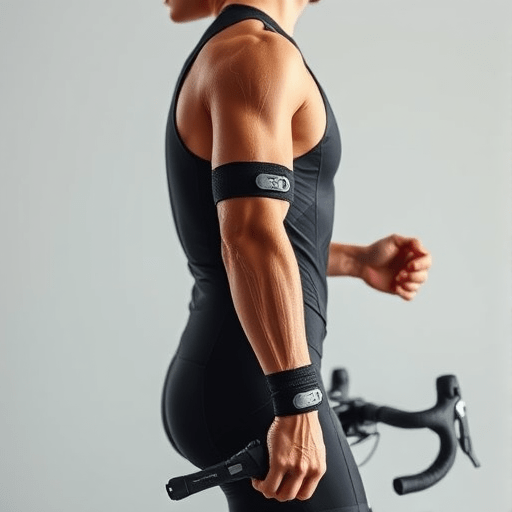
Modern dual-sport wearables typically combine three data streams. First, inertial measurement units (IMUs) track acceleration, rotation, and body orientation across multiple axes. Second, force-sensing elements — whether in pedal spindles, cleats, or handlebar mounts — measure how evenly you apply pressure. Third, surface electromyography (EMG) sensors, increasingly embedded into arm sleeves or bike shorts, record the electrical activity of key muscle groups at the surface of the skin. Together, these inputs let a device observe not just what you did, but which muscles were doing the work and how evenly they were sharing it.
Why the Swim-Bike Crossover Changes the Injury Prediction Game
The most interesting development is what happens when swim and bike data are interpreted together. A swim sensor alone can tell you that your left arm pulls longer than your right, creating a consistent rotational bias. A bike sensor alone can tell you that your right leg is producing 12 percent more torque in the final hour of a ride. But neither conclusion is particularly new. What changes in dual-sport systems is the cross-referencing of those patterns into a holistic picture of imbalance.
Consider a common scenario: a triathlete with a history of chronic ankle soreness. On the bike, the sensor detects a subtle heel raise during the pull phase. In the water, it notices that the same side is trending toward a wider early vertical forearm. Viewed separately, these seem like two unrelated technique issues. Viewed together, they point to a restricted range of motion in the posterior chain and an over-reliance on the quadriceps to compensate. That kind of inference explains why the merged data set is becoming a genuine injury-prevention tool, rather than a combination of two productivity trackers.
This dual-sport approach also helps address a frustrating limitation of single-sport analysis: fatigue is rarely visible in the moment. An endurance athlete’s movement pattern usually degrades slowly, and by the time they feel a niggle, the asymmetry has already been accumulating for weeks. By comparing swim metrics from Monday morning with bike metrics from Saturday’s long ride, the sensor can detect a developing imbalance in the shared muscle chains — the core, the hips, the glutes — before either individual session looks alarming on its own.
How Algorithms Turn Raw Motion into Early Warnings
The hardware is only half the equation. The software layer that powers injury-risk prediction has become more mature, borrowing heavily from sports medicine and rehabilitation science.
Most predictive systems follow a three-stage process. First, they establish an individual baseline of normal asymmetry. Some degree of left-right difference is natural in almost every athlete; forcing perfect symmetry can actually be counterproductive. Second, the wearable tracks deviations from that baseline during progressive exercise — a hill climbing session, a hard interval block, a long brick workout. Third, machine learning models classify these deviations into risk groups, flagging changes that match the signatures of known overuse injuries such as patellofemoral pain, rotator cuff strain, or Achilles tendinopathy.
What makes the latest generation smarter is that it calculates strain relative to load. A small smile in torque symmetry in a worn-down week after heavy training may be a critical warning sign. The same numbers appearing after a fresh, well-fueled session might be harmless. Current algorithms are increasingly capable of making that distinction by layering in perceived exertion, sleep quality, and recent training volume.
What to Look for in a 2026 Dual-Sport Sensor
If you are analyzing a current model, certain capabilities clearly separate the injury-aware devices from ordinary trackers.
- True left/right sensing: The device should separately track each limb rather than extrapolating one side from the other.
- Muscle activation data: Skin-contact EMG offers a critical layer of insight that accelerometer-only sensors cannot provide.
- Cross-sport battery memory: Since swim and bike sessions happen at different times, the sensor needs enough onboard memory to store multiple full workouts before syncing.
- Context-aware algorithm: A model that incorporates recovery metrics and training load is far more useful than one that judges every session in isolation.
- An open data policy: Effective use of predictive analytics often means exporting your own data to a coach or training platform. Some manufacturers restrict this; the best ones embrace it.
The Limits of Prediction: What Sensors Still Cannot Tell You
It is worth being honest about the boundaries of this technology. A consumer-grade wearable cannot replace a biomechanist’s gait analysis or a physiotherapist’s clinical assessment. Surface EMG, for example, picks up signals from larger muscle groups but struggles with deeper stabilizers like the piriformis or the deep hip rotators. Similarly, a sensor can flag the existence of an imbalance, but it cannot tell you whether that imbalance is a cause of injury, a compensation for an old injury, or simply a structural variation you have carried since adolescence with no negative consequences.
False positives are a real risk. An athlete who overreacts to every red flag might end up altering a stroke that was working perfectly. The best approach is to treat these wearables as an early-detection layer, not as a diagnostic oracle. Use the signal to schedule a conversation with a professional or to modify a training load, rather than to self-diagnose a tissue injury.
The Big Picture for Endurance Athletes
The path forward for dual-sport sensors is not about packing in more metrics. It is about weaving existing measurements into a more coherent narrative of how the body handles the stresses of swimming and cycling. The idea that a wrist-worn computer could warn you about a developing muscle imbalance before your knee aches — and that it could do so by connecting what happens on the bike to what happens in the pool — would have sounded like science fiction even a few years ago. That capability is now quietly becoming the standard for the sport’s most conscientious athletes.
As the technology matures, the athletes who benefit the most will likely be those who treat it as a dialogue: listen to the sensor, validate its signals against real-world feeling, and let a professional interpret the full picture. When used that way, smart swim and bike sensors that predict injury risk are one of the most practical injury-prevention tools available in endurance training today.