At a neighborhood bakery, a $50 Raspberry Pi camera spots stale pastries and adjusts discounts in real time using a heuristic ML model—and that simple setup has reduced unsold baked goods by nearly 30%. No expensive industrial sensors. No cloud GPU training runs. Just a modest single-board computer, a camera module, and a cleverly designed machine learning system that understands what fresh bread actually looks like as the morning turns into the afternoon.
It is easy to assume that AI food-management systems belong in large supermarkets with enterprise software budgets. But the bakery’s approach shows how small food businesses can use tiny, interpretable models to solve a very old problem: how do you sell a croissant before it stops being a croissant?
The Problem: Bakery Waste Is a Timing Failure, Not Just a Leftover Problem
Bakeries throw away a distressingly large share of their daily production. Many of them rely on a simple rule: everything left at closing time gets donated, bagged for day-old sales, or trashed. The challenge isn’t that the pastries are bad—it’s that they were priced based on the time of day instead of their actual condition.
Traditional discounting usually starts at a fixed hour. At 4 p.m., everything gets 20% off. At 6 p.m., it goes to 50%. That system misses the real signal: one pastry might lose its flake by 2 p.m., while another can still be excellent at closing time. The old model punishes both too early and too late, creating unnecessary waste and leaving money on the table.
The bakery wanted something that could read freshness continuously, rather than following a daily markdown schedule. That is why the team turned to a Raspberry Pi camera and a heuristic approach to machine learning.
Why a Raspberry Pi Camera Is Enough for Stale-Pastry Detection
Stale-pastry detection does not require a million-image dataset or a state-of-the-art deep neural network. The visual cues of staleness are often small but consistent: a dulling surface, tiny wrinkles, a loss of sheen on glazes, or the appearance of micro-cracks in crusts. These features can be measured with classical image processing and lightweight classification rules.
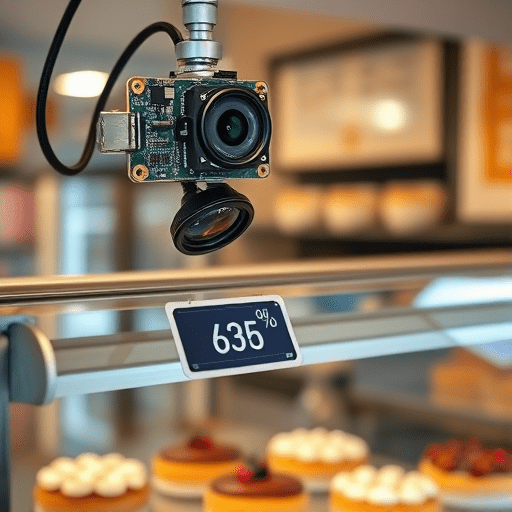
The bakery’s setup uses a Raspberry Pi with a camera module mounted above the pastry display case. Every five minutes, the camera captures a normalized image of each tray. The heuristic ML model looks at specific regions of interest—the top curve of a brioche, the shiny glaze of a fruit tart, the crenellated surface of a muffin—and extracts simple numerical features.
These include:
- Average gloss and specular highlight intensity, which drops as moisture evaporates from glazes and icing.
- Edge contrast around pastry contours, which increases as crusts dry and crack.
- Color saturation in visible toppings, especially fruit fillings, which fades as exposure to air continues.
- Texture gradient across the pastry crown, which changes as the crumb settles and loses its airy structure.
The model then compares each feature to a set of heuristic thresholds. No feature alone is proof of staleness, but the combination creates a reliable “staleness score” between 0 and 100. The score is not a black-box output. The bakery owner can see exactly which visual feature triggered an alert—useful when a new batch of sourdough behaves differently than the previous batch.
How the Heuristic ML Model Makes Smarter Discounts in Real Time
The real magic is what happens after the staleness score is calculated. The Raspberry Pi shares the score with a small e-ink price tag attached to each tray. The tag refreshes automatically, so a customer walking by at 3:47 p.m. might see a 30% discount on a pastry that just crossed a threshold, while the item next to it remains full price.
The system uses three decision points:
- When the staleness score passes 35, the pastry is moved to a “gentle discount” tier at 20% off.
- At a score of 60, the discount deepens to 50%, signaling that the texture is still pleasant but past its prime.
- Above 75, the system sets the price to 70% off—enough to move the item out before the shop closes.
This is a heuristic ML model in action: it uses learned rules and image-derived features rather than a massive neural network. The word heuristic matters. The system encodes a simple truth that human bakers already know: a pastry with a visible change in surface moisture should not be sold at the same price as one that just came out of the oven. By automating that judgment, the bakery avoids the all-or-nothing approach of time-based discounting.
What Makes the Model “Heuristic” Instead of a Giant Black Box
Deep learning models can be impressive, but they are often impractical for a shop with one or two counters. Training a custom convolutional neural network to identify every type of pastry from every angle would require thousands of labeled images and careful retraining. The bakery’s heuristic approach is different: it relies on hand-designed features and simple classifiers that run in a few milliseconds on the Raspberry Pi’s CPU.
That design choice creates three benefits for food retailers:
- Interpretability: The model’s decisions can be traced back to visible changes in the pastry. The owner can say, “The model discounted the danish because the glaze lost its shine,” instead of reading an inscrutable attention map.
- Low maintenance: When a new product is introduced—say, a gluten-free muffin—the bakery can adjust the relevant thresholds for that tray without retraining a network.
- Privacy and reliability: Because the system runs on local hardware, the image data never leaves the bakery. The process still works if the internet goes down.
The model is not trying to detect every product with pixel-perfect accuracy. It is looking for relative changes over time. This makes it far easier to run on a $50 Raspberry Pi camera than a heavyweight vision transformer. The result is a practical system that any bakery or café could replicate without a data science team.
The 30% Waste Reduction Is Only One Part of the Story
The bakery measured a 30% drop in unsold pastries over the first three months of operation. But reducing waste by 30% with a Raspberry Pi camera is not just about the discount label doing its job. The system changed the bakery’s entire relationship with its products.
Before the camera, bakers often avoided making risky, weather-dependent items because they were hard to sell. After seeing real-time freshness data, they became more confident about making a small batch late in the day, because they knew the model could lower the price before the items entered the visible staleness zone. The bakery also started positioning trays differently after noticing that some spots in the display case produced quicker surface drying than others.
The economic impact goes beyond the recovered revenue. Staff no longer spends twenty minutes at 5 p.m. walking around with stickers and markers. Less food going into the bin means lower disposal costs and a smaller environmental footprint. The bakery also saw an uptick in close-to-closing customers who learned to check the e-ink tags for deals—a small but loyal crowd that never waited for a blanket discount.
What Other Food Businesses Can Learn from This Setup
The main lesson is not that every bakery needs a Raspberry Pi camera, but that smart waste reduction can happen at the edge. A system that spots stale pastries and adjusts discounts in real time is especially valuable in 2026, when ingredient costs are tight and customers expect transparent inventory practices.
For a similar deployment, a food business starts with a simple question: what measurable visual change happens before a product becomes unsellable? For banana bread, it might be browning of the top. For sandwiches, it might be the color of leafy greens. Once that signal is identified, the heuristic model can be built around it.
No single algorithm will solve food waste. But combining a camera, a threshold-based model, and an automatic price display is a powerful way to make the last few hours of a product’s life profitable instead of wasteful.
Conclusion
This bakery’s experience shows how a small, explainable system can have an outsized impact. A Raspberry Pi camera spots the first signs of staling, a heuristic ML model turns those signs into a score, and a real-time price tag adjusts discount levels before products lose their appeal. The 30% waste reduction is a reminder that food waste technology does not have to be expensive or complex. It just has to be attentive at the right moment.