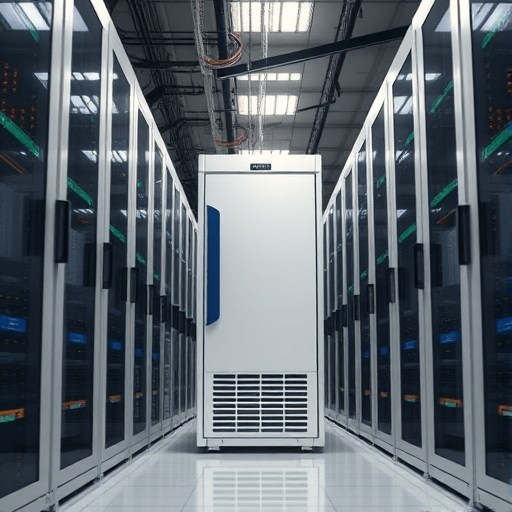
Quantum computing limits for data centers are no longer theoretical talking points. As enterprise IT leaders evaluate next-generation infrastructure, the gap between quantum hype and physical reality is becoming the most important planning factor. Vendor roadmaps promise fault-tolerant machines by the end of the decade, but the day-to-day reality of operating quantum hardware is anchored in cryogenics, subatomic noise, and infrastructure demands that clash with standard data center designs. This is not a dismissal of quantum’s potential — it is a reality check for anyone who needs to budget, lease space, or hire talent for a future that includes quantum processors.
The Cold Hard Truth: Cryogenic Cooling Constraints
Quantum processors based on superconducting qubits require operating temperatures around 10–15 millikelvin — colder than intergalactic space. Dilution refrigerators achieve those temperatures, but they are not just another cooling unit. They are precision instruments that demand specialized power, continuous helium circulation, and a level of thermal isolation that most data center cooling architectures simply cannot supply.
For an IT leader, the immediate implication is space and energy. A single dilution refrigerator can consume more power in a day than a high-density classical rack, most of it for compressors, pumps, and cryocooler stages, not for computing. The heat rejected into the data center hall is manageable in small deployments, but at fleet scale it changes the cooling calculus entirely. Liquid cooling and rear-door heat exchangers help, but they do not solve the fundamental mismatch between quantum’s need for extreme cold and a facility designed around 20–30°C air-cooled environments.
Noise, Vibration, and the Quantum Decoherence Wall
Quantum states are ephemeral by nature. A superposition collapses if a single photon scatters off the chip, a cosmic ray strikes the substrate, or a floor vibration shifts the magnetic field by a tiny fraction. This is not a software bug; it is a physics limit. Data centers are noisy places: cooling fans vibrate, backup generators hum, and people walk on raised floors. For quantum processors, those everyday disturbances are catastrophes.
To maintain qubit coherence, vendors place systems in acoustic enclosures, active vibration isolation tables, and electromagnetic shielding that resembles a Faraday cage more than a server rack. Even with those measures, qubit coherence times are measured in microseconds or milliseconds depending on the qubit architecture. Error correction overhead then multiplies the physical qubit count by a factor of 10 to 1000, depending on the desired logical error rate. The decoherence wall is not just a chip-design problem; it is a siting problem. A quantum data center must be built away from highways, railway lines, and even large mechanical equipment — a zoning challenge as much as an engineering one.
The Footprint Problem: Why Quantum Racks Are Not Racks
IT leaders are used to density metrics: compute per rack, storage per U, watts per square foot. Quantum systems break every one of those metrics. A single quantum processor unit with its dilution refrigerator, control electronics, and room-temperature readout system occupies an enclosure roughly the size of a large wardrobe. For the next few years, most of that space will contain components that are not quantum at all — they are classical control and measurement systems.
That means the first wave of quantum computing in data centers will not look like a rack of servers. It will look like isolated “quantum pods” with dedicated power distribution, dedicated chilled water loops, and reinforced floors. The utilization rate of that square footage is poor by classical standards. A 10-qubit machine might take up 4 square meters and deliver zero useful throughput for most enterprise workloads. As qubit counts grow, the footprint expands faster than linear because each additional qubit requires more control lines, more filtering, and more physical separation to reduce crosstalk.
Scaling Beyond a Few Qubits: Interconnect and Control Bottlenecks
Adding qubits to a chip is not like adding CPU cores. Superconducting qubits interact with neighbors through capacitive coupling, and every qubit needs at least one resonant control line and one readout line. For a 1000-qubit processor, that implies well over a thousand microwave cables running from the room-temperature control stack down into the cryostat. Each cable conducts heat, so engineering groups use attenuators, isolators, and custom wiring looms to minimize thermal load. This is a physical limit that no roadmap can wish away.
There is also the problem of qubit connectivity. A processor with 100 adjacent qubits is not fully connected. Remote qubits require swap gates that involve intermediate qubits, which creates long sequences of operations and increases error rates. Some vendors are pursuing modular architectures, connecting multiple quantum processors with optical interconnects or photonic links. But those links have their own fidelity limits, and the classical control systems needed to synchronize modules are growing in complexity. For data center operators, the takeaway is simple: quantum scaling is not progressing on a Moore’s-law curve. It is a painfully slow march constrained by wiring, crosstalk, and the need to keep every qubit isolated from its neighbors at the quantum level.
Power, Cost, and the Hybrid Integration Gap
If cryogenics were solved tomorrow, quantum would still face a power problem. The classical computers that run error correction, process measurement results, and execute quantum gate sequences consume far more energy than the quantum processor itself. An optimistic estimate for a single logical qubit — with error correction — is somewhere between 100 and 10,000 physical qubits, depending on gate fidelity. Multiply that by the number of logical qubits needed for a useful chemistry simulation or optimization problem, and the energy ledger becomes brutal.
There is also the latency gap. Data center applications run on a classical computing stack that handles storage, networking, and orchestration. A quantum processor is not a drop-in accelerator; it is a co-processor accessed over a network, often with queue times measured in minutes or hours. Even with a fast classical frontend, the round-trip between a classical workload and a quantum execution unit is measured in microseconds to milliseconds. For latency-sensitive use cases like live fraud detection or real-time logistics, that is far too slow. The realistic near-term use cases are batch-oriented: chemistry simulations, portfolio optimization, protein folding, and materials discovery — where a single quantum run can take hours and the result is then post-processed classically.
What This Means for IT Decision-Makers
None of these five limits mean quantum computing will never enter the data center. They mean that the journey will be more like building a cleanroom fabrication facility than adding a new GPU cluster. IT leaders who plan now will focus on creating “quantum-ready” spaces: low-vibration slabs, high-voltage power capability, additional liquid cooling capacity, and strong physical security. They will also diversify — investing in classical high-performance computing, GPU-accelerated simulation, and algorithm development that can run quantum-inspired techniques on classical hardware today.
For the next several years, the enterprises that gain an edge from quantum will not be those with shiny machines in their basements. They will be those that recognize quantum computing limits for data centers and plan around them — building hybrid workflows, training staff on quantum algorithms, and partnering with cloud providers who absorb the physical pain of operating cryogenic infrastructure. The quantum future is real, but it will arrive quietly, in specialized facilities, and only for workloads that justify the immense engineering cost.