Most startup re-work doesn’t arrive with a big bang. It arrives quietly, as a truncated conversation that ends with “we’ll decide later” — and then two people build in slightly different directions. A micro-decision log is the lightweight antidote: a shared doc where quick choices get captured in a few lines so the whole team can see them. For leaders, it’s the most underrated tool for cutting re-work and preventing alignment drift, not by slowing anyone down, but by making small decisions visible.
Why Re-Work Is the Most Expensive Output a Startup Produces
Re-work is deceptive because it looks like progress in the moment. The first version of a feature feels like momentum. The PM reviews it, realizes the default sort order doesn’t match the customer conversation from last Tuesday, and the engineer resets. That’s not a bug — that’s an undefined decision resurfacing three days later.
The cost compounds. A ten-minute decision that was never written down can consume a full day of engineering time when it’s discovered the hard way. Multiply that by a handful of micro-decisions per week, and a startup silently loses two to three engineering days per sprint — not to code quality, but to alignment debt.
Consider a typical example. A product manager and a designer agree over Slack that the new onboarding flow should skip the email step for now. Nobody writes it down. The engineering team, already building the form, adds the email field back because it’s in the original spec. Two days of work, reverted. The decision existed, but only in a chat thread that scrolled past everyone’s memory.
In 2026, the stakes are higher. AI-assisted coding tools let a single engineer ship far more code per day than was possible a few years ago. That speed is incredible, but it also means bad assumptions get compiled into existence faster than ever. The bottleneck isn’t code production anymore; it’s convergence. And convergence is exactly what a micro-decision log supports.
What Counts as a Micro-Decision Worth Logging
Not everything belongs in the log. The discipline is in knowing the difference. A micro-decision has three identifying traits:
- It was made quickly, usually in under fifteen minutes, often in a chat thread or a quick call.
- It affects at least one person outside the conversation — a designer, a backend engineer, a sales rep who’ll demo the feature.
- It is currently undocumented, with nothing in the wiki, the ticket, or the spec capturing it.
Common examples: choosing the default view of a dashboard, postponing a deprecation notice, agreeing on an API naming convention, picking a library, or deciding to hide a button rather than disable it. Leave out anything already captured in an architecture doc, ticket criteria, or PR description. Duplication kills trust in the log. But if you’re unsure, log it. The cost of one extra line is negligible; the cost of a missing line is a long debate three weeks later.
The Three-Field Rule for a Log People Will Actually Update
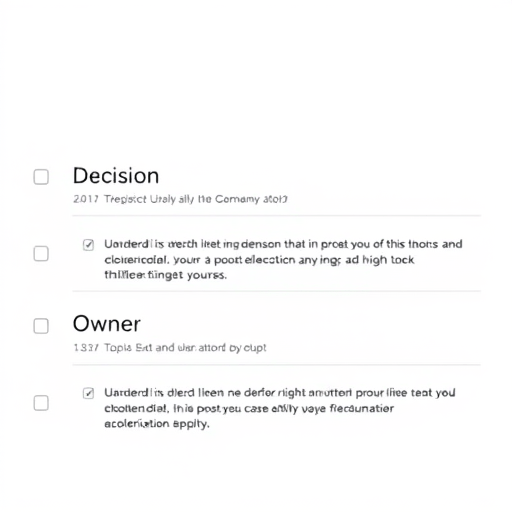
The fastest way to fail is to over-design the system. No tags, no status columns, no approval workflows, no Jira integration. The log should sit at the top of an existing shared doc — the one the team already opens daily — with exactly three fields per entry.
Decision
One sentence starting with a verb. “We chose the two-column checkout for the pilot.” “We’re deferring exports until after beta.”
Reason
One sentence capturing the trade-off. “Because the single-column version tested lower with mobile users.” “Because sales needs the API stable first.”
Owner and date
“Lena, 2026-03-02.” The owner is who made the call, not who wrote it down.
That’s it. A three-column table or a running list of bolded decisions works perfectly. The moment the log requires a plugin, a database, or a permission scheme, it’s dead. Startups don’t need another tool; they need one more heading in the doc they already use. Google Docs, Notion, Confluence, or even a Markdown file at the root of the repository all work. What matters is that it’s the same place every time, and that it’s easy to append to.
The Five-Minute Weekly Review That Turns the Log Into Alignment
A log that nobody reads is just a diary. Once a week, one person — usually the tech lead or PM — reads the new entries and checks for contradictions. If an engineer logged a decision to remove a component while a designer logged one to keep it, the friction becomes visible before anyone builds the wrong thing.
The review should be a quiet read, not a meeting. If something needs resolution, the reviewer messages the two owners directly. That keeps the log from becoming a governance layer. Sprint boundaries are a natural checkpoint: a quick “any conflicting decisions?” question at the start of planning prevents a mid-sprint reset. The goal is not to relitigate old choices; it’s to catch collisions early enough that they cost a conversation instead of a rebuild.
How the Log Prevents Alignment Drift Without Bureaucracy
The deeper payoff is cultural. When decisions are recorded in a shared space, team members stop guessing about intent. A new engineer can skim the last few weeks of entries and absorb the “why” behind the current codebase in ten minutes, instead of reconstructing context from Slack threads.
The log also improves the quality of decisions. When a leader knows they’ll record the reason in one sentence, they make the reason explicit. Vague choices get caught at the moment of writing, not at the moment of review. That’s a subtle but powerful filter.
Crucially, the log is not a permission gate. Nothing says “wait for approval before you log.” The flow stays fast: decide, write one line, move on. It’s a transparency layer, not a checkpoint — which is exactly why teams keep using it. It never asks anyone to slow down.
The AI Edge: Keeping Human Context in the Loop
There’s also a pragmatic reason to adopt this now. AI assistants draw context from tickets, READMEs, and chat history. When decisions live only in a two-person chat, the AI’s next suggestion will reflect a stale assumption, silently adding re-work to the code it generates.
A micro-decision log gives the team — and the AI tools they use — a stable, human-authored layer of intent. It’s low-tech, but it’s the kind of guardrail that keeps fast-moving teams from paying compound interest on small misunderstandings.
Keep the Log Alive, and the Pace Follows
The micro-decision log is not a project management system, and it should never feel like one. It’s shared memory for the team’s tiny choices. Write one sentence, name the trade-off, move on. Review it for five minutes a week. Let it quietly prevent the re-work that used to eat your sprints — without adding a single meeting.