Injury prevention is a cornerstone of high-performance sport, but for many Paralympic clubs, the biomechanics labs and expensive motion capture systems used by elite national teams remain out of reach. That gap is closing quickly. With the rapid evolution of markerless pose estimation and open-source software, a surprisingly effective setup can be assembled for under a few hundred euros using just two standard webcams. This low-cost motion capture system for injury prevention in Paralympic clubs is not a distant dream—it is a practical, accessible tool that can be deployed this season to help coaches and physiotherapists make data-informed decisions for every athlete.
Why Paralympic Clubs Need Affordable Biomechanics
Many Paralympic disciplines place asymmetrical demands on the body. A wheelchair racer, a para-rower, or a seated volleyball player relies on upper-body power, often developing overuse injuries in the shoulder, elbow, and wrist. Without objective movement analysis, coaches rely on visual observation alone, which can miss subtle compensations introduced by impairment or fatigue. Traditional motion capture systems require multiple infrared cameras, reflective markers, and a controlled laboratory environment—costing tens of thousands of euros and demanding specialist expertise.
Low-cost, two-webcam motion capture changes the equation. It provides quantitative data on joint angles, symmetry, movement velocity, and range of motion—metrics that are directly relevant to injury risk. This allows Paralympic clubs to screen athletes regularly, monitor training loads, and adjust technique before a small asymmetry becomes a serious injury. The barrier to entry is less about money and more about knowing how to set up a simple, reliable system.
How Two Webcams Can Replace a Lab-Grade System
Markerless motion capture has matured enormously in recent years. Using computer vision algorithms and machine learning, software can now estimate 3D human joint positions from standard 2D video. The trick lies in using two synchronized cameras to provide slightly different viewpoints, allowing the software to triangulate the position of joints in three-dimensional space. This is the same principle that underlies professional systems—but it is achieved with consumer hardware and open-source tools.
Understanding the Basics of Markerless Motion Capture
At the heart of this approach are open-source pose estimation models such as OpenPose, MediaPipe, or DeepLabCut. These models detect anatomical landmarks—like the shoulder, elbow, wrist, hip, knee, and ankle—in each video frame. When two webcams are placed at a 60–90 degree angle to each other, the software can match those landmarks across both views and reconstruct their 3D coordinates. This is mathematically similar to how your brain estimates depth using two eyes, and it is robust enough for gait analysis, squat assessment, and upper-body throwing or pushing mechanics.
Selecting the Right Webcams and Setup
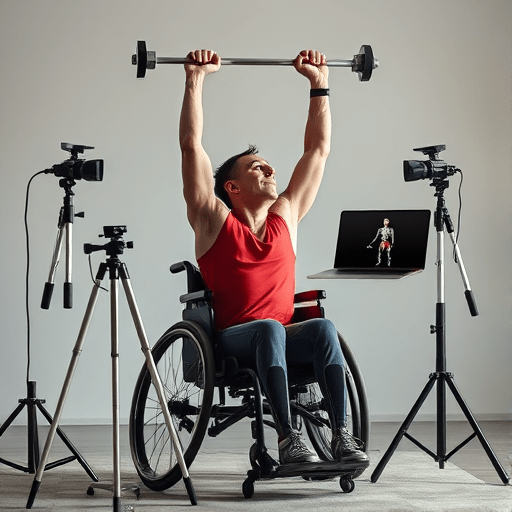
Not all webcams are equal, but you don’t need high-end models. Choose webcams that support a fixed focal length, a resolution of at least 720p (1080p is better), and a frame rate of 30 fps or higher. Avoid wide-angle lenses, as they introduce distortion that complicates calibration. Two identical Logitech C920 or C922 webcams are a proven budget-friendly choice. To keep the setup truly low-cost, use standard tripods or clamp mounts and position the cameras between 2 and 4 meters from the capture area, at roughly 0.8–1.2 meters above the floor. For athletes in wheelchairs, adjust the camera heights to align with the range of motion you need to capture, and ensure the entire movement is visible in both cameras.
Open-Source Software Stack: A Practical Guide
The real power of this low-cost motion capture for injury prevention in Paralympic clubs lies in the software. Several open-source projects have been built specifically for markerless motion capture, and they are increasingly user-friendly. The two most practical starting points are OpenCap and FreeMoCap. OpenCap is web-based, requires no local installation, and uses two iPhone cameras or webcams to stream video to a cloud processing pipeline. FreeMoCap is a fully open-source Python desktop application that records from two or more webcams and runs pose estimation locally on a standard laptop. Both produce 3D joint kinematics and can export CSV files for further analysis in Excel or Python.
Calibration and Data Capture
Calibration is the key to producing accurate 3D data. For a two-camera system, calibration usually involves waving a calibration board (a printed checkerboard pattern) in front of both cameras for a few seconds, or using a wand with two markers at a fixed distance. OpenCap and FreeMoCap automate most of this process. After calibration, you can record a short trial where the athlete performs a set of prescribed movements—such as a squat, an overhead press, or a wheelchair propulsion motion on a roller. Ensure good lighting without harsh shadows, and make the background as plain as possible to help the pose estimation algorithm lock onto the athlete.
Processing and Analyzing Movement Patterns
Once the trial is recorded, the software processes the video frames and reconstructs joint angles over time. For injury prevention, you don’t need to interpret every metric. Focus on three or four key parameters: the degree of bilateral symmetry (e.g., comparing left and right shoulder flexion during a push), the range of motion at critical joints, and any abnormal posture or movement signature that could indicate maladaptive compensation. FreeMoCap includes a built-in interface to visualise joint angle curves, while OpenCap offers a web dashboard with plots and summary tables. These outputs help coaches and physiotherapists ask better questions: Is the athlete’s trunk rotation excessive during a tennis serve? Is the knee collapsing inward in a static squat? That information guides targeted strengthening or technique changes.
Building an Injury-Prevention Workflow for Athletes with Impairments
Paralympic athletes are not a homogeneous group. A system designed for able-bodied sport may need adjustments when working with athletes who have limb deficiencies, spasticity, visual impairments, or spinal cord injuries. The beauty of a webcam-based setup is its flexibility. It can be positioned to capture upper-body movements for wheelchair users, lower-limb movements for amputee runners, or asymmetries in a thrower’s overhead motion. But it is essential to adapt protocols to individual needs rather than forcing athletes into a one-size-fits-all assessment.
Adapting Protocols to Individual Needs
For athletes with limited standing balance, perform assessments in the wheelchair or on a stable bench. For those with one-sided limb absence, the pose estimation software can still detect the intact limb and the residual limb, but the markers on the absent side will be noisy or missing. In such cases, you can modify the analysis to focus on intact limb mechanics and trunk control, which are often the source of overuse injuries. Always involve the athlete’s coach and physiotherapist in designing the movement tasks, and allow sufficient practice trials so that the athlete feels comfortable and can perform at their typical intensity.
Reading the Data: Key Metrics to Watch
To keep the workflow simple, start with qualitative visual inspection of the reconstructed 3D skeleton, then move to quantitative metrics. For wheelchair propulsion, watch shoulder joint angle symmetry during the push phase and the ratio of work done by the shoulder versus the elbow. For throwers or seated shot-put athletes, examine trunk rotation velocity and whether the non-throwing shoulder is overextended. For para-skiers or runners with prostheses, compare vertical ground reaction force estimation (available via OpenCap’s inverse dynamics module) and knee or hip flexion angles. Early negative deviations from the athlete’s baseline are more valuable than comparing to a textbook average—so schedule monthly capture sessions to track changes over time.
Overcoming Common Challenges in Low-Cost Setups
No system is without hiccups. The most common issue in two-webcam markerless motion capture is hidden body parts: when an athlete’s arm blocks their trunk, or a wheelchair wheel obscures the lower limb, the pose estimation may flicker or lose track. To mitigate this, choose movement tasks that keep the body mostly in view of both cameras, or add a third webcam for complex movements (still low-cost). Another challenge is varying lighting conditions; the pose estimation models are trained on standard images, so a too-bright gym or a daylight-filled window can confuse them. Use curtains or portable panels to even out light. Finally, synchronization between the two webcams is often handled automatically by the software (using audio or time codes), but you must ensure the cameras are connected to a machine with sufficient USB bandwidth. Use a USB 3.0 hub and keep the cables short.
Despite these small obstacles, the reliability of open-source motion capture has reached a level where it can serve as a daily screening tool. The hardware costs little, the software is free, and the data produced can be exported to spreadsheets for long-term athlete monitoring. For Paralympic clubs that are ready to embrace the sports-science revolution without breaking the bank, this approach is a game-changer.
Conclusion
Low-cost motion capture using two webcams and open-source software is not merely a budget alternative—it is an innovative, adaptable injury-prevention strategy for Paralympic clubs. By bringing quantitative biomechanics into everyday training environments, clubs can monitor asymmetries, guide technique adjustments, and shield athletes from preventable injuries. The tools are accessible today, and the only requirement is a willingness to experiment, learn, and integrate simple movement data into a holistic coaching process.