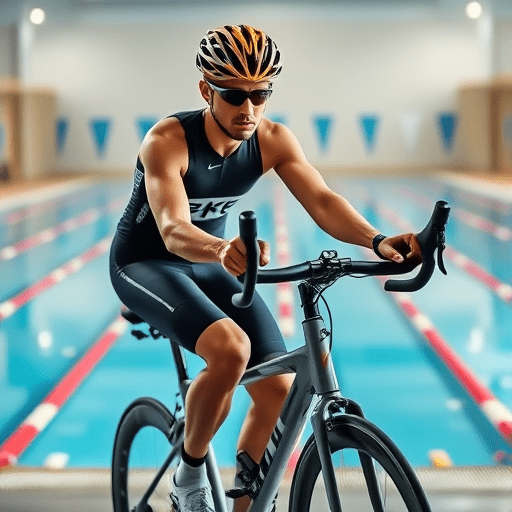
Swimmers and triathletes will do almost anything to speed up shoulder recovery between swim sets—cupping, scraping, stretching, compression sleeves, even avoiding the pool. Yet a surprising recovery tool is waiting in a cross-training room: the stationary bike, ridden at an intentionally low cadence. Low-cadence strength rides for swimming recovery involve pushing a large gear at 45–60 revolutions per minute instead of the light, spinning pace most athletes choose for recovery. The result is a gentle but powerful muscular pulse around the shoulder complex that flushes edema, downregulates inflammation, and helps swimmers return to a strong pull faster. It sounds like a contradiction, but in this recovery method, heavy gears are the healing gears.
Why Slow Pedaling Helps Swimmers Recover Faster
The traditional recovery ride at 90 rpm does little for the shoulders. A relaxed hold on the bars lets the chest collapse, and the arms hang on the handlebars without sustained muscle activation. For a swimmer’s irritated shoulder, this is not a recovery stimulus—it simply lets blood pool in dependent tissues and can amplify the sensation of tightness. Low-cadence strength work changes the task completely. Because each pedal stroke requires high muscular effort from the hips and torso, the body has to stabilize the shoulder joint to maintain a braced posture. The rhomboids, teres minor, infraspinatus, and even the long head of the triceps all contract to hold the humeral head centered in the glenoid fossa. When you hold that position under load for several minutes, those deep stabilizer muscles receive their own blood supply again.
Also, slow revolutions force you to produce torque all the way around the pedal stroke. As you pull up at the bottom of each stroke, you naturally set the scapula into a posterior tilt. That position is the opposite of the forward, internally rotated posture typical after a heavy swim set. In effect, the bike becomes a repetitive loading device that coaches the upper body into better alignment while the legs perform the majority of the work.
The Perfusion Burst: What Heavy Gears Do for Sore Shoulders
Why would a swimmer feel less shoulder pain after making their legs work hard? The answer lies in what exercise physiologists call the perfusion burst. Muscle contraction raises intramuscular pressure, which drives deoxygenated blood, cellular waste, and pro-inflammatory mediators out of the tissue. When the contraction relaxes, newly oxygenated blood rushes into the vacated space. Over a five-minute block of low-cadence grinding, swimmers create many such cycles across the entire upper-body fascial chain—including the axillae, subacromial space, and rotator cuff tendon bellies.
The cadence matters because revolutions per minute determine how sustained each contraction is. At high cadence, muscle contractions are brief and ballistic, producing limited tension through the shoulder. At slow cadence, the muscles of the shoulder girdle contract for a longer period within each revolution. The sustained force serves as a slow, deep release for the often stiff muscles that attach to the upper arm. Unlike static stretching or foam rolling, this process keeps the nervous system engaged and doesn’t require a swimmer to place a tender shoulder in an extreme range of motion.
The 40-Minute Torque Ride: A Low-Cadence Strength Session
When structured correctly, a low-cadence recovery session should not leave a swimmer exhausted; it should make the shoulders feel open, warm, and slightly heavy—but not painful. Use this protocol on a stationary bike or smart trainer with a controllable resistance.
- Warm-up (10 minutes): Ride at 90 rpm with light resistance. After five minutes, focus on full, relaxed exhales and let the shoulders settle away from the ears.
- Torque blocks (4 x 5 minutes): Shift into a heavy gear at 45–55 rpm. Keep your hands on the hoods, elbows bent about 100 degrees, and maintain a tall spine. You should be working at a 6 or 7 out of 10 in perceived exertion. Between each block, spin easily at 90 rpm for two minutes.
- Shoulder reset (2 minutes): After the last block, release the bars one hand at a time and circle the shoulder gently for 20 seconds each side.
- Cool-down (8 minutes): Spin at 90–100 rpm and breathe deeply. Allow the torso to be easy, but do not slump the upper back.
If the session feels too easy at 50 rpm, add resistance rather than increasing speed. If the shoulders feel sharp, pinching pain during the ride, reduce the gear, raise cadence to 70 rpm, and focus on keeping the shoulders in a straight line above the handlebar. Recovery work should never reproduce the pain pattern of the swimmer’s shoulder injury.
Shoulder-Safe Position and Grip Cues
A heavy gear magnifies any position flaw. Keep these cues in mind:
- Hands on the hoods, not the drops. The drops put the humeral head in a more internally rotated position, which can impinge the front of the shoulder. The hoods allow a neutral wrist and a slightly wider grip.
- Press the bar like you mean it. Instead of passively resting on the handlebar, press the palm and fingertips into the hoods as if trying to bend the bar in half. This activates the pectoralis minor and the rotator cuff, creating a protective cocontraction around the glenohumeral joint.
- Spread the bar gently. Imagine dragging the hoods slightly apart. This recruits the posterior cuff and opens the chest—a mini thoracic reset each second.
- Stay seated. Standing pedaling is acceptable only if the force goes through the leg; most swimmers will naturally compress the shoulders.
Position checks matter more than raw wattage. If a swimmer fits the bike too long or too low, every heavy pedal stroke will be counterproductive. A short reach with the stem slightly higher is often the best adjustment for this specific drill.
When to Ride Around Your Swim Schedule
Timing is everything. The best window for a low-cadence strength ride is about six to eight hours after a hard swim session or on the morning after an intense evening of pulling, before the next swim practice. This leaves enough time for the perfusion effect to settle while not interfering with sleep. A 20-minute mini version can also be effective between swim practices on a double-training day, as long as it is shorter, moderate in resistance, and followed by an easy cooldown.
It is wise to avoid heavy bike gears immediately before a swim set. The legs will be slightly fatigued, and the coordination needed for a fluid kick or a strong wall push-off relies on fresh neuromuscular drive. Instead, sequence the ride after the hardest aerobic swim or on the day of a long, easy distance session, when precise leg movement is less critical.
Monitoring Recovery Gains With Data and Feel
Recovery outcomes are hard to measure, but you can structure this drill to provide useful feedback. On a smart trainer, track your power output at a fixed cadence of 50 rpm. If you can maintain a consistent power across six minutes with a low heart rate drift, your body is absorbing load well. In the pool, use the shoulder rating scale: rate pain from 0 to 10 during the first 100 yards after a ride. A well-placed low-cadence session should lower that number by at least one point within ten minutes.
Combine objective markers—mood, shoulder range of motion, sleep quality—with the pool session’s perceived effort. The best recovery session is the one that lets you swim with better technique at the same pace.
Conclusion: Low-cadence strength rides offer swimmers a recovery tool that is effective, repeatable, and refreshingly different. Instead of avoiding all upper-body work on recovery days, these rides gently load the shoulder in a safe, supported position, producing a perfusion-like response. By riding at 45–55 rpm with precise posture, swimmers can accelerate shoulder recovery between swim sets and return to the water with a stronger, more resilient pull.