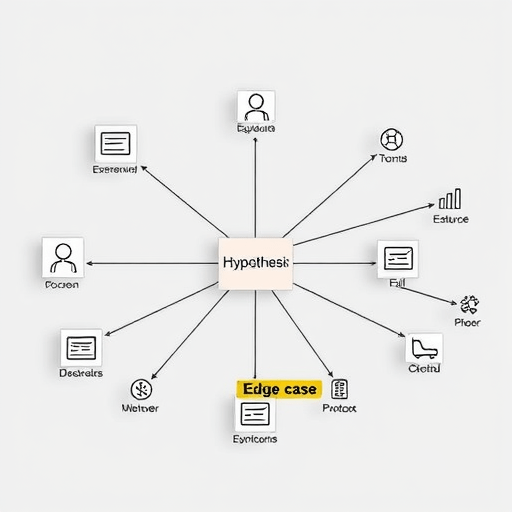
Integration testing walks a tightrope: you want enough realism to catch real failures, but you can only hand-write so many scenarios before exhaustion sets in. Property-based testing flips the old assumption that every test needs a hand-crafted example. Instead of asserting one expected output for one input, you declare invariants that must hold across a generated universe of inputs, and Hypothesis does the exploring for you. In 2026, with services multiplying in numbers and data shapes growing stranger every year, automating integration test cases with Hypothesis has evolved from a clever trick into a practical survival skill.
Why Integration Tests Keep Missing the Edge Cases That Matter
Most integration suites are still example-based. You create a user, call the orders service, assert a 201 status, move on. The problem is the gap between what you test and what production actually sends you. Real APIs are hit with null query parameters, strings that look like timezones but aren’t, decimal amounts with more precision than the database column allows, and JSON keys that appear in an order no frontend would ever produce.
Hand-written examples cannot keep up. The whole point of an integration test is to validate that multiple systems behave correctly together, but the moment you hard-code the same five fixtures, you simply train your code to pass those five fixtures. Hypothesis addresses this by generating thousands of inputs from the properties you define, so your test suite covers combinations you never thought to write.
From Unit Fuzzing to Stateful Integration Fuzzing
Hypothesis has its roots in property-based testing for pure functions, but the version you’ll use today is far more interesting. Its RuleBasedStateMachine lets you model a sequence of interactions with a running system: push an event, read state, call an endpoint, trigger a webhook, and check an invariant at every step. This is where property-based testing stops being a unit-testing toy and becomes a genuine integration testing tool.
For example, imagine testing an e-commerce checkout flow. Instead of writing one test that creates an order and another that applies a discount, you define rules that randomly combine order payloads, promo codes, payment attempts, and inventory changes. Hypothesis walks through the whole workflow and verifies that the total always equals the sum of line items, that stock never goes negative, and that order status transitions are valid.
class CheckoutMachine(RuleBasedStateMachine):
    def __init__(self):
        super().__init__()
        self.client = create_integration_client()

    @rule(payload=OrderPayload, promo=PromoCode)
    def create_order(self, payload, promo):
        self.order = self.client.post("/orders", json={**payload, "promo": promo})

    @invariant()
    def total_matches_line_items(self):
        assert self.order.total == sum(item.price for item in self.order.line_items)
Stateful integration fuzzing catches a class of bugs that single-call tests cannot see: temporal ordering problems, resource leaks that appear only after repeated interactions, and services that behave differently depending on the history of requests.
Schema-Aware Input Generation for API Contracts
One early objection to property-based integration testing was that the generated inputs felt like garbage. When you fuzz an API with random bytes, the service returns a 422 and your test learn nothing. Hypothesis solves this with schema-aware generation. The hypothesis-jsonschema plugin takes an OpenAPI document and produces data that satisfies it. You get payloads that are valid according to your contract but almost certainly absent from your test plan: unexpected enum values, deeply nested arrays, integer fields that flirt with their maximum, and strings that match a regex but contain Unicode beyond Latin-1.
This matters because integration bugs rarely come from completely invalid requests. They come from requests that are valid enough to get past the boundary service, but confusing enough to break something deeper in the system. Using your real API contract as the generator means you fuzz the boundary between “schema-valid” and “semantically meaningful,” which is where 2026-era integration failures actually live.
Where the Hidden Edge Cases Actually Hide
Once Hypothesis starts driving your integration environment, you will quickly notice a pattern. The failures cluster around places where different components disagree about the shape of the world. Common examples include:
- Caching layers keyed by raw query parameter strings, where parameter order changes the cache hit rate.
- Databases that enforce constraints the API layer never validates, causing errors that surface only at commit time.
- Downstream services that assume a field is always present, even though the upstream schema marks it optional.
- Logging and tracing pipelines that choke on high-cardinality data generated by large or deeply nested objects.
None of these show up in a typical example-based integration suite. They require a generator that deliberately explores the messy space between service contracts.
Practical Patterns for a 2026 Hypothesis Workflow
Start with one boundary and one invariant
You do not need to fuzz the entire platform on day one. Pick a single service boundary, define one invariant that must never break, and let Hypothesis attack it for five minutes. This keeps the search space small enough for failures to be interpretable and for your team to trust the tool.
Let Hypothesis shrink before you debug
When Hypothesis finds a failure, it shrinks the counterexample to something minimal: a one-character string, a single bad enum value, a sequence of two calls instead of a thousand. Spend real time reading shrinking output. The minimal failing case tells you exactly which input property triggers the bug and often reveals the root cause faster than staring at logs.
Archive failures and reuse them
Hypothesis persists failing examples in a local database directory. Keep this directory in CI. Every failure becomes a regression example automatically, which means your integration suite gets wiser every time the fuzzer discovers a bug. Your test suite effectively becomes a living record of production incidents.
Run fuzzing in CI with a time budget
There is no excuse in 2026 to let property-based tests block every commit. Run Hypothesis in a dedicated CI job with a generous timeout and a curated seed database. This gives you continuous fuzzing without slowing down developers, and it ensures edge case discovery keeps happening after the initial test suite is written.
Conclusion
Automating integration test cases with Hypothesis means changing how you think about testing itself. You stop guessing which inputs matter and start surveying the entire input space; you stop hoping for edge cases and start pinning down invariants that every service interaction must obey. By combining stateful rule-based machines with schema-aware generators, you can build integration tests that stay ahead of production surprises.