In an increasingly distributed workplace, measuring employee sentiment quickly and accurately has become a strategic imperative. AI‑Powered Pulse: Real‑Time Remote Culture Scorecard equips leaders with a live snapshot of team morale across multiple time zones, turning raw data into actionable insights within minutes. This article explores the architecture, design, and deployment of such a dashboard, offering a fresh perspective on how AI can transform remote culture management in 2026.
Why Real‑Time Morale Matters in a Global Workforce
When teams operate across borders, the cadence of feedback shifts from periodic surveys to continuous signals. Traditional pulse surveys, though valuable, suffer from delayed response cycles, low participation, and recall bias. By contrast, a real‑time scorecard surfaces issues before they snowball, allowing interventions that prevent disengagement, burnout, or talent loss.
- Immediate Detection: Spot sudden dips in sentiment following a product release or organizational change.
- Granular Insights: Differentiate sentiment by department, region, or project team.
- Proactive Culture Building: Use data to tailor well‑being programs, recognition schemes, and communication strategies.
The Core Components of an AI‑Powered Pulse Dashboard
Data Sources that Feed the Scorecard
Building a robust scorecard requires ingesting heterogeneous signals:
- Instant Messaging & Collaboration: Slack, Teams, Mattermost chat logs, with permission‑based text mining.
- Productivity Metrics: Git commit frequency, issue tracker activity, meeting attendance.
- Well‑Being Platforms: Pulse surveys, health app check‑ins, and anonymous suggestion boxes.
- Social Media & Public Sentiment: Company‑related mentions on Twitter, LinkedIn, and industry forums.
Real‑Time Aggregation and Temporal Alignment
Data arrives at different rates and timestamps. A stream‑processing layer (e.g., Kafka Streams, Flink) normalizes data into consistent time windows—typically 5‑minute granules—to ensure accurate aggregation across time zones.
AI‑Driven Sentiment Analysis at Scale
Advanced transformer models fine‑tuned for corporate language extract sentiment scores, emotion tags, and intent. Zero‑shot or few‑shot learning enables adaptation to new domains without extensive retraining. The model outputs a normalized “morale index” per 5‑minute window, which the dashboard visualizes.
Building the Dashboard Architecture
Choosing the Right Tech Stack (Databases, Stream Processing, Visualization)
- Ingestion Layer: Apache Kafka for high‑throughput streaming.
- Processing Layer: Flink or Spark Structured Streaming for real‑time analytics.
- Storage: Time‑series database (TimescaleDB, InfluxDB) for efficient querying.
- Visualization: Grafana or Power BI embedded with custom panels; React or Vue for interactivity.
Integrating with Existing Collaboration Platforms
Slack and Microsoft Teams provide rich APIs. By deploying a dedicated bot, the system can harvest message metadata and text, respecting user privacy settings. Data is anonymized before sentiment extraction.
Time‑Zone Normalization and Clock Skew Management
Employees span continents; a 9 AM in Tokyo is 10 PM in São Paulo. The dashboard stores timestamps in UTC, then displays local times per user or region. A clock‑skew algorithm reconciles server time discrepancies, ensuring consistent 5‑minute windows.
Design Principles for an Intuitive User Experience
Visualizing Trends Across Time Zones
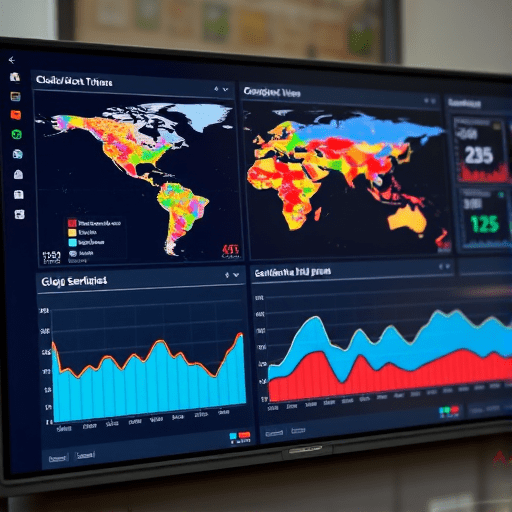
Heat maps overlay sentiment scores onto world maps, while line charts show longitudinal trends per region. Users can drill down to a specific team or day, with filters for sentiment, project, or device type.
Alerting and Actionable Insights
When the morale index falls below a threshold for three consecutive windows, the system triggers a notification to HR and managers. Suggested actions—like scheduling a check‑in meeting or sending a wellbeing resource—appear alongside the alert.
Privacy‑First Data Governance
Data residency compliance (GDPR, CCPA) is enforced via data‑at‑rest encryption, role‑based access control, and audit logs. Employees can opt‑out of data collection for sentiment analysis, and the system automatically excludes their data from the scorecard.
Case Study: A 150‑Employee SaaS Company
AcmeSoft, a global SaaS provider, implemented an AI‑Powered Pulse dashboard in Q2 2026. Their engineering, sales, and support teams operate across North America, Europe, and Asia.
Implementation Steps
- Audit existing data sources and secure API access.
- Set up Kafka clusters and deploy Flink pipelines.
- Fine‑tune BERT‑based sentiment models on AcmeSoft’s internal corpus.
- Design Grafana dashboards with region‑specific panels.
- Roll out a pilot with the engineering squad; refine thresholds and alerts.
- Scale across all departments; integrate with HRIS for automated wellbeing actions.
Results and KPI Impact
- Employee Net Promoter Score (eNPS) rose by 12 points within three months.
- Attrition rate dropped by 18% in high‑risk regions.
- Response time to morale dips reduced from days to minutes.
- Survey fatigue decreased; voluntary check‑ins increased by 30%.
Best Practices for Maintaining Accuracy Over Time
Continuous Model Retraining
Language evolves; slang, abbreviations, and cultural references shift. Retrain models quarterly using recent data, employing active learning where flagged outliers are reviewed by linguists.
Handling Language and Cultural Nuances
Multilingual sentiment models ensure non‑English text is accurately interpreted. Cultural sentiment calibration—accounting for different expressions of satisfaction—improves the reliability of cross‑regional comparisons.
Transparent Model Explanations
Explainable AI (XAI) dashboards show key phrases driving sentiment scores. This transparency builds trust among users and aids compliance audits.
Future Directions: Beyond Morale
As AI matures, real‑time culture scorecards can incorporate additional dimensions:
- Skill Development: Track learning activity and skill gaps in real time.
- Diversity & Inclusion: Sentiment tied to inclusion metrics, like language usage around underrepresented groups.
- Environmental Impact: Correlate remote work patterns with carbon footprint, providing eco‑friendly culture insights.
Ultimately, the AI‑Powered Pulse becomes a core component of a holistic People Analytics ecosystem, enabling leaders to nurture a thriving, adaptive, and resilient remote culture.
By combining high‑velocity data ingestion, sophisticated sentiment analysis, and a privacy‑first design, organizations can transform fleeting moments of sentiment into strategic action. In 2026, the teams that invest in real‑time culture metrics will not only survive the complexities of distributed work but will also thrive on the momentum of continuous, data‑driven engagement.