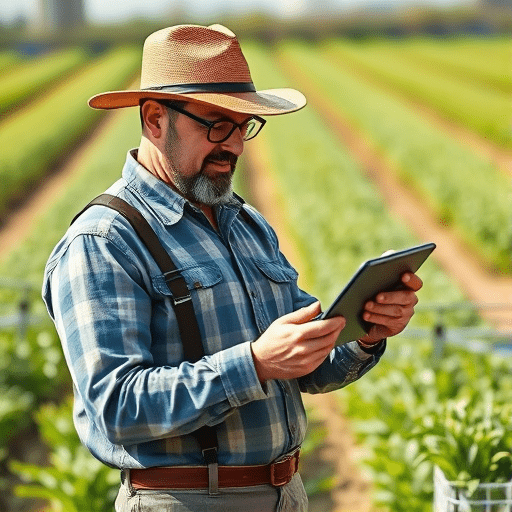
In 2026, the agri‑tech landscape has matured, yet local farmers still face a gap in affordable, tailored software. By Create a Profitable Micro SaaS for Local Farmers Without VC, founders can fill this niche, build a subscription business, and grow sustainably—all without external investors. This blueprint outlines the market opportunity, validation steps, product features, pricing, growth channels, scaling tactics, and exit strategies that keep the runway long and the community thriving.
1. Why Local Farmers Are the New Micro‑SaaS Goldmine
- High Demand for Precision: Small‑scale growers now have sensors, drones, and AI tools, but lack an integrated platform to turn data into actionable insights.
- Low Existing Competition: Most large agri‑tech firms target corporates; local farms are underserved by generic solutions.
- Stable Subscription Needs: Farm planning, pest forecasting, and market pricing require ongoing updates, making recurring revenue a natural fit.
- Community Trust: Local farmers value peer recommendations; a product built with farmer input can quickly gain traction.
2. Lean Validation: Test Before You Build
2.1 Conduct Field Interviews
Spend 48 hours on farms, listening to pain points. Use a simple questionnaire: “What data do you currently track?” “How do you forecast yields?” “What would a $20/month tool solve?” Capture stories, not just metrics.
2.2 Create a Minimum Viable Dashboard
Instead of coding full back‑end logic, prototype a static dashboard in Figma. Show a mockup of weather alerts, soil moisture graphs, and a price feed. Validate visual hierarchy and language with farmers.
2.3 Run a Pilot Subscription
Offer the prototype to 10 farms for $10/month, with a 30‑day trial. Track activation, churn, and qualitative feedback. Iterate until you hit a 70% satisfaction rate.
3. Building the Core Product: Features That Matter
3.1 Smart Weather & Pest Forecasting
Integrate NOAA data and local radar. Use machine‑learning models trained on regional pest histories to deliver alerts at a 48‑hour horizon.
3.2 Soil Health Dashboard
Aggregate data from in‑field sensors, provide nutrient maps, and suggest targeted fertilization schedules.
3.3 Market Pricing Hub
Pull real‑time commodity prices from USDA and local cooperatives. Offer price alerts when thresholds are met.
3.4 Farm‑Level Accounting Simplifier
Automatic expense categorization from bank feeds; yield‑to‑profit visualizations.
4. Pricing Strategy: Value‑Based, Not Feature‑Based
Farmers are price sensitive, yet they’ll pay for clear ROI. Adopt a tiered model:
- Basic ($12/month): Weather & pest alerts, soil dashboard.
- Pro ($24/month): Adds market hub, accounting, and priority support.
- Enterprise (Custom): Unlimited users, API access, data export, and on‑site training.
Offer a 2‑month discount for first‑year commitment. Include a 7‑day free trial to lower the entry barrier.
5. Growth Without Venture Capital
5.1 Community‑Led Referrals
Implement a referral program that rewards both referrer and new user with a month free. Leverage farmer networks—cooperatives, local markets, and extension services.
5.2 Content‑First Lead Generation
Publish “How‑to” guides: “Optimizing Your Orchard Yield with Data” or “Avoiding Pest Outbreaks in 2026.” Use SEO and email capture to build a list of 5,000 leads.
5.3 Strategic Partnerships
Collaborate with equipment suppliers (e.g., drone manufacturers) to bundle software in their sales funnels. Provide co‑branded webinars on farm efficiency.
5.4 Local Agronomy Outreach
Host free workshops at regional extension offices. Present the platform as a cost‑effective decision‑making tool, securing adoption through live demos.
6. Scaling Sustainably: Operational Playbook
6.1 Modular Architecture
Build each feature as a micro‑service; this allows incremental scaling and easier maintenance without a monolithic code base.
6.2 Cloud Infrastructure on a Budget
Use AWS Lightsail or DigitalOcean droplets for compute, combined with serverless functions (AWS Lambda) for event‑driven tasks. Keep costs below 30% of revenue until you hit $500k ARR.
6.3 Automate Onboarding
Implement a self‑serve onboarding flow: farm profile creation, sensor integration wizard, and data import scripts. Reduce support tickets by 40%.
6.4 Data‑Driven Feature Roadmap
Use a lightweight analytics stack (Amplitude + Segment) to capture user interactions. Prioritize features that increase daily active users by >5% each quarter.
7. Exit Options Without VC
- Strategic Acquisition: Large agri‑tech firms may acquire your micro‑SaaS to enter the local farm segment.
- Buyout by a Cooperative: A local farmers’ cooperative could purchase the platform to enhance member services.
- Maturity Monetization: As ARR grows to $5‑10M, consider an IPO on a niche tech exchange or a revenue‑share model with a private equity fund focused on sustainable agriculture.
- Licensing to Government: Offer the platform to state agriculture departments for subsidy tracking and compliance.
8. Resources & Tool Stack
- Frontend: React + Tailwind CSS
- Backend: Node.js + Express
- Database: PostgreSQL with TimescaleDB for time‑series data
- Analytics: Amplitude, Mixpanel
- Hosting: DigitalOcean or AWS Lightsail
- Support: Intercom for live chat, Zendesk for tickets
All tools above are free or low‑cost tiers that scale with revenue. The key is to keep the stack lean until revenue stabilizes.
Conclusion
Launching a profitable micro‑SaaS for local farmers without VC is entirely achievable in 2026. By validating with farmers early, focusing on high‑value features, pricing for ROI, and growing through community partnerships, founders can build a sustainable subscription business. Scaling with a modular architecture and data‑driven roadmap ensures the platform adapts to evolving farm needs, while keeping operational costs under control. The result: a thriving SaaS that empowers local growers, generates steady revenue, and offers clear exit pathways—all without the overhead of venture capital.