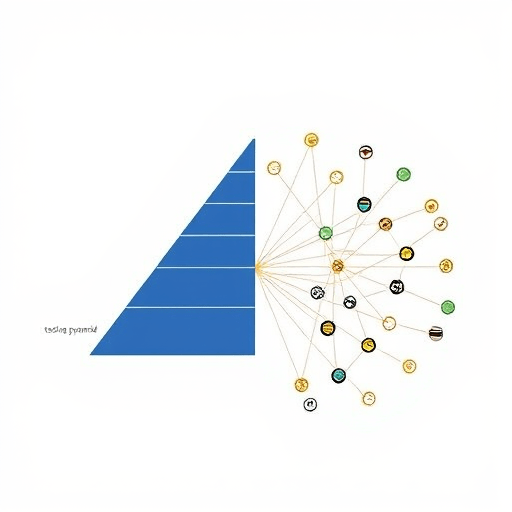
For years, the testing pyramid dictated that unit tests should form the broad base, with end-to-end (E2E) tests at the top as few and fragile. But AI-generated tests are changing the economics of test suites, forcing teams to rethink unit and E2E balance. With AI capable of generating both unit and E2E tests in seconds, the old rule of thumb—write more unit tests because they are cheaper—no longer holds in the same way. The real question is not which type is cheaper to create, but when to rely on end-to-end coverage to protect what matters most.
Why the Testing Pyramid Is Losing Its Foundation
The traditional logic was straightforward: unit tests are fast, isolated, and easy to debug, so they are inexpensive to maintain. E2E tests, on the other hand, require full system deployments, test data management, and painful debugging when a selector changes. That cost imbalance justified a pyramid with a wide base of unit tests and a narrow apex of E2E tests.
AI changes this by making test generation itself almost free. An AI helper can inspect a function and produce dozens of boundary-case unit tests in minutes. It can also watch a user session and generate an E2E script that clicks through the same flow. The expense of creating tests evaporates. What remains is the cost of reviewing, curating, and maintaining them—and that cost varies by type.
The Hidden Cost Shift: From Writing to Curating
When AI generates tests, developers become test editors, not test authors. This shift is dramatic for unit tests because AI can produce many low-value tests that merely re-state the implementation. Filtering those requires understanding the code’s intent. But for E2E tests, AI-generated flows often come from real user behaviour, so they naturally align with business value. The hard part becomes keeping them stable as the UI evolves.
In 2026, AI-powered tools can reduce E2E flakiness by using better selectors and self-healing locators. Smart waits and visual snapshots handle minor layout shifts. Still, not every E2E test is worth preserving. The new cost equation is not about generation; it is about deciding which tests deserve ongoing attention.
When End-to-End Tests Still Deserve a Place in Your Suite
Some teams see the fall in generation costs as a reason to abandon E2E testing entirely. That is a mistake. Unit tests can validate a cart calculation, but they cannot verify that a payment gateway returns the correct redirect. E2E tests remain the only reliable way to catch integration failures across services, APIs, and third-party dependencies. Choose E2E when:
- The flow spans multiple systems or teams.
- A failure would cause revenue loss, data corruption, or reputational damage.
- You need to verify the experience from the user’s perspective, not just internal logic.
- Regulatory or contractual obligations require evidence of end-to-end behaviour.
These are the scenarios where the cost of not having an E2E test is far higher than the cost of maintaining one—even if AI makes both options look similar on paper.
AI Makes E2E Tests Sharper, Not Just Cheaper
AI can also improve the quality of E2E tests, not merely reduce their creation time. Instead of manually writing brittle CSS selectors, AI can analyse the DOM and identify robust attributes. Instead of waiting for a release, AI can generate synthetic test data on the fly. Most importantly, AI can learn from production errors and suggest new E2E tests for the exact journeys that broke in the past.
This flips the old rule of relying on E2E only for “happy paths.” AI-generated E2E tests can cover edge cases, permission errors, and server failures without requiring a developer to script every one. The result is an E2E suite that is broader, more resilient, and more aligned with real-world usage. However, that expansion requires thoughtful guardrails so that the suite does not balloon into a slow, flaky monster.
The Focused Mesh Strategy
To make sense of this new landscape, think of a mesh instead of a pyramid. Unit tests still cover the granular logic, but their volume can be smaller because AI helps them target true invariants. E2E tests occupy a larger portion of the mesh because they cover critical user journeys, while AI-generated smoke tests act as a safety net. This structure balances speed with confidence.
The key is to define a clear strategy before generating tests. If you map your most important user journeys, you can use AI to generate a candidate E2E test for each one. Review that candidate, keep it if it adds value, and delete the rest. For unit tests, aim for meaningful assertions around business rules, not 100% coverage metrics. AI can then fill in gaps with regression tests that run quickly in parallel.
Practical Ways to Rethink Your Balanced Test Suite Today
If you are ready to adjust your unit and E2E balance, start with these actions:
- Identify your top ten user journeys. These should be the only E2E tests you keep if you have to choose. Use AI to generate them and compare the output with your existing scripts.
- Run a cost-per-bug analysis. Track which tests would have caught recent production incidents. If an E2E test would have helped, write that test—even if it duplicates lower-level coverage.
- Let AI generate, then prune ruthlessly. Do not throw every generated test into your suite. Use a pull request review that asks, “Would this test fail if a genuinely incorrect change appeared?”
- Treat E2E tests as living documentation. Keep them close to the user story and update them when the flow changes, not after a release breaks. AI can flag mismatches between the test and the current UI.
- Automate diagnostics for flaky E2E tests. If a test fails because of a timeout, AI can suggest a better wait condition. This reduces the classic objection to E2E test upkeep.
Do Not Abandon Unit Tests—Narrow Them
The new balance does not mean unit tests disappear. They remain indispensable for complex algorithms, security checks, and pure functions. But with AI generating tests, you can stop using unit tests as a safety net for wiring. Instead, reserve them for business logic that can be expressed in deterministic statements. This makes the unit suite smaller, more readable, and more likely to be maintained.
Teams that adopt this approach report that their test suite runs faster and catches more real defects. Why? Because the E2E tests catch wiring errors that unit tests cannot, and the unit tests focus on logic that E2E would be too slow to cover. The AI-generated portions fill the gaps that humans would ignore for lack of time.
The Future of AI-Generated Tests and E2E
Looking ahead, AI will continue to blur the line between test types. We may soon see AI-generated tests that adapt at runtime, choosing between a unit-level simulation and a real end-to-end call based on risk. But until that day, the responsibility falls on engineers to decide when to rely on end-to-end. The answer will be driven by the cost of failure, not the cost of writing the test.
In a world where AI can generate a thousand tests for free, the valuable skill is curation. Knowing which tests to delete, which to protect, and which to trust is the new challenge. The pyramid is gone. The mesh is here.
In summary, AI-generated tests lower the cost of creation for both unit and E2E suites, but they do not eliminate the fundamental distinction in value. Unit tests remain precise and fast, while E2E tests provide the confidence that the whole system works as users experience it. The wise move is to let AI help you build more E2E tests around your critical journeys, while trimming unit tests that only assert implementation details. That is how thoughtful teams are rethinking unit and E2E balance in 2026, and it gives them a clear competitive advantage.