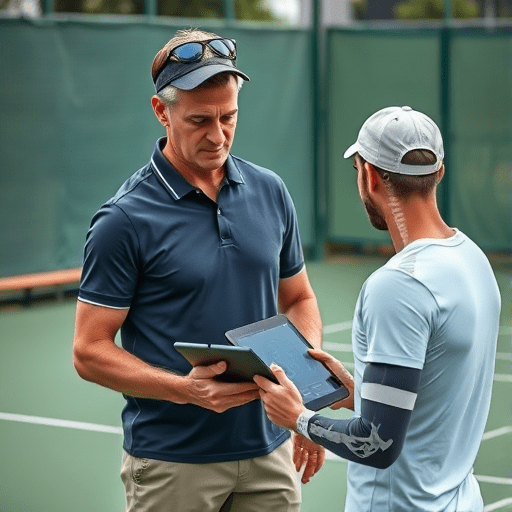
The ritual is familiar at every tennis academy: a coach films a player’s serve, walks to the fence, scrolls back through the footage, and points at a phone screen. That workflow is on its way out. In 2026, the shift toward AI biomechanics feedback on court means coaches no longer need to interrupt a session to review a clip. Instead, wearable inertial sensors and edge-based AI compute a player’s joint angles, racquet path, and kinetic chain efficiency in milliseconds—projecting corrections onto a tablet or, increasingly, a wearable haptic cuff. This is not a high-performance lab luxury anymore; it is a practical coaching tool for clubs, academies, and private lessons.
For the serve specifically—the most biomechanically complex stroke in the sport—real-time motion capture offers a level of insight that video review simply cannot match. Video provides a record of what happened. AI biomechanics explains why it happened, and it does so while the player is still on the court, ready to apply the correction.
The Limitations of Video Review for Serve Mechanics
Video analysis has served tennis well for decades. Coaches use it to identify toss inconsistencies, knee flexion issues, and racquet drop positions. But as a diagnostic tool for serve mechanics, it has structural limitations that become obvious at high repeatability levels.
- Temporal lag: By the time a coach reviews footage, the player has already repeated the same faulty pattern several more times. Every rep without feedback reinforces the error.
- Frame-rate blind spots: The serve’s critical positions—trophy position, racquet lag, ball impact—occur in less than a second. Standard video frames capture fragments, not the continuous motion path.
- Qualitative guesswork: A 30-degree difference in shoulder external rotation is visible on video, but subtle asymmetries between left and right sides are hard to quantify with the naked eye.
- Context loss: Video shows what the body looks like, but not the forces, torques, and joint accelerations producing that posture.
None of this means video is useless. It means video is retrospective. AI biomechanics feedback on court is prospective—it tells the coach what to fix before the next serve begins.
How On-Court AI Motion Capture Actually Works
Modern systems are a far cry from the optical marker arrays used in motion-capture studios. The current generation relies on lightweight inertial measurement units (IMUs) embedded in a compression sleeve, shorts, or a chest harness. These IMUs—combining accelerometers, gyroscopes, and magnetometers—sample movement at 400 Hz or higher, capturing vibrations and rotations that video cannot perceive.
On the court, the sensor data streams via Bluetooth to a smartphone or a dedicated edge device. An on-device neural network, trained on thousands of professional serve motions, reconstructs the full kinematic chain in real time. Because inference happens locally, latency stays under 50 milliseconds. There is no cloud round trip, no internet dependency, and no delay between the player’s motion and the coach’s feedback.
Some newer systems add a single wide-angle camera for depth context, but they use it only to align sensor data with court positioning—not for full skeletal tracking. This hybrid approach avoids the occlusion problems that plagued earlier camera-only systems, where a racket or arm could block the view of a joint during the critical moments before impact.
From Raw Data to Coaching Language
The most important breakthrough in 2026 is not the hardware. It is the interpretation layer. Raw joint angles mean little to a coach in the middle of a lesson. Modern systems translate sensor output into coaching cues: “toss drifting left by 8 cm,” “knee flexion decreasing by 12 percent,” “shoulder rotation stalling at the peak.” These messages appear on a tablet within seconds, often as a simple visual overlay on a stick-figure avatar.
Voice feedback is also gaining traction. A coach can set thresholds for key variables, and the system announces a correction through a small wireless earpiece: “Toss too far right. Toss too far right.” The player adjusts on the next attempt, without the session ever stopping.
Real-Time Corrections: Moving Beyond the Screen
One common objection to on-court AI is that it replaces the coach’s eye. The better framing is that it extends the coach’s perception. A skilled coach already spots a pronation problem from ten meters away; what the AI adds is precise, measurable confirmation of that observation, plus a handful of hidden variables the coach cannot see.
The real value, though, is in the feedback loop. With video review, the loop is: serve, walk to the fence, watch, discuss, return, serve again. That loop takes 90 seconds and dissipates the player’s focus. With AI biomechanics feedback on court, the loop is: serve, hear a cue, adjust, serve again. The entire cycle fits inside the natural rhythm of practice, keeping intensity high and honing the player’s kinesthetic awareness.
There is a psychological benefit too. Players are often defensive about video scrutiny; they feel judged by the footage. AI feedback, delivered through neutral voice or vibration cues, feels more like a practice tool and less like an evaluation. It shifts the conversation from “what did I do wrong” to “what should I adjust next.”
The Serve-Specific Metrics Coaches Should Watch
Not every biomechanical variable matters equally for the serve. The most useful systems allow coaches to select which metrics appear in real time. Based on current coaching science, these are the highest-value parameters for serve correction:
- Joint loading rate: The peak rate of loading on the shoulder cuff during the cocking phase. A sudden spike indicates a technique breakdown that can lead to injury.
- Pelvis rotation lead: The time delay between pelvis and thorax rotation. A lead of 50 to 80 milliseconds is typical for elite servers; losing that separation reduces power transfer.
- Toss-to-impact consistency: The AI tracks the toss position relative to the left foot and body axis, flagging deviations larger than five centimeters.
- Racquet head speed at release: Measured at the wrist just before impact, this metric correlates strongly with ball velocity and is a direct output of the kinetic chain.
- Forearm pronation angle: At contact, the forearm should internally rotate through a specific range. Systems can now measure this dynamically, not just infer it from what the player’s finish position looks like.
What a 2026 Practice Session Looks Like
Imagine a high school player preparing for a match on a fast hard court. The warm-up begins with a quick calibration: the player puts on a sensor sleeve and performs three shadow swings. The system maps the baseline serving motion and flags one anomaly: the pelvis starts rotating 90 milliseconds too early, causing upper body tension to leak out before contact.
The coach pulls up the tablet and points to the avatar’s midpoint. “Your hips are opening toward the court too soon,” the coach says. “The system says your shoulder separation drops to 30 degrees right at the moment you usually hit your biggest serves.” The player nods, not fully convinced. The coach sets an audio cue for pelvic rotation timing.
Over the next twenty minutes, the player hammers flat and slice serves. Each time the pelvis fires early, a quiet beep sounds in the earpiece. By the final set, the beep rate drops by 60 percent. The player’s first-serve percentage did not improve in one session—that is not how biomechanics works—but the movement pattern is now registered in the player’s nervous system, and the coach has a baseline to compare against next week.
The old workflow would have required three camera angles, a slow-motion review, and a paper checklist. The new workflow produced the same diagnosis in one sentence, then spent the rest of the session actively correcting it.
Practical Considerations for Coaches Adopting This Technology
Adoption is not just about buying a sensor kit. Coaches need to integrate the new data stream into their existing teaching philosophy. A few practical points matter:
- Start with one stroke. The serve is the logical choice because its closed, repeatable pattern suits sensor calibration. Once the workflow feels natural, extend it to second serves or forehand groundstrokes.
- Set thresholds before the session. Systems with configurable alerts become annoying if they fire constantly. Choose two or three metrics per player and mute the rest.
- Pair the AI with your observations. The system is a measurement tool, not a replacement for your eye. If the AI reports a pelvis timing issue but you see a toss path issue, trust your visual diagnosis for the first ten minutes.
- Use the post-session report for long-term tracking. Most systems generate a summary of progress over weeks and months. This is where video still has a role—as a supplementary record alongside the sensor data, reviewed by the coach after the session, not during it.
The Bottom Line
AI biomechanics feedback on court is not a futuristic promise; it is a standard practice tool that has matured over the past four years. Its greatest contribution to serve coaching may not be the accuracy of the measurement, but the compression of the correction loop. When a player can adjust a mechanical flaw on the very next attempt, the practice session becomes a laboratory for motor learning rather than a passive exercise in repetition. Coaches who embrace this shift are not abandoning their expertise; they are amplifying it with a real-time layer of insight that video review could never provide.