Over the last few seasons, AI avalanche forecasting has quietly moved from research labs into the operational workflow of real avalanche centers, giving backcountry skiers more granular data than ever before. But the question is no longer whether machine learning can produce a useful avalanche bulletin—it’s how skiers should interpret it, and why forecasters still say a layer of human judgment is irreplaceable. For anyone planning a tour beyond the ropes, understanding what AI can and cannot do is becoming a survival skill in itself.
How Machine Learning Is Reshaping Avalanche Bulletins
The most visible shift is happening behind the scenes. Regional avalanche centers across the Alps, North America, and Scandinavia are using machine learning to synthesize data from weather stations, snowpack sensors, satellite imagery, and historical avalanche observations. Instead of a single human forecaster staring at a handful of weather models, these centers now feed thousands of data points into statistical and deep-learning systems that output something like a raw probability map for avalanche danger.
What ends up in the bulletin is still a human-produced product, but the pipeline is now heavily augmented. In some operational frameworks, ML models rank the most important variables affecting instability on a given day—such as recent wind loading or snowpack settlement rates—letting forecasters focus their attention where it matters most. This hybrid approach has improved accuracy for broad regional forecasts, especially in the 24-to-48-hour window, and has made it easier to continuously update danger ratings when conditions change unexpectedly.
And the technology is only accelerating. Newer models incorporate data from distributed temperature sensors, avalanche activity reports submitted by recreationists, and even crowdsourced tour data from smartphone apps. Some experimental platforms are experimenting with transformer-based architectures, similar to those used in modern language models, to model the temporal sequence of snowpack evolution. The goal is not to replace forecasters but to give them a much sharper digital lens.
Why the Black-Box Problem Still Haunts AI Forecasting
However, there is a catch that every backcountry skier should understand: the most powerful machine learning models are often the least explainable. When a deep neural network predicts a “considerable” danger rating, it rarely tells you why—and if it doesn’t align with observed conditions, forecasters have to decide whether to trust the model or override it. That tension creates real risk. A bulletin based on a wrong model output, accepted blindly by a fatigued forecaster, can lead to systematic errors in danger ratings.
This is not a theoretical concern. In the past few years, studies of ML-based avalanche forecasting in Switzerland and Norway have shown that while models often outperform simple statistical baselines, they struggle with extreme events and unusual snowpack structures. An avalanche year in which the snowpack evolves in a way the training data never encountered can produce confident but wildly incorrect predictions. Ironically, the latest AI models can be even more dangerous than simpler ones because their outputs look authoritative.
For forecasters, the solution is to treat AI outputs as a recommendation, not a verdict. Many centers are now adopting “human-in-the-loop” protocols, where machine-generated danger maps are flagged as anomalous when they disagree with field observations or human reasoning. This is the new reality of operational forecasting: a constant negotiation between statistical confidence and experiential wisdom.
More Data, More Uncertainty: The Skiers’ Perspective
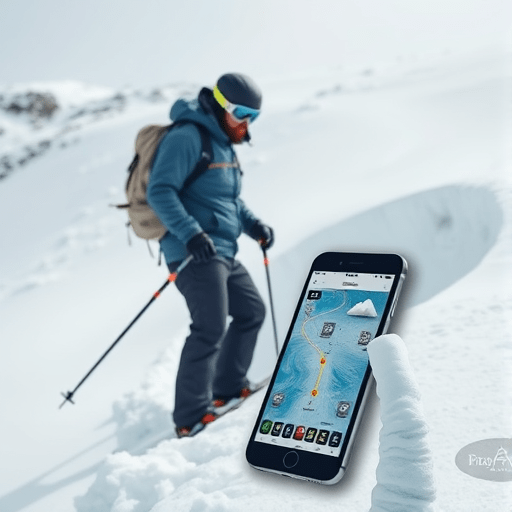
If you are reading an avalanche bulletin from your phone in the trailhead parking lot, you might not notice any of this. The danger rating still appears as a color: green, yellow, orange, red. But behind those colors, the uncertainty is growing. Many centers now publish the full probability distribution—meaning they show not just the most likely danger level but also the chance of a more severe, less likely scenario. This is a deliberate shift toward uncertainty communication, and it can be unsettling for skiers who just want a clear answer.
What does this mean for your touring decision? It means you should treat the bulletin as a starting point, not a final answer. An AI-enhanced forecast might correctly tell you that the avalanche danger is “moderate” in your zone—but it cannot tell you whether the slope you plan to ski is the one in ten that fails catastrophically. The resolution of even the most advanced models remains too coarse to account for local wind loading, micro-terrain features, or the precise depth of a persistent weak layer in a specific couloir.
This is the paradox of the current era: the data you receive is richer than ever, yet the fundamental uncertainty of snowpack stability is unchanged. A machine can tell you the odds, but it can never tell you with certainty what will happen when you drop into a north-facing bowl at 11 a.m. on a warm spring day.
Why Manual Skills Still Matter (More Than Ever)
If AI can crunch millions of data points and still miss the critical slope, what is the skier supposed to do? The answer, echoed by avalanche educators and seasoned guides, is that manual skills—trip planning, terrain assessment, snowpack observation, and rescue practice—are no longer just complementary to the bulletin. They are the essential layer of safety that fills the gap between statistical prediction and on-the-ground reality.
Consider what a machine cannot see: the subtle change in snow surface texture as you approach an exposed ridgeline, the hollow “whumpf” of a collapsing slab under your skis, the crack that shoots out from your edges on a test slope. These are physical signals that no sensor network has yet learned to interpret reliably. And while AI models are getting better at processing weather data, they still struggle to ingest the kind of qualitative information that a trained observer gathers in a few minutes of field assessment—the depth of a hand pit, the resistance of a snowpack layer, the way the snow responds to a ski cut.
Most experts agree that the “2026 backcountry skier” needs a hybrid skill set: the ability to consume and critique data-driven forecasts, combined with the hands-on ability to evaluate snow stability in real time. If you rely solely on the bulletin, you lose the ability to adapt when local conditions deviate—and they often do. The most competent forecasters are the first to admit that they would never make a decision about a single slope based purely on a regional bulletin, AI or not.
The Future: Collaborative AI, Not Autonomous Forecasting
Looking ahead, the next evolution of AI avalanche forecasting is not a fully autonomous system issuing danger ratings without human supervision. The more realistic future, already visible in experimental programs in Canada and the European Alps, is a collaborative assistant that integrates data from every possible source and then surfaces the most relevant information to a human forecaster in real time. Imagine a view of your tour area showing a constantly updated danger map that blends current weather, recent avalanche reports, and snowpack model output—highlighted with uncertainty bands and a clear list of confidence metrics. That future is probably only two or three seasons away for the better-funded forecasting centers.
But here is the crucial nuance: as the availability of data increases, the value of human judgment actually grows rather than shrinks. The more information you have, the less obvious the signal becomes. A well-designed machine learning tool will not make a skier safer if the skier is not trained to understand its limitations. This is why the most forward-thinking avalanche education programs are moving away from simply reading danger ratings and toward teaching students to use multiple sources of information—including AI-enhanced bulletins—as part of a layered decision-making framework.
A New Equilibrium Between Machines and Mountains
So is AI avalanche forecasting ready for backcountry skiers? The honest answer is that it is ready to be used, but only as a powerful supplement to manual skills, not a replacement. The algorithms are improving fast, and the best bulletins in 2026 are already benefiting from machine learning in ways that are invisible to the public. But snow stability is a phenomenon that resists easy quantification. The snowpack does not care how big your model is.
For the backcountry skier, the most important takeaway is this: master the bulletin, but never delegate your judgment. Let the AI show you the probabilities, look for the uncertainties, and then go into the field prepared to test the snow yourself. That combination—data literacy, field observation, humility, and training—is the only forecast that matters when you are standing at the top of a slope.