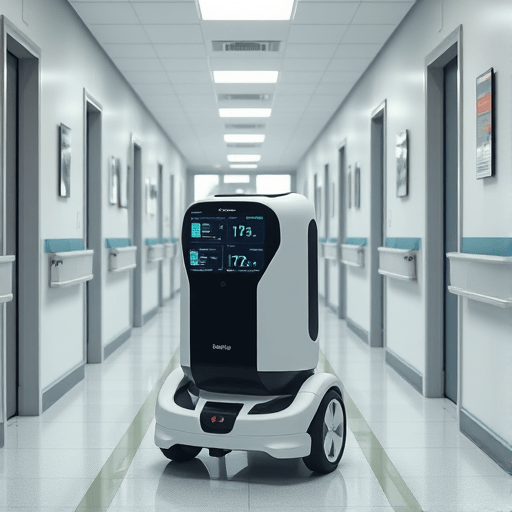
Hospital delivery robots are no longer experimental, but choosing the right open-source middleware for hospital delivery robots remains a stubborn integration hurdle for IT managers. In 2026, the dominant candidates are ROS 2, the de facto standard for robot control, and FIWARE, the European framework for context-aware smart environments. Neither is a drop-in solution, and picking wrongly can mean months of glue code, unplanned security reviews, and frustrated robotics teams. This comparison focuses specifically on integration challenges—not just feature lists—so you can align middleware capabilities with your hospital’s architectural reality.
The Integration Hurdle: Why Middleware Cannot Be an Afterthought
Hospital delivery robots must navigate contested hallways, integrate with elevators and automatic doors, and report status to command centers. But the harder problem is data interoperability. Your robots will need to talk to an Electronic Health Record (EHR) for patient-specific deliveries, a nurse call system for notification, and a security stack for access control. ROS 2 and FIWARE approach this from opposite directions: ROS 2 is a robot-centric middleware built around message passing and node graphs, while FIWARE is an open-source platform for orchestrating context information across the entire facility. IT managers often misunderstand that one is not a substitute for the other, yet each can serve as the backbone depending on where the integration burden actually lies.
ROS 2: The Robot Operating Brain
ROS 2 (Robot Operating System 2) is the evolution of ROS, with real-time support, security via DDS (Data Distribution Service), and a modular graph of nodes that communicate over topics, services, and actions. For a delivery robot, ROS 2 handles the difficult low-level concerns: lidar processing, path planning, obstacle avoidance, and motor control. It is the middleware that robot software engineers are most comfortable with, and it has an expanding ecosystem of simulation tools like Gazebo and Nav2.
Strengths for Hospital Delivery
- Sensor-to-actuator latency: DDS allows quality-of-service policies that can prioritize safety-critical navigation messages, reducing jitter compared to traditional HTTP-based integrations.
- Local autonomy: The robot can continue to operate even if the Wi-Fi degrades, because ROS 2 nodes are designed for local peer-to-peer communication.
- Skilled ecosystem: Many robotics vendors and hospital integration partners already employ ROS 2 savvy engineers, so the learning curve is contained within the robotics team.
Limitations IT Managers Must Know
For IT governance, ROS 2 is not a comfortable fit. DDS introduces a large network boundary that often requires opening multicast ports, enabling dynamic discovery across subnets, and maintaining per-robot security certificates. In a hospital, this triggers firewall reviews and can expose flaws in your network segmentation. Additionally, ROS 2 does not inherently know what a patient is, what a bed is, or how to read an HL7 message. Its data model is about transforms, maps, and sensor data—not business or clinical objects. That means you will build an integration layer to convert robot events into FHIR resources or webhook payloads for other departments.
FIWARE: The Context Broker for the Facility
FIWARE is an open-source standard for context information management, built around the Orion Context Broker and the NGSI-LD API. It is designed to collect, update, and share information in a smart city or smart building. In a hospital environment, FIWARE can be the digital backbone that aggregates robot locations, room availabilities, elevator states, and even patient transport requests. It excels at dealing with heterogeneous data sources and exposing them through a standardized query interface.
Strengths for Hospital Integration
- Semantic clarity: FIWARE’s NGSI-LD lets you model entities like “DeliveryTask”, “Medicine”, or “Elevator” with attributes and relationships. This is a natural fit for integration with FHIR-based EHRs and asset management systems.
- RESTful and familiar: IT departments already have experience exposing and consuming REST APIs. FIWARE’s context broker fits into existing API gateways, API management platforms, and monitoring tools without requiring a new protocol family.
- Historical and real-time views: Combined with QuantumLeap or STH-Comet, you get a ready-made time-series database, useful for auditing delivery routes and usage analytics.
Limitations in Robotic Control
FIWARE does not control motors. It has no concept of laser scans, path planning, or emergency stops. You can send a command to move to a location, but the actual safe navigation must be handled elsewhere. Also, FIWARE’s context broker can become a bottleneck if your robots send high-frequency telemetry at 30 Hz; it is designed for asynchronous state changes, not real-time control loops. In addition, most FIWARE tutorials assume a cloud or server deployment, so local edge deployment on the robot itself is rare. You would likely run FIWARE on a central hospital server, which introduces a hard dependency on network connectivity.
A Head-to-Head for Hospital Deployments
The choice between ROS 2 and FIWARE becomes clearer when you examine the operational demands of the hospital. IT managers need to weigh these factors:
- Primary integration surface: If your primary challenge is making a robot drive reliably, choose ROS 2. If the challenge is connecting fleet status and delivery requests to hospital ERP and EHR systems, choose FIWARE.
- Network resilience: ROS 2 is designed for distributed compute with DDS discovery, but it can cause multicast storms in large VLANs. FIWARE uses simple HTTPS, which is easier to secure but less resilient when Wi-Fi drops.
- Security model: ROS 2 supports DDS security, but practical implementation varies by vendor and often requires additional configuration. FIWARE integrates well with existing OAuth2 and OpenID Connect infrastructure, a huge advantage for hospital IT compliance.
- Data governance: Hospital robot data may contain location and timing information that should be treated as protected health information. FIWARE’s explicit entity models make it easier to implement retention policies and data anonymization rules.
- Team skill sets: Your internal robotics group likely knows ROS 2. Your enterprise integration team likely knows REST APIs, JSON, and FHIR. FIWARE aligns with the latter, while ROS 2 aligns with the former.
The Hybrid Approach: When Best of Both Worlds Makes Sense
Most successful hospital delivery robot projects in 2026 will not choose between ROS 2 and FIWARE as if they were mutually exclusive. A rational architecture uses ROS 2 inside the robot for real-time autonomy, then bridges curated status messages to a FIWARE context broker at the facility level. Your robots would subscribe to a FIWARE-based task queue, publish completion events, and expose their current position as NGSI-LD entities. The hospital’s existing dashboard, nurse call system, and analytics platform then receive contextual updates without needing to understand DDS or distributed robot protocols. This reduces the integration burden by placing the security boundary at a well-defined REST endpoint.
That said, a hybrid approach requires building a translation layer. Several open-source projects can help, but you must still decide which robot state is worth publishing, how often to publish it, and which events should trigger FHIR updates. Start with a small set of entities: DeliveryTask, Robot, ElevatorCall, and LocationUpdate. Design these with your FHIR integration team, not just the robotics engineers, because this is where the hospital integration hurdles actually live. The middleware decision then becomes less about one technology dominating and more about defining a clean interface between the robot’s brain and the hospital’s nervous system.
Conclusion
For hospitals deploying delivery robots, the middleware decision hinges on where the integration pain is greatest. ROS 2 gives you precise, reliable robot control but demands careful network engineering and a custom data model for clinical integration. FIWARE provides a standards-based context backbone that aligns with enterprise IT and clinical systems but cannot navigate a corridor. A hybrid architecture, with ROS 2 on the inside and FIWARE at the edge, often solves the integration hurdle more cleanly than a single-platform bet. The best choice is the one that lets your patients, nurses, and security team experience the robot as a quiet, useful part of the hospital—not as a middleware experiment.