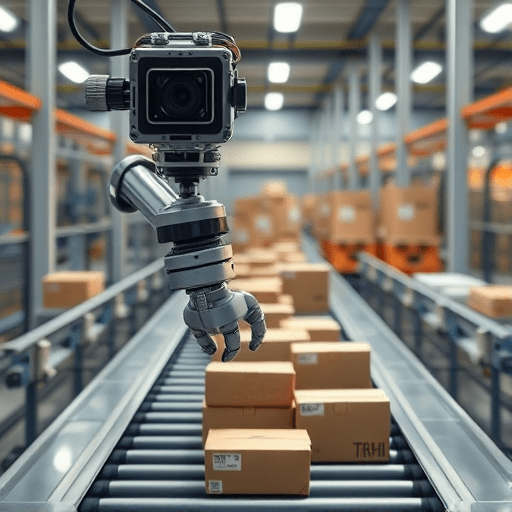
Retrofit legacy conveyors with vision-guided robots: a how-to that doesn’t start with ripping out steel. It starts with adding a 3D depth camera above the belt and an open-source PLC brain that can talk to the machine you already own. Conveyors are often the longest-lived equipment in a plant, but they are also the most likely to be treated as dumb, fixed-speed furniture. By attaching vision-guided robots to that furniture, you can introduce flexible picking, placing, and diverting without the months of downtime required by a full conveyor replacement. In fact, a carefully scoped retrofit can deliver many of the same benefits as a new line for a fraction of the capital cost.
Why Retrofit Instead of Replace?
Legacy conveyor systems usually have strong structural steel, proven drives, and gearboxes that can run for decades. The expensive part of an automated line is rarely the belt or the rollers; it is the surrounding system: the layout, the safety zones, the upstream and downstream interfaces, and the control logic. Replacing a conveyor means redesigning all of those connections. Retrofitting means preserving the physical asset and upgrading the information layer around it.
A vision-guided robot retrofit is especially attractive for lines that handle mixed product sizes. In the past, adding a robot to a conveyor meant installing precision nests, gates, or stopper arms to present each part in the same place. Depth cameras eliminate that need. The camera sees where each box or part actually is and tells the robot to pick it from that location. This makes the conveyor, not the robot, the flexible partner in the system.
The Core Retrofit Stack: Depth Camera, Robot, Open-Source PLC
The math for a retrofit changes dramatically once you consider open-source PLCs. Traditional PLCs are reliable, but they often require proprietary software, expensive communication modules, and long delivery lead times. Open-source PLC runtimes, such as OpenPLC, can run on compact industrial PCs and talk natively with common industrial protocols like Modbus TCP, EtherNet/IP, and MQTT. That makes them a practical bridge between a depth camera, a robot controller, and an old conveyor with no modern network interface.
A typical retrofit stack looks like this:
- A depth camera mounted above a defined pick zone on the conveyor.
- A robot arm positioned next to the conveyor with enough reach to cover the pick zone and a drop zone.
- An open-source PLC runtime handling the sequencing: when a part is visible, when the robot should move, and when the conveyor should continue.
- A simple HMI or message dashboard for operators to monitor vision exceptions and recover from missed picks.
This approach avoids the two biggest cost drivers in traditional automation: custom part-presentation hardware and expensive proprietary vision packages.
Step 1: Audit the Existing Conveyor Control System
Before buying any hardware, document what the conveyor actually does. Locate the existing PLC or relay logic, the motor starter panels, photoeyes, and safety interlocks. Note which motors run continuously and which are started only when a product is present. Identify the signals that a new controller can safely share. In many older lines, there is a handshake signal hidden in a relay: for example, a photoelectric sensor that tells the conveyor to stop when a package reaches a certain point. That signal is gold for the retrofit because it defines the pick zone boundary.
If the original electrical drawings are incomplete, create your own “as-is” diagram. This is the most important step in the whole process. A vision-guided robot can compensate for many mechanical problems, but it cannot compensate for not knowing where the safety relays are located or how the existing drive is controlled.
Step 2: Choose a Depth Camera for the Real World
The depth camera is the perception layer of the retrofit. Not all depth cameras are created equal, and the choice affects both cost and reliability. Structured light cameras are affordable and work well on smooth surfaces, but they can struggle in direct sunlight or with materials that absorb infrared. Time-of-flight cameras perform better in darker environments and can see a wider range of surface types. Stereo depth cameras are often the best balance for conveyor applications because they work well indoors and generate dense point clouds at close range.
Mount the camera so that its field of view covers the entire pick zone without seeing the robot itself. A common mounting position is directly above the conveyor, slightly upstream of the robot’s maximum reach. This gives the robot motion planning time to close the gripper before the product leaves the pick zone. Consider lighting carefully: bright sunlight from a loading door can ruin depth data, so a simple shield or a camera model with high ambient-light tolerance is worthwhile.
Step 3: Build a Vision-to-PLC Bridge with Open-Source Tools
The depth camera produces point clouds, but the robot needs more than a raw image. The system must convert the point cloud into a position, an angle, and a timestamp. Open-source computer vision libraries, including OpenCV and the Intel RealSense SDK, are ideal for this step. You can run them on the same industrial PC that hosts the open-source PLC, or on a separate computer that sends results over MQTT.
MQTT is a lightweight messaging protocol that works well in brownfield environments. The vision software publishes messages with the coordinates of each detected object, and the open-source PLC subscribes to those messages. The PLC then checks whether the robot and conveyor are in the correct state before triggering a pick. This clear separation between vision, control, and motion makes the system much easier to test and debug. It also means that if the camera fails, the conveyor can continue running in a safe manual mode instead of stopping the entire line.
Step 4: Perform Robot-to-Camera Calibration
A vision-guided robot is only as accurate as its calibration. The depth camera sees the world in its own coordinate system, but the robot moves in a different one. Hand-eye calibration is the process of calculating the mathematical transform between the two systems. This is normally done by moving the robot through several known positions while observing a calibration marker with the camera. The result is a transformation matrix that allows the robot to reach the exact coordinates the camera reports.
For conveyor retrofits, the calibration should account for the conveyor’s movement. If the belt is moving while the robot is picking, the PLC must add an offset based on the conveyor speed and the time between the camera image and the robot pick. The open-source PLC is ideal for this calculation because it can combine the vision timestamp, the conveyor encoder pulse count, and the robot’s readiness signal in one control loop. Start with a static pick test, then move to a slow conveyor, and finally increase the speed as the calibration proves itself.
Step 5: Test with a Low-Risk Pilot Sequence
Do not attempt a full production rollout on day one. Use the open-source PLC to create a quiet mode: the camera detects a product, the PLC records the detection, and the robot starts in a safe “air pick” position without touching the product. This lets you validate the vision trigger, the conveyor encoder offset, and the PLC sequencing without any risk of a crash.
Once the logic is clean, run a pilot with a single product type. Use a clear path for the robot and keep the speed modest. Watch how the system handles edge cases: a box that is slightly tilted, a package that is torn, or a product that passes through the pick zone while the robot is still busy. The open-source PLC allows you to define exception handling easily, such as sending the missed item down the line to a rework area instead of creating a jam. This kind of graceful degradation is what separates a modern retrofit from an old-school hard-wired installation.
End-of-arm tooling matters in the pilot, too. A suction gripper works well for cartons, while a two-finger gripper is better for irregular parts. The vision system should send not only the pick position but also the required gripper angle and height.
Safety Is Still a PLC Responsibility
Even with an open-source PLC, safety must remain a hard-wired, certified chain. Do not rely on a vision system to keep people safe. Add a light curtain, laser scanner, or safety PLC that stops the robot whenever anyone enters its working envelope. The open-source PLC can handle the operational sequencing, but the safety-rated circuit should bypass it. This is not a limitation; it is best practice. In a retrofit, the safety system will likely be new, and that is actually an advantage because it gives your old conveyor a modern safety layer for well under the cost of a replacement line.
The Retrofit Pays for Itself
The most persuasive business case for retrofitting legacy conveyors is not the cost of the hardware; it is the reduced risk. There is no multi-week conveyor teardown, no re-engineering of the entire line footprint, and no retraining of maintenance staff to understand a completely new system. Many of the components, like industrial PCs and depth cameras, are inexpensive and replaceable. The open-source PLC means the control logic is not locked inside a proprietary environment. Your engineers can view, modify, and improve the code over time without waiting for a vendor to quote a change order.
Even for a single robot cell, the return on investment is clear. The robot can perform picking, packing, inspection, or palletizing at the edge of the existing conveyor. If the product mix changes next year, the same camera and PLC can be reprogrammed for a different task. That flexibility is the real prize of the retrofit.
Conclusion
Retrofitting legacy conveyors with vision-guided robots is no longer an experimental research project. A depth camera, an open-source PLC, and a modest robot arm can turn an old conveyor into a smart, adaptive system that handles mixed products without costly replacement. The key is to respect what the existing line already does well, add a clean layer of perception and control, and let the open-source PLC make the old iron understandable to new software. That approach will extend the life of the conveyor and prepare it for the next era of factory automation.