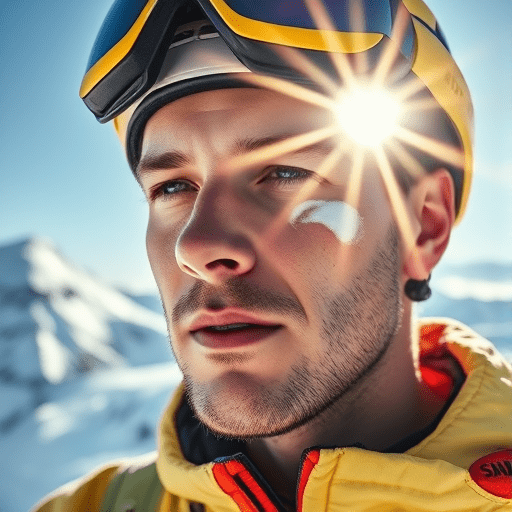
If you’ve ever asked why SPF 50 fails you above 8,000 ft, you’re not imagining things. A sunny 25°F day on a snowfield can sunburn your skin faster than a hot beach in July. The reason is simple: altitude increases UV dramatically, snow reflects it back up at you, and a normal reapplying routine is not designed for that much radiation. This isn’t a case for buying any higher SPF blindly—it’s a case for changing how you think about alpine sun exposure.
At 8,000 ft, “normal” sunscreen behavior breaks down. The UV index can be 80 percent higher than at sea level before you account for snow. Add fresh powder reflecting around 80 percent of UV, and the actual UV load on your face, neck, and eyes is enormous. That’s why the high-altitude sun protection baseline is now SPF 70, reapplied every 2 hours.
The Altitude UV Jump: 10 Percent More per 1,000 Feet
The most important number in high-altitude sunburn is not SPF; it’s the UV jump. For every 1,000 feet you climb, ultraviolet intensity rises by roughly 10 percent. At 8,000 feet, that’s about 80 percent more UV than the same location at sea level. A UV Index of 6, which might be “moderate” on a beach, becomes a 10.8 at 8,000 ft—a “very high” or even “extreme” reading.
Why does altitude do this? The atmosphere gets thinner as you go up, so there’s less ozone and less air to absorb UV before it reaches your skin. This is true even in bright winter conditions. Cold air does not filter UV. In fact, cooler conditions often encourage people to stay outside longer because the heat doesn’t warn you of sun damage.
Snow Reflects 80 Percent of UV: Double Exposure
The second factor that separates high-altitude from low-altitude sunburn is snow. Fresh snow is one of the best natural reflectors of UV radiation. It can reflect up to 80 percent of the UV that hits it. On a ski slope, you’re getting direct UV from above and reflected UV from below. That can more than double the effective dose to your skin.
This explains why the underside of your chin, the rims of your ears, and even the interiors of your nostrils can sunburn during a day of skiing or snowshoeing. It also means that sitting in “shade” isn’t enough if that shade is a few feet away from a bright snowfield. Reflected UV reaches you from every direction.
Cloud cover helps less than you’d expect. Thin, high-altitude clouds still allow 80 to 90 percent of UV to pass, and scattered clouds can actually increase UV by reflecting radiation from the sides. If you’re above 8,000 ft, you need sun protection even on overcast mornings.
Why SPF 50 Is Not Enough Above 8,000 ft
Let’s look at the SPF numbers. SPF 50 allows about 1/50th of UVB to reach your skin—roughly 2 percent. SPF 70 allows about 1/70th—roughly 1.4 percent. At sea level, that difference often doesn’t matter. But above 8,000 ft, the total UV dose is much larger, so even a small percentage of a large number is enough to burn.
If the direct UV is 80 percent stronger and snow reflection adds another 80 percent on top of that, the effective exposure can be several times what you’d get at sea level. The 2 percent that SPF 50 leaves behind stops being harmless when the UV load triples. The bigger issue is human application. Most people apply less than half of the recommended sunscreen amount. If you use half the dose, an SPF 50 product performs more like an SPF 7, and an SPF 70 product gives you a little more room to make a mistake.
SPF 50 also has a weakness in high-altitude settings: photostability. Sunscreens get used up as they absorb UV. Sweat, and the physical friction of goggles, masks, and pack straps, break the film faster. A product that works for two hours at sea level may protect for far less time on a ski slope. That’s why the 2-hour rule exists.
The SPF 70 Every 2 Hours Protocol
If you’re heading above 8,000 ft, make SPF 70 broad-spectrum your default. Spray formulas are convenient but beware—they are easy to under-apply. A set-it-and-forget-it approach only works if you really do reapply every 2 hours. Set a timer on your watch or phone before you start skiing, and treat that alarm as non-negotiable.
Here is the practical protocol:
- Apply a generous layer of SPF 70 sunscreen 20 to 30 minutes before you go outside. Use about one full squeezed-out shot glass-worth for your whole body.
- Reapply every 2 hours on the trail, not after you return to the lodge. Sun exposure is cumulative, and waiting until lunch gives the first application too much time to wear off.
- Reapply immediately after heavy sweating, toweling off, or swapping any gear that rubs your face or neck.
- Use a separate SPF lip balm with at least SPF 30 or 50. Lips have thin skin and no melanin protection; they burn fast at altitude.
- Don’t forget the spots below the brim: ears, back of neck, scalp part, and under the chin. Reflected UV from snow hits these areas from below.
Some people worry that higher SPF means more chemical load. In practice, the difference between SPF 50 and SPF 70 is not a doubling of active ingredients. The formula can use better stabilizers and UV filters. What matters most is broad-spectrum protection with enough UVA coverage, since altitude increases UVA and UVB together.
Beyond SPF: What High-Altitude Sunscreen Should Do in 2026
For the coming seasons, sunscreen options above 8,000 ft are improving. Look for formulas labeled “broad-spectrum” and “water/sweat resistant for 80 minutes” as a starting point. But don’t stop there. A good high-altitude sunscreen should also be photostable, meaning the UV filters don’t degrade quickly in sunlight. Older avobenzone-only formulas may need more frequent reapplication. Newer filters and encapsulated technologies keep the protection persistent during long alpine days.
Another 2026 upgrade is the return to mineral options. Zinc oxide and titanium dioxide sit on the skin, reflect UV, and are less likely to irritate sensitive skin or sting when you sweat. The downside is cosmetic—mineral formulas can leave a white cast—but new micronized versions have improved. If you’re skiing in cold, windy conditions, a mineral stick or balm is easy to reapply without getting liquid sunscreen in your eyes.
Finally, check the sunscreen’s UVA rating. In the U.S., “broad-spectrum” is the label signal, but other countries may show a PA rating or PPD number. Since snow reflects both UVA and UVB, a high PA rating matters for preventing long-term skin damage, not just sunburn.
Make Altitude Sunburn Non-Negotiable
Altitude sunburn can happen quickly and without warning. The “burn” may not show until six to twelve hours later, by which time the damage is done. The combination of thin atmosphere, snow reflection, and cold, deceptive weather means your skin needs more than a casual morning sunscreen.
For anyone spending time above 8,000 ft, the formula is straightforward: use SPF 70, reapply every 2 hours, and protect every exposed surface. It’s not about being fussy—it’s about respecting the mountain sun. If you treat the 2-hour alarm as part of your high-altitude gear, you can come down from the mountain without a peeling face.