AI-personalized reminders are no longer a theoretical upgrade to patient apps; they are becoming the core mechanism for achieving lasting patient app adherence. Unlike traditional notification systems that fire at fixed times, predictive algorithms now study each patient’s behavior, anticipate moments of friction, and adapt notifications to real-world habits. The result is a reminder that feels less like a nagging push and more like a subtle, timing-aware nudge from someone who genuinely understands the patient’s daily rhythm.
For years, the standard approach was simple: remind patients to take a medication, log a symptom, or attend a check-in at the same time every day. That approach worked for a small slice of patients, but it failed to account for the messy, irregular texture of real life. People sleep late on weekends, eat at different times, travel across time zones, and shift their routines during stressful weeks. Static reminders are blind to all of that. The next frontier is about building reminders that observe, learn, and adjust — not just send a push notification when the calendar says so.
Why Static Reminder Schedules Fall Short
Patient app adherence tends to decline sharply after the first two weeks. The initial excitement of a new health goal fades, and the daily notification becomes white noise. Static reminders are particularly vulnerable to a phenomenon called reminder fatigue: when an alert fires at a moment that has no connection to the patient’s current activity, it gets swiped away with nothing more than a flick of the thumb. Worse, a reminder that arrives at the wrong time can actively breed resentment toward the app itself.
Context matters just as much as timing. A reminder to take an insulin dose may be clinically correct at 6:30 PM, but it will be ignored if the patient is driving, sitting in a meeting, or pushing a stroller through a crowded grocery store. Predictive algorithms solve this by learning what “the right time” means for each person — not from a static schedule, but from patterns in their behavior, location, and device usage.
How Predictive Algorithms Adapt to Patient Habits
Predictive algorithms do not simply randomize notification times. They build a personalized model of the patient’s daily life by combining data from several sources: app openings, sensor readings, wearable activity, and self-reported inputs. The goal is to answer a deceptively simple question: what is the probability that this patient will complete the desired action right now, in this context?
Mining Behavioral Patterns Without Clinician Effort
Modern smartphones and wearables generate a rich stream of contextual clues. Step counts, location data, heart rate variability, and even typical phone-unlock patterns help the algorithm learn when a patient is likely to be available and responsive. For example, if a patient consistently logs their blood pressure readings while waiting for a morning coffee, the algorithm will place a gentle reminder in that same temporal sweet spot. It does not need a clinician to manually annotate habits; it learns them from data over the course of a few days.
Probabilistic Models of Medication and Symptom Behavior
Beyond simple time-of-day prediction, advanced systems use probabilistic modeling to understand how a patient’s behavior fluctuates across days, weeks, and life events. Missed doses on weekends, late symptom logs after a poor night’s sleep, and patterns around physical activity are all incorporated into a probability score. When a reminder is sent, the app can decide whether to send a simple notification, a more direct alarm, or a message that offers extra support. In this model, an adherence reminder becomes a dynamic intervention rather than a fixed broadcast.
Context-Aware Notification Triggers
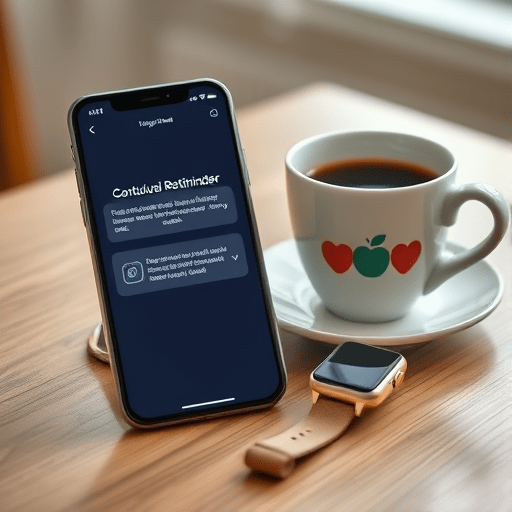
The most exciting developments involve context-aware triggers that combine location, activity, and social signals. If the app knows the patient has just arrived home after a long commute, it may delay a reminder for a medication that would otherwise have been forgotten during the drive. If a wearable detects that the patient is inactive and likely resting, the reminder can be delivered in a format that does not feel invasive, such as a gentle smartwatch tap or a lock-screen message.
This level of adaptation is not science fiction. Several patient engagement platforms already use on-device machine learning to decide the best delivery moment for each user. The shift is significant: reminders are no longer based on intention; they are based on evidence about how the patient actually behaves.
Designing for the Habit Loop, Not Just the Task
One reason AI-personalized reminders outperform static ones is that they align with the habit loop: cue, routine, reward. A static reminder supplies a weak cue because it is unrelated to any existing behavior. A predictive algorithm, by contrast, attaches the cue to a routine the patient already performs. Taking a medication after brushing teeth, logging a meal after using a fitness app, or measuring blood glucose after a morning shower are all examples of habit stacking. AI helps discover those natural stacks automatically.
Habit-based reminders also reinforce the reward side of the loop. When a patient completes an action at a moment that feels natural, the sense of accomplishment is stronger, and the digital reward—such as a progress graph or a simple streak—becomes more meaningful. Over time, the app can fade out explicit reminders entirely because the behavior has been absorbed into a stable morning routine.
Beyond Pill-Taking: What Adherence Looks Like in Practice
AI-personalized reminders are not limited to medication timing. Modern patient apps use the same predictive techniques to improve a broader range of adherence behaviors:
- Digital check-ins: reminding patients to complete daily symptom surveys at moments when they are likely to have a few free minutes.
- Physical therapy exercises: detecting patterns of movement and rest to suggest the best times for rehabilitation practice.
- Clinician appointment attendance: predicting the likelihood of no-shows and sending behavioral support messages with directions, parking tips, or rescheduling options.
- Blood glucose and blood pressure monitoring: adapting measurement reminders to mealtimes, stress levels, and physical activity in order to improve continuous data collection.
When patients receive reminders that respect their habits, they not only complete more actions; they also develop greater trust in the app. This trust is essential for long-term engagement, because patients are more likely to share honest health information with an app that demonstrates an understanding of their daily lives.
The Privacy and Equity Tightrope
AI-personalized reminders depend on sensitive data. Location, activity, and social cues can reveal far more than a patient may realize. It is therefore critical to design these systems with data minimization and transparency at their core. Patients should be told explicitly what data is being collected, why it is being used, and how long it will be stored. On-device processing and federated learning offer a promising path, allowing the predictive model to improve locally without uploading a massive behavioral signature to a central server.
Equity is another concern. If predictive algorithms are trained primarily on data from high-income, tech-savvy patients, they may perform poorly for older adults, low-income users, or people with irregular daily schedules. The next generation of reminder systems must be built on diverse training data and be flexible enough to handle unpredictable days. A model that assumes “normal” working hours will fail the shift worker, the new parent, and the caregiver. The best AI-personalized reminders are those that gracefully adapt even when no stable pattern exists.
What the Next Generation of Patient Apps Will Do Differently
The next phase of this evolution is heading toward fully closed-loop systems. Instead of simply predicting when to send a reminder, the app will adapt the entire patient experience around adherence patterns. Missed actions will trigger supportive outreach through a preferred channel—phone call, text, or in-app message—based on what the patient has responded to in the past. Clinical teams will receive aggregated insights about when patients lag, enabling proactive interventions before a small slip becomes a complete discontinuation.
Natural language models are also entering the picture. Future reminders may not be fixed text at all. They will be generated dynamically to match the patient’s language tone, current emotional state, and previous responses. A patient who responds well to direct, succinct prompts will get a different message than someone who prefers a warmer, more encouraging tone. This kind of personalization becomes possible because predictive algorithms are learning not just when patients act, but how they express motivation, frustration, and hesitation.
Conclusion
AI-personalized reminders represent a genuine shift in how patient apps approach adherence. By replacing static notifications with algorithms that observe, infer, and adapt, digital health tools can finally meet patients where they are — in their routines, their contexts, and their real lives. The result is not simply better medication compliance; it is a more respectful, human-centered model of digital care, where technology supports healthy habits without demanding that patients rearrange their lives around an app.