In 2026, the old live-service playbook of battle passes and seasonal sales is showing its seams. Players are tired of paying for content that only reinforces their own progress while the wider world stays static. Enter the crowdfunded event: a mechanic that asks players to pay to unlock shared player rewards, not just for themselves, but for an entire server, faction, or even the whole game world. Done well, these events transform individual spending into a public good. Done poorly, they feel like a charity shakedown. This article explores why crowdfunded events are becoming the most promising social monetization model in modern games—and how designers can avoid turning their community into an ATM.
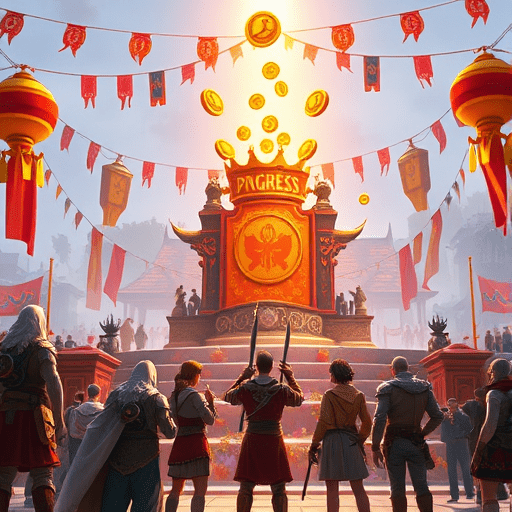
At its core, the crowdfunded event is a promise: if enough players contribute, something remarkable happens that everyone gets to enjoy. A new world boss awakens. A city is rebuilt. A racewide buff is unlocked. The reward isn’t just a mount or a skin in a personal inventory; it’s a transformation of the shared game world. That shift from private gain to collective consequence is exactly why this model is gaining traction in games that pride themselves on community-driven narratives.
Why Shared Crowdfunding Feels Different from Monetization
It would be easy to dismiss crowdfunded events as a repackaged donation drive, but the psychological difference is profound. Traditional monetization asks players to buy something for themselves. Even a cosmetic purchase that supports the developers still feels like a personal transaction. Crowdfunded events invert that dynamic: the purchase is a contribution toward a communal goal, and the reward is shared by everyone on the server, including those who didn’t pay a cent.
This inversion creates a socially positive feedback loop. Contributors feel like benefactors, not customers. Non-contributors feel grateful rather than envious. And the game world itself becomes the canvas on which that generosity is displayed. The result is a rare subset of monetization that can actually increase community cohesion rather than divide it into whales and free-to-players.
But that magic is not automatic. The design must make the communal benefit visible and meaningful. If the shared reward is just a buff that lasts five minutes or a few decorative banners on a loading screen, players will quickly realize they’re funding a gimmick. The rewards need to be structural, persistent, and woven into the game’s fiction.
The Psychology of Collective Success: More Than a Progress Bar
Humans are wired to overvalue rewards we achieve together. A study of cooperative play suggests that shared effort amplifies emotional highs because it activates a sense of belonging and mutual recognition. In video games, this manifests as the famous “servers with a story” moments: when a community comes together to overcome a challenge, the memory sticks. Crowdfunded events harness this by replacing an individual grind with a server-wide project.
Consider the difference between buying a battle pass and watching the world evolve before your eyes. The former is a commitment to your own schedule; the latter is a shared ritual. Every time a player contributes to the pool, they can see the global progress bar edge upward. Every time someone else contributes, the contributor feels their own contribution was part of a larger movement. The progress bar becomes a public artifact of trust.
Of course, the design must also address fairness. If only high-spending players drive the majority of progress, the event may re-ignite class-based resentment. Smart designers therefore cap weekly contributions, include non-monetary progression paths, and celebrate the community as a whole rather than individual top donors. The hero of the event should be the collective, not a leaderboard.
Design Principles for Player-Funded Events
After watching the first wave of crowdfunded events, a clear set of best practices has emerged. These principles are not optional extras; they are the difference between a beloved tradition and a PR disaster.
1. Radical Transparency: Show Where Every Dollar Goes
The fastest way to destroy trust is to make the event read as a cash sink. Players need to see precisely how much has been raised, how many people have participated, and what the actual cost of the reward would be if it were a standard patch. Displaying a live financial model—“the new map receives 100% of this event’s funds after platform fees”—goes a long way. Some studios even publish a post-event breakdown of how the money affected their budget, making the event feel like a partnership rather than a transaction.
2. Shared, Not Gatekept, Rewards
The reward must be accessible to everyone on the server, regardless of contribution. If a crowdfunded event unlocks a new dungeon, that dungeon should be playable by all players. If it unlocks a seasonal festival, the festival should be free to enter. This is not a punishment for non-payers; it is the entire point. The act of paying is not to buy an advantage but to buy a shared experience. When players see that everyone benefits, they are far more likely to contribute the next time.
3. Scalable Tiers with Graceful Cooldowns
Nobody likes watching a goal get stuck at 99%. Design the event with incremental milestones so that progress is celebrated along the way. If the full goal is not met, the game should still unlock something—maybe a smaller reward tier for those who contributed, or a postponed event that carries a bonus next season. The key is to avoid the feeling of a wasted effort. A crowdfunded event should never end in a final state of silent failure.
When the Goal Isn’t Met: Refunds, Make-Goods, and Trust
The elephant in the room is the failed crowdfund. What happens if a server never reaches its target? The worst possible answer is to keep the money and disappear. The best answer is a carefully designed make-good system.
Many successful events offer partial refunds, in-game credits, or a “carry-over” bonus if the event is later rerun. Some games have experimented with a “community vote” after a failed event: players can choose to donate their contribution to a smaller but still meaningful shared reward. This turns a failure into a point of community agency. It also sends a powerful signal that the developer is not focused on extracting money, but on building a long-term relationship.
Failures, ironically, are where the real trust is built. Players remember a studio that apologizes with transparency and follows through with good-faith gestures far more fondly than a studio that quietly patches away a broken event.
The Next Frontier: Player-Governed Event Crowdfunding
As the model matures, the next logical step is to let players choose what those shared rewards actually are. Imagine a system where the community votes every quarter on a shortlist of world events, and then crowdfunds the one that resonates most. This is not simply a crowdfunding mechanism; it is a democratic design process. Players become co-creators of the world’s future, which dramatically raises emotional investment.
In 2026, several indie live-service titles are already experimenting with player-governed roadmaps. They are discovering that when players feel a sense of ownership over the direction of the game, they are less likely to churn and more likely to evangelize. The shared player reward is no longer just the content that gets unlocked; it is the power to decide that content in the first place.
This evolution also opens the door to charitable mashups. Some games are pairing crowdfunded events with real-world causes, allowing players to unlock an in-game monument or a permanent NPC that represents a charity milestone. This adds a layer of ethical significance that pure entertainment rarely touches, and it gives spending a sense of purpose that no loot box can replicate.
Conclusion
Crowdfunded events are not a silver bullet for monetization, but they represent a hopeful turn in games’ relationship with their audiences. By asking players to pay to unlock shared player rewards, designers can turn an economic exchange into a moment of community pride. The challenge is to maintain transparency, fairness, and graceful handling of failure. When those principles are met, the crowdfunded event becomes more than a feature—it becomes a shared memory. And in a medium where memories are the truest currency, that is the most valuable reward of all.