For years, industrial IoT architectures followed a familiar pattern: sensors generate data, gateways forward it to the cloud, and cloud-based AI models return decisions milliseconds later. In factories where a millisecond can mean a scrapped part or a safety incident, that round-trip is no longer acceptable. The convergence of Edge AI and private 5G is fundamentally rewriting how industrial automation processes information, pushing intelligence to the source of the data and collapsing the latency gap that once required a cloud handshake.
Why Cloud Round-Trips Are Becoming a Bottleneck
Traditional IoT deployments rely on public cellular, Wi-Fi, or wired backhaul to shuttle telemetry to centralized servers. Even with high-bandwidth links, every hop introduces delay, jitter, and a dependency on external connectivity. For use cases like robotic control, predictive maintenance on rotating equipment, or computer-vision quality inspection, these inconsistencies translate into measurable losses in throughput and yield.
Cloud round-trips also create data sovereignty concerns. Sensitive process parameters, machine telemetry, and proprietary production metrics often traverse third-party infrastructure, raising compliance questions in regulated industries such as pharmaceuticals, defense, and food processing. Local processing keeps intellectual property inside the plant fence.
Private 5G: The Connectivity Layer Built for the Factory Floor
Private 5G networks are dedicated cellular installations that operate within a defined industrial site, using licensed, shared, or unlicensed spectrum. Unlike Wi-Fi, private 5G delivers deterministic performance, predictable handoffs for moving assets, and the capacity to support massive device densities without contention.
- Ultra-reliable low-latency communication (URLLC): One-way air-interface latency below 5 milliseconds, suitable for closed-loop control.
- Network slicing: Logical partitions that reserve bandwidth for critical traffic, isolating safety systems from best-effort telemetry.
- Massive machine-type communication (mMTC): Support for hundreds of thousands of sensors per square kilometer.
- Mobility without handoff gaps: AGVs, autonomous forklifts, and robotic arms stay connected while moving at speed.
These characteristics make private 5G a natural partner for edge computing. The network is no longer just a pipe; it is a programmable fabric that can prioritize workloads based on latency budgets and reliability requirements.
Edge AI: Intelligence Where the Data Originates
Edge AI refers to running inference—and increasingly lightweight training—on devices or local servers physically close to the data source. Modern industrial edge platforms combine GPU-accelerated inferencing, neural processing units (NPUs), and ruggedized industrial PCs capable of surviving heat, dust, and vibration.
The shift is not simply about speed. By processing data on-site, factories can:
- Act on anomalies within single-digit milliseconds rather than hundreds.
- Reduce upstream bandwidth costs by transmitting only summarized events or model updates.
- Operate continuously during internet outages, preserving uptime for critical lines.
- Anonymize or filter sensitive signals before any data leaves the facility.
When Edge AI runs natively on private 5G-connected devices, the cloud becomes an orchestrator rather than a decision-maker. Models are trained centrally, deployed to the edge, and refined through federated learning loops that never expose raw operational data.
Industrial Use Cases Already Benefiting
Predictive Maintenance on High-Speed Rotating Equipment
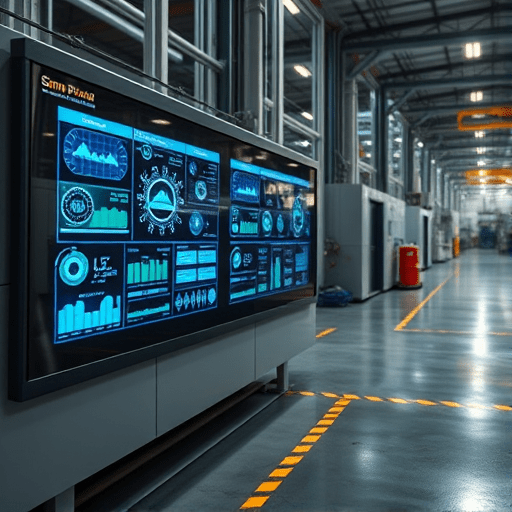
Vibration, acoustic, and thermal sensors mounted on motors, pumps, and spindles generate continuous streams of high-frequency data. Edge AI models detect bearing wear, imbalance, and lubrication faults in real time, triggering maintenance orders before catastrophic failure. Because inference happens locally, warnings appear on dashboards within the same production cycle, not the next one.
Computer-Vision Quality Inspection
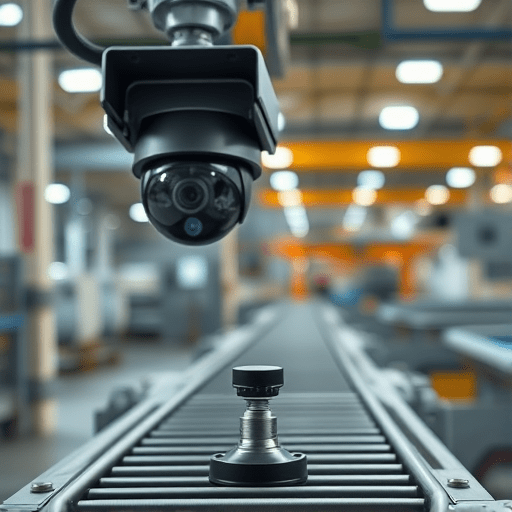
High-resolution cameras on assembly lines must inspect thousands of parts per hour. Cloud-based inference introduces variability that disrupts line balancing. Edge AI accelerators process frames on the line, flagging defects instantly and rejecting parts with pneumatic actuators in real time.
Autonomous Mobile Robots and AGVs
Autonomous guided vehicles depend on split-second decisions to avoid collisions and coordinate routes. Private 5G ensures uninterrupted connectivity across large warehouses, while onboard Edge AI handles perception, path planning, and obstacle avoidance without depending on remote servers.
Energy Management and Demand Response
Factories are increasingly participating in dynamic energy markets. Edge AI analyzes consumption patterns locally and adjusts non-critical loads in real time, responding to price signals or grid constraints faster than any cloud-managed system could.
The Architecture Behind the Shift
A modern Edge AI + private 5G deployment typically follows a three-tier model:
- Device tier: Sensors, cameras, robots, and rugged gateways with embedded NPUs or compact accelerators.
- Edge tier: On-premise servers or micro data centers running containerized AI workloads, often managed via Kubernetes distributions designed for industrial environments.
- Cloud tier: Centralized platforms for model training, fleet management, and long-term analytics. Connectivity here is asynchronous and best-effort.
Standards such as O-RAN, 3GPP Release 18 enhancements, and industrial edge frameworks from major cloud providers are converging around interoperable architectures. This reduces vendor lock-in and allows plants to mix best-of-breed components.
Challenges and Practical Considerations
Despite the momentum, several hurdles remain. Edge AI hardware must be selected carefully for thermal tolerance and long-term availability. Model lifecycle management—versioning, A/B testing, and rollback—is more complex when inference runs across hundreds of distributed nodes. Cybersecurity responsibilities expand because every edge device becomes a network endpoint that must be patched and monitored.
Organizations also need new skill sets. Plant engineers are becoming conversant in MLOps, while data scientists must understand deterministic networking and industrial protocols. Cross-training programs and managed service partners are filling this gap, but talent remains a constraint.
What 2026 Looks Like for Industrial AI Deployments
The latest wave of industrial rollouts is moving beyond pilot projects into multi-site standardization. Leading manufacturers are treating Edge AI + private 5G as core infrastructure, much like electricity or compressed air. Model deployment pipelines push updates overnight, edge nodes self-validate, and network slices are dynamically allocated to match production schedules.
Federated learning is gaining traction, allowing plants to collaboratively improve shared models without exposing proprietary process data. Meanwhile, digital twin platforms are consuming edge-generated insights to simulate what-if scenarios in near real time, enabling faster engineering decisions.
The Bigger Picture: From Automation to Autonomy
Eliminating cloud round-trips is not an end in itself. It is a prerequisite for the next stage of industrial evolution: autonomous operations where machines self-optimize, self-diagnose, and self-coordinate with minimal human intervention. Private 5G provides the deterministic fabric, and Edge AI provides the cognition. Together, they enable factories that respond to changing conditions within the same heartbeat of the process itself.
As more enterprises recognize that latency, sovereignty, and resilience are not optional features but operational necessities, the combination of Edge AI and private 5G is shifting from competitive advantage to baseline expectation. The cloud will remain essential for training, orchestration, and cross-enterprise analytics—but for the decisions that matter on the factory floor, the round-trip is finally being cut short.