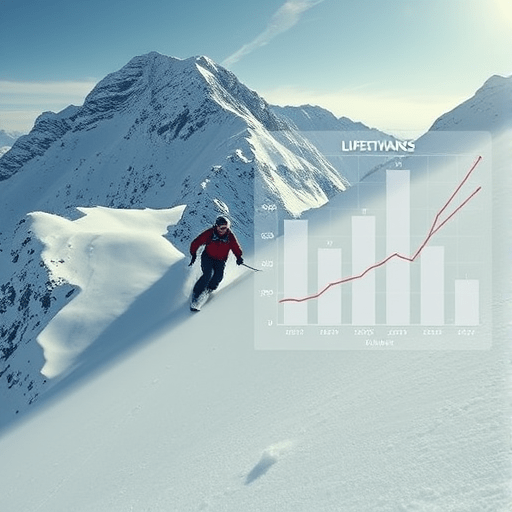
When most people hear the phrase “extreme athlete,” they picture a daredevil chasing the next impossible line, a cliff, or a wave. But behind every helmet and harness is a quiet financial ledger. The same individual making six figures climbing frozen waterfalls, freeriding backcountry powder, or BASE jumping from towers is also running a personal business where the principal is their body and the interest rate is measured in worn cartilage, fractured bones, and deferred career plans. Calculating the real return on investment (ROI) of high-risk adventure sports no longer lives in barstool conversation — it now sits inside spreadsheets, actuarial tables, and lifetime earnings models.
This fresh-angle piece digs into the data: how extreme athletes can quantify lifetime rewards against cumulative injury costs and career trade-offs, and why that framework matters more than ever as the adventure economy scales.
Why ROI Matters for the Modern Adventure Athlete
The adventure economy has matured. Sponsorship deals once reserved for Olympic podiums now flow toward freeriders, big-wave surfers, and wingsuit pilots. Prize purses have grown, social media amplification has turned athletes into personal brands, and outdoor brands spend roughly $1.4 billion annually on athlete endorsements worldwide. That money tempts talented athletes into careers with shorter windows and higher medical bills than traditional sports.
Yet the legacy advice for extreme athletes remains stuck in platitudes: “follow your passion,” “trust the process,” or “the mountain chooses you.” What is missing is the same basic financial literacy any small-business owner would use before signing a lease. A serious ROI model asks three blunt questions:
- How much can I earn over my peak performance window?
- What is the probability and cost of injuries that cut that window short?
- What alternative career paths am I walking away from, and what are those worth?
Without those numbers, the “investment” is really an unhedged bet dressed up as a calling.
The Anatomy of an Adventure Sports Investment
To calculate ROI, an athlete first has to define what counts as the “investment.” For most, it bundles together training time, gear, coaching, travel, certifications, insurance, and the opportunity cost of skipping conventional education. For freeride mountain bikers and ski mountaineers, gear alone can top $15,000 before a single competition, while wingsuit pilots routinely spend more than $30,000 on suits, parachutes, and jump-site access.
Then there is the human capital side. Recovery weeks, altitude camps, and mental conditioning eat into the calendar. Any seasoned coach will tell you that elite progression demands 15 to 25 hours of focused training per week. That is the same commitment expected from a medical resident or a junior associate at a law firm, and the comparison matters because both lines of work produce measurable income over time.
Quantifying Lifetime Earnings: The Reward Side of the Equation
Professional freeride snowboarders at the top of the Freeride World Tour can earn base prize purses, plus performance bonuses and appearances, sometimes surpassing $250,000 in a single strong season. Add sponsorships, content royalties, and clinics, and a five-year peak window might produce $1.2 million to $2 million before taxes. Big-wave surfers in the WSL Big Wave division, elite ultra-runners, and competitive climbers at the IFSC World Cup see similar curves, though with thinner sponsorship support.
However, those numbers belong to the top tier. The median adventure athlete earns far less. Sponsorship data from 2024 shows that roughly 70% of sponsored freeride skiers make under $40,000 a year from sport-related income. Set that against a software engineer who clears $150,000 annually by age 32, and the lifetime earnings gap widens fast. A common analytical move is to discount future adventure income at a higher rate than a traditional salary to reflect the volatility of sponsorships and the physical ceiling on career length.
The Injury Ledger: A Data-Driven Approach to Cumulative Costs
If the reward side is glamorous, the cost side is unforgiving. Studies on action-sports athletes have documented injury rates up to four times higher than team sports like soccer or rugby. A 2023 review in the British Journal of Sports Medicine found that extreme sport athletes averaged 8.2 injuries per 1,000 exposure hours, with concussion rates climbing fastest in gravity sports like mountain biking, skiing, and BASE.
The financial fallout can be staggering. ACL reconstruction in the United States runs between $20,000 and $50,000 per knee, while complex shoulder repairs can hit $30,000. Add imaging, follow-up rehab, and lost training time, and a single season-ending injury can consume $80,000 or more. Multiply that by recurring injuries and the lifetime medical bill for a high-volume athlete often lands between $200,000 and $500,000 — not counting lost income during recovery.
Beyond the Medical Bill: Hidden Costs of an Extreme Career
- Lost ranking points and sponsor exposure during recovery windows
- Higher premiums for health and disability insurance
- Reduced lifetime earning power if injuries become chronic
- Retirement planning compressed into a shorter working span
A useful framework is to compute a personal “injury-adjusted earnings multiple.” Take projected gross earnings, apply an injury probability curve year by year, and discount the result. The output is a realistic expected value rather than a best-case fantasy.
Modeling Career Trade-Offs in 2026
The economic landscape for adventure athletes in 2026 looks different from five years ago. Three shifts stand out:
- Insurance products tailored to action sports have matured, offering riders for loss of income and high-coverage disability plans.
- Brands now pay for athlete longevity rather than viral moments, prioritizing ambassadors with steady competitive results.
- Credentialing and micro-degrees in fields like GIS mapping, avalanche forecasting, and sports physiology are giving athletes parallel careers with strong fallback value.
Athletes who treat their sport as a portfolio — combining competition income, coaching, content production, and a part-time technical qualification — tend to come out ahead. The brain surgeon who also climbs 5.14, or the data analyst who also runs ultras at elite level, dilutes risk while keeping passion alive.
A Practical ROI Framework for Extreme Athletes
A simple, replicable model can be built in any spreadsheet. The steps look like this:
- List expected annual income sources, conservative and optimistic.
- Estimate peak performance years remaining based on current age and sport-specific career curves.
- Compute cumulative injury costs using sport-specific injury rates and average treatment prices.
- Subtract deferred traditional earnings for the same horizon.
- Discount future values to net present value at a risk-appropriate rate of 6% to 10%.
- Stress test by simulating injuries, sponsorship loss, or early retirement scenarios.
The output is rarely tidy, but it is honest. Athletes are often surprised to discover that the most rewarding path is not the one with the highest absolute earnings but the one that balances peak income against the cost of getting there in one piece.
Shifting the Culture From Heroism to Stewardship
Adventure culture has long celebrated sacrifice as virtue. Data should not erase that spirit; it should sharpen it. Athletes who model their careers the same way an entrepreneur models a startup — with a clear runway, risk-adjusted returns, and defined exit strategies — tend to retire on their own terms rather than on a stretcher. They also leave room for second acts that keep them connected to the sports community as coaches, guides, judges, or analysts.
The real ROI of high-risk investment is not a trophy or a paycheck. It is a life spent partly in the arena, partly in the classroom, and partly in the clinic — calculated honestly so the dream of flying down a mountain or off a cliff does not silently bankrupt the body that makes it possible.