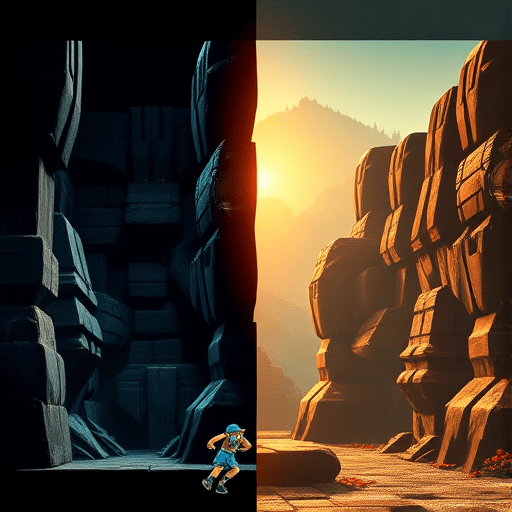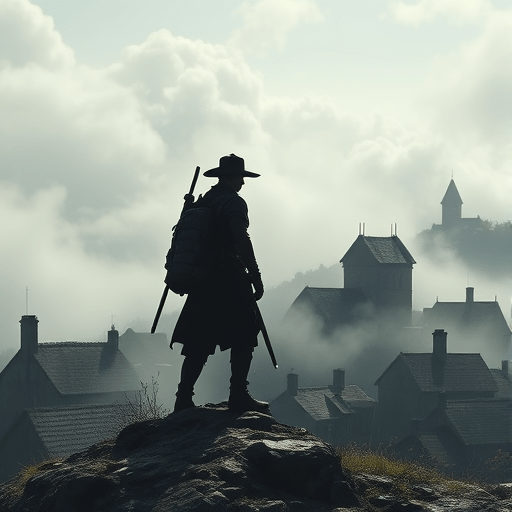
For decades, open-world role-playing games promised freedom, but most players still funnelled themselves down a glowing marker on the map, sprinting past entire biomes just to reach the next quest giver. In 2026, that contract is being rewritten. Studios are quietly retiring the rigid main-quest spine in favour of environmental storytelling in open-world RPGs, letting geography, weather, ruined architecture, and ambient audio carry narrative weight that used to live in dialogue trees. The result feels less like a game you complete and more like a place you learn.
The Slow Death of the Glowing Waypoint
The traditional RPG main quest has always been a leash. It tells you where to go, what to feel when you get there, and when you are allowed to leave. Even acclaimed open worlds such as The Witcher 3 and Breath of the Wild used quest markers to keep players tethered to a designer-approved sequence of events.
What has changed is player literacy. Audiences who grew up tracking lore through reddit threads, fan wikis, and 40-minute video essays now arrive at a new RPG expecting to read the world rather than be told about it. Developers have noticed. Quest logs are shrinking. Compass clutter is being stripped back. In its place, teams are leaning on the oldest trick in fiction: show, don’t tell.
From Cutscenes to Climates
Sucker Punch’s 2025 hit Ghost of Yotei demonstrated the new playbook. Rather than scripting Atsu’s revenge arc beat by beat, the studio seeded hints across the island: a scorched farmstead pointing toward a vanished clan, a frozen shrine echoing a lullaby the player heard once in a tutorial, a herd of deer migrating away from a ridge that turns out to be the location of the next major encounter. Players regularly report assembling entire storylines from geography before a single NPC delivers exposition.
Reading the Ruins: How Designers Encode Lore Into Space
Environmental storytelling is not new; Dark Souls proved its power more than a decade ago. What is new in 2026 is how the technique is being weaponised against the very idea of a main quest. Instead of stacking lore on top of a linear plot, modern RPGs are letting the environment be the plot.
Several design patterns have emerged across recent releases:
- Spatial causation: the placement of objects implies a story. A child’s toy in a bunker, a wedding ring on a corpse outside town walls, an overturned cart on a mountain pass — each is a sentence in a paragraph the player authors.
- Iterative landscapes: regions change over time based on what the player has done elsewhere. Burn a supply line in act one and a village you have not yet visited will be deserted when you arrive, its NPCs quietly relocated.
- Audio archaeology: directional sound carries meaning. A radio broadcast bleeds through a wall, a distant horn signals a festival the map never marks, and footsteps in snow carry a unique crunch that signals hidden history.
- Negative space: the most powerful moments are absences. A throne room with no king, a port with no ships, a forest with no birds.
Together these techniques dissolve the boundary between side content and critical path. The “main quest” simply becomes the path the player happened to walk.
Why This Subversion Matters in 2026
Three converging forces are pushing the genre in this direction. First, generation costs are exploding; hand-scripting every cinematic is no longer sustainable, so designers invest in reusable environmental kits that pay narrative dividends across hundreds of hours of play. Second, machine-assisted world-building tools allow studios to populate space with higher-fidelity set dressing than ever before, making the world itself feel authored rather than decorated. Third, players themselves have learned the grammar of environmental cues and reward studios that respect their intelligence.
There is also a quiet ideological shift at work. Linear main quests tend to centre a chosen protagonist as the saviour of a passive world. Environment-led design inverts that hierarchy. The world was here before the hero, and will be here after. The player is a witness, not a messiah. That philosophical reframing is showing up in titles from smaller studios as much as from the AAA heavyweights.
The Tensions That Remain
It is not all smooth sailing. Subverting the main quest through environment-first design introduces real friction. Accessibility is the most pressing concern: players with cognitive differences, neurodivergent players, and those who simply want a clear objective can feel lost when a quest log offers only a cryptic poem. Studios are experimenting with opt-in guidance modes, layered difficulty settings for narrative density, and companion characters whose dialogue gently points toward the next beat without restoring the old waypoint leash.
There is also a pacing problem. When the entire world is the quest, climactic moments lose their shape. Some designers are responding by reintroducing occasional high-rails sequences — not as the spine, but as punctuation marks in a free-roaming narrative. Others trust the player to feel the peaks and valleys themselves, arguing that discovery itself is the dopamine.
Finally, reward structures still favour completion. Achievement hunters, completionists, and trophy hunters need something to chase. The most successful 2026 releases hide their rarest trophies and cosmetic rewards inside environmental puzzles that require no marker at all, turning the act of paying attention into the prize.
What Comes Next
Looking toward the next hardware generation, expect environmental storytelling to deepen in three ways. Procedural weather and ecosystem systems will let worlds react to player choices across real-time seasons, so a forest cleared in spring is still empty in winter. Companion AI will become narratively literate, commenting on what the player has clearly seen rather than waiting for quest triggers. And cross-media tie-ins — a podcast episode that unlocks a region, a short film that explains a silhouette in the mountains — will let stories extend beyond the screen without forcing the main quest to carry the weight.
The most exciting prediction is also the simplest: within the next few years, a major RPG will ship with no traditional main quest at all. Its “campaign” will be a curated first-player’s journey, an optional ghost trail for newcomers, while the experienced audience simply wanders, reads, and assembles meaning from a world that was already telling its story long before they arrived.
Conclusion
Environmental storytelling is not just a craft technique anymore; it is becoming the structural backbone of open-world RPG design. By trusting the world to carry the plot, developers are quietly subverting the main quest itself, freeing players to become readers of places rather than runners of errands. The result is a genre that finally lives up to its name: a role-playing world, not a role-playing checklist.