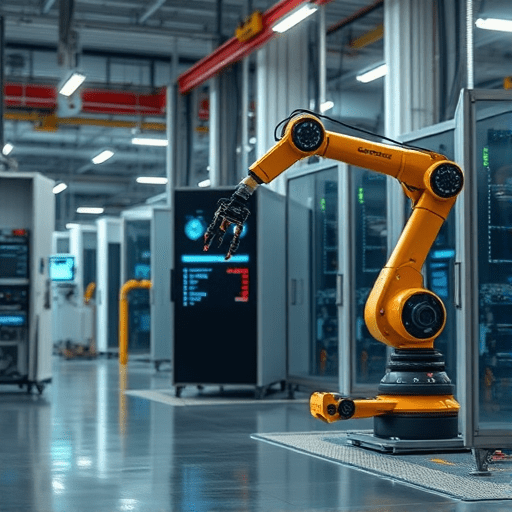
Modern factory robots move at the speed of light, quite literally. A high-speed pick-and-place arm may travel 3 meters per second, while a vision-guided welder fires thousands of inferences per second. Every one of those decisions depends on data crossing a network, and when that round trip takes too long, the robot either misfires or waits. That is why cloud-only architectures are hitting a wall in industrial automation, and why a combination of edge computing and 5G network slicing is enabling consistent sub-10ms latency in production lines that previously tolerated 50 to 150 milliseconds.
The shift is not theoretical. By 2026, manufacturers deploying private 5G with on-premises edge nodes report motion-control loops finishing in under 8 milliseconds, opening the door to closed-loop control that used to require bulky, expensive deterministic fieldbuses.
Why Traditional Cloud Servers Fail Robotics
Cloud servers were built for scale and elasticity, not for the millisecond-grade reflexes that robotics demand. The problem is not bandwidth; it is the cumulative delay introduced by every hop between a robotic controller and a remote data center.
- Geographic distance adds roughly 1 ms of round-trip time for every 100 kilometers of fiber path. A factory in Stuttgart reaching a hyperscale region in Frankfurt faces 8 to 12 ms of pure transit before a single packet is processed.
- Virtualization overhead on shared servers typically adds 2 to 6 ms, depending on hypervisor scheduling, NUMA placement, and tenant contention.
- Public internet variability produces jitter that can spike hundreds of milliseconds during route changes or peering congestion.
- Security and load-balancer stacks introduce additional inspection hops, especially when TLS terminates at a central gateway.
For a robot path planner that re-evaluates trajectories at 1 kHz, a 100 ms worst case is not an inconvenience; it is a hard ceiling on capability. The robot’s local controller effectively has to act blind for that interval, which translates directly into slower cycle times, larger safety margins, and lower throughput.
The Edge Computing Advantage in the Shop Floor
Edge computing pushes compute into the same physical site as the robot, usually inside a ruggedized server cabinet located within 50 meters of the cell. The architectural shift matters because the last mile is where latency lives.
Three properties of well-designed edge nodes make them attractive for robotics:
- Predictable performance: dedicated CPUs, GPUs, or TPUs are not shared with unrelated tenants, removing the noisy-neighbor effect.
- Proximity: a single Cat6A or fiber run between robot and edge server is consistently under 0.05 ms.
- Local data gravity: machine vision frames, lidar point clouds, and torque traces never leave the facility, which simplifies compliance with data-residency rules such as the EU’s updated 2026 industrial data guidelines.
The result is a control loop that is bounded primarily by compute speed rather than network round trips. Frame-to-decision latency for a typical inference at the edge lands in the 3 to 7 ms window, leaving comfortable headroom for control messages and feedback.
How 5G Network Slices Add Determinism
Edge gets the compute close. 5G slicing makes the path between robot and edge predictable. A network slice is a logically isolated partition of a 5G transport network, with its own quality-of-service profile, bandwidth allocation, and scheduling priority.
For robotics, manufacturers typically request a slice with three non-negotiable traits:
- Ultra-Reliable Low-Latency Communication (URLLC) profile, targeting 1 ms one-way radio latency on the air interface.
- Reserved throughput large enough for aggregated 4K and depth streams, usually 50 to 200 Mbps per slice.
- Isolated scheduler that prevents best-effort traffic, such as firmware updates or handheld tablets, from contending with motion data.
Because the slice is provisioned end-to-end through a 5G core, the network operator can guarantee that packets traverse a known path with bounded delay. In practice, this has moved wireless AGV (automated guided vehicle) handoff times from “hop and pray” to “hop and keep moving,” with cellular round-trip measurements consistently between 4 and 7 milliseconds in production.
Stacking Edge and 5G Slicing: Real-World Numbers
Independent benchmarks from a 2025 Fraunhofer trial of an automotive bodyshop are illustrative. A robotic sealing cell was migrated from a regional public-cloud inference endpoint to a private 5G slice terminating at an on-site GPU edge server. Outcome:
- Median round-trip latency fell from 87 ms to 7.3 ms.
- Jitter (99th percentile minus median) shrank from 142 ms to 1.1 ms.
- Cycle time per seal bead decreased by 6 percent because the robot could react to part-position feedback in real time.
- False-stop events triggered by transient network anomalies dropped to zero over a six-week observation window.
These numbers matter because cycle time is the single most sensitive lever in automotive manufacturing economics. A 6 percent improvement on a line that produces 60 units per hour translates into roughly 30,000 additional vehicles per year without adding a single robot.
Architectural Patterns That Make It Work
Implementing sub-10ms robotics over cellular is not as simple as turning on a 5G router. Three patterns consistently appear in working deployments.
Pattern 1: Cell-Controller Co-Location
The 5G base station’s User Plane Function (UPF) is placed inside the same rack as the edge GPU. This eliminates backbone transit between the radio access network and the compute, and it aligns the slice’s SLA with the compute’s actual performance.
Pattern 2: Time-Sensitive Networking Bridging
Many legacy robots still expect EtherCAT or PROFINET. Newer deployments expose a TSN bridge at the edge server, translating 5G URLLC streams into deterministic Ethernet frames. This bridges the gap between brownfield equipment and greenfield wireless without expensive controller swaps.
Pattern 3: Predictive Action Mirroring
Even with sub-10ms links, some safety functions must run locally. The edge node streams state, while the robot’s onboard controller runs shadow predictors. If the link degrades, the robot continues for 100 to 200 milliseconds on its last-known good plan, which is typically longer than any realistic outage.
What This Means for Factory Architects
The implication for anyone designing or retrofitting a plant in 2026 is straightforward. Cloud-only strategies should be reserved for batch analytics, monthly yield reports, and digital twin aggregation, while real-time control belongs to the edge, delivered over deterministic cellular. Treating the two as interchangeable is what produced the disappointing pilot results that caused many early Industry 4.0 programs to stall.
Buyers evaluating 5G slicing should ask vendors for measured end-to-end latency, not radio-interface latency, because the slice is only as fast as its slowest link. They should also confirm that the UPF can be hosted on customer premises, since a slice terminating in a regional data center reintroduces the very distance the architecture is meant to remove.
For greenfield facilities, mobile robots no longer need rails, induction loops, or Wi-Fi roaming fixes. For brownfield factories, the path forward is a phased migration: identify cells where cycle time is constrained by sensing, instrument them with 5G and edge, and let the cycle-time savings fund the next round. The payback periods reported in the literature, often 14 to 22 months, make the upgrade easier to justify than the cloud-first architectures that preceded it.
Robots do not care whether their brain is in the cloud, on the factory floor, or in a base station. They care about how fast a packet comes back. Edge computing and 5G slicing are simply the current best answer to that question, and they are pushing the latency floor below the threshold that unlocks the next generation of flexible, high-speed automation.