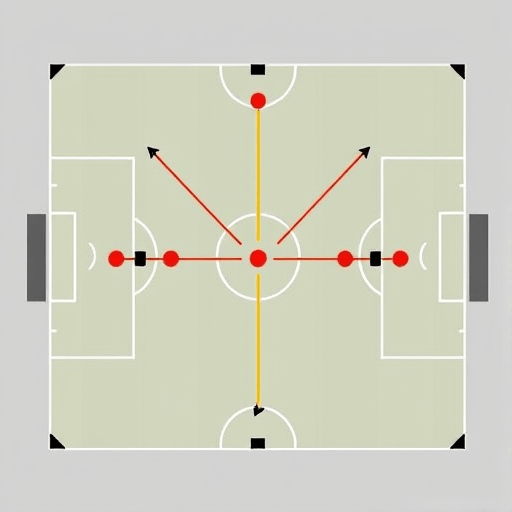
By 2026, tactical crossover talk is no longer confined to analysts with whiteboards. Fans already describe football through basketball language: “not enough penetration,” “poor spacing,” “too many bodies around the ball.” That is why the most interesting tactical question of the moment is also the most natural one: can basketball’s five-out formation fix football’s low-block problem? It is not about dropping five strikers onto the penalty spot. It is about borrowing NBA spacing cues to change how we see deep, compact defenses.
The Low-Block Problem Is a Space Problem
A football low block is more than a negative defensive tactic. It is a compact spatial strategy. Four defenders, two screening midfielders, and a front line all shrink toward the space between the penalty spot and the edge of the area. That makes the middle of the pitch unplayable and dares the attacking team to deliver crosses from wide areas—where center-backs are usually stronger than strikers.
Low-block defenders are not all doing their own jobs. They are following a simple set of rules:
- Shrink distances between players, especially in central areas.
- Shift the entire block toward the side of the ball.
- Collapse toward the six-yard box when the ball enters wide areas.
The result is not a lack of space for the opponent; it is a lack of useful space. A team can have 70 percent possession without ever creating an open lane into the penalty area.
Five-Out Formation: More Than “No Big Man”
In basketball, the five-out formation places all five offensive players beyond the three-point line. There is no traditional center camped in the paint. At first glance, this seems counterintuitive: if nobody is near the basket, how does a team score inside?
The answer is that five-out creates interior space by refusing to occupy it. When the ballhandler drives toward the rim, the defense must decide whether to help. If a defender steps into the paint, the ball is kicked to an open shooter. If no defender helps, the ballhandler gets an uncontested layup. That is the same dilemma an attacking football team wants to create when facing a low block: make defenders choose between protecting the middle and covering the spaces outside it.
Three NBA Spacing Cues Football Can Use
Football cannot copy the five-out formation directly. The pitch is larger, the offside rule changes vertical movement, and there is no shot clock forcing a team to commit attackers early. But the underlying spacing cues can be translated.
1. Drive-and-Kick Becomes Pass-and-Move
In the NBA, drive-and-kick action punishes defenders who collapse toward the ball. In football, a midfielder driving from outside the block into the half-space is the equivalent move. When the block shifts to close that drive, the attacker must make a quick pass to the weak side, where another runner is ready to attack the vacated area. The ball does the stretching; the players do the relocating.
2. Weak-Side Action Beats the “Ball Watcher”
Five-out offenses constantly use weak-side movement to prevent the defense from helping. Football’s version happens when the attacking team moves a runner into the far half-space before switching the play. The low block tends to shift with the ball, leaving the far side unprotected. A well-timed switch after that movement gives the receiver time to turn and face the goal.
3. Empty-Corner Actions Create Backdoor Lanes
NBA teams sometimes empty the corner to make the paint even easier for a driver. In football, an empty central striker position works in the same way. If the striker drops deeper, the center-back must decide whether to follow. If he follows, the space behind him is open. If he stays, the striker receives the ball in the pocket between the defensive and midfield lines—one of the most dangerous spaces in modern football.
Tactical Case Study: 4-3-3 Against a 5-4-1 Low Block
Imagine a possession-based team in a 4-3-3 trying to break down a side camped in a 5-4-1. The first-half performance looks familiar: the No. 9 stays high, the wingers hug the touchline, and the midfielders pass sideways in front of a wall of defenders. The low block does not need to tackle; it only needs to keep the ball outside the penalty area.
Now apply five-out spacing cues. The striker drifts toward an outside center-back, creating a two-on-one situation between that center-back and the wide defender. The attacking midfielder moves toward the edge of the box, unmarked because the center-backs are occupied. One winger pins the opposing full-back deep, while the other winger moves into the half-space behind the block’s midfield screen.
The ball is then played to the striker’s feet near the shoulder of the center-back. The center-back must step out, leaving the space behind him open. The attacking midfielder makes the cut into that open channel, receives a first-time return pass, and has a clean look at goal. No cross. No long shot. Just a low block forced to shift until its structure no longer protects the most dangerous parts of the pitch.
This is not a perfect five-out action. It is a football move inspired by five-out logic: use perimeter occupation to open a lane, then attack the lane before the defense can recover.
Why Five-Out Cannot Be Copied Directly
The honest answer to the headline question is both yes and no. Five-out formation can inform football tactics, but it cannot be lifted and placed onto a grass pitch. Basketball has fewer players, a smaller playing surface, and a shot clock that forces the defense to defend an immediate attempt. Football’s low block can absorb pressure for long stretches because it can reset after every clearance. It can also rely on transition chances, meaning the attacking team can never leave too many players high and wide.
There is also the offside law. Five-out basketball lets every player stand beyond the three-point line because there is no offside behind the last defender. In football, if an entire attacking team stays near the last line, the referee’s flag will end half of the moves before they start. So the fix is not a direct formation transplant. The fix is a mindset shift: force the low block to respond to players who position themselves in different relationships, not fixed diagram slots.
Settling the Low-Block Debate for Fans
For years, fans were told that a low block should be solved with more crosses, more powerful shots, or bigger forwards. Five-out formation says otherwise. Space created by intelligent movement is often more valuable than an extra body in the penalty area. The center forward who drags a defender away is sometimes the most important player in the move. The full-back who holds width to stretch the block is doing what a basketball shooter does from the corner. The central midfielder who drives into the empty half-space is playing the role of the aggressive point guard.
The low block is not unbeatable. It is just a spatial problem that requires spatial thinking. Five-out basketball cannot fix football’s low block by itself, but it gives fans and coaches a better way to talk about the solution: create space through movement, punish defensive shifts with quick passes, and attack the lanes that open when the block is forced to choose.