For the past decade, the most passionate arguments in sports have not been about who won, but why a team won. A fan in the stands no longer shouts “shoot it!” at a golden opportunity; they shout “that’s only a 0.12 xG!” The 3-point revolution in basketball and the expected goals (xG) revolution in soccer have done more than change play styles—they have changed how fans judge every possession. By comparing shot selection data across sports, we can see a clear pattern emerging, one that points to the next tactical trend: measuring the value of space before the shot is even taken.
The 3-Point Revolution: More Than a Tactic, an Expectation Reset
Basketball was the first sport to fully embrace the idea that not all shots are created equal. The 3-point line, introduced as a novelty in the 1960s and adopted by the NBA in 1979, remained an afterthought for decades. Then came the analytics wave of the 2010s, led by the Houston Rockets’ “Moreyball” philosophy. Teams realized that a 35% 3-point shooter delivered more points per possession than a 50% mid-range shooter. The math was undeniable, and the shot selection data transformed the league.
By 2026, the 3-point revolution is no longer a strategy; it is the baseline. The NBA has seen a record number of 3-point attempts for years running. Fans have internalized the efficiency charts—when a player takes a long contested two-pointer, the replay is immediately criticized. The era of “good shot, bad result” is over. Now, the question is not where the shot was taken, but how much space was created before it. This subtle shift is the first clue to the next trend.
xG Gives Soccer Fans a New Way to Argue
Soccer followed a similar path, but with an added layer of complexity. A simple shot location chart in basketball could approximate value; in soccer, defenders, goalkeeper position, and the angle of the chance all matter. Expected goals (xG) arrived as a statistical model that assigns a probability to every shot based on distance, angle, assist type, and more. It gave fans a common language to explain why a team deserved to win even when the scoreboard disagreed.
Soccer’s tactical evolution mirrors basketball’s. The old “hit and hope” long shot is now viewed with suspicion. The low- xG chancer is considered a wasted possession. Coaches are building entire playing styles around creating high-quality chances in the box, rather than shooting from distance. Fans have adopted xG as a sort of moral scoreboard, using expected goals to argue that their team was unlucky or that the opponent was overperforming. This is the same expectation reset that happened in basketball—except in soccer, the data extends beyond the shot itself. The next step is already being measured with “expected threat” (xT), which assigns value to passes and dribbles that move the ball into more dangerous areas. But that is only the beginning.
The Common Thread: Shot Selection Data Across Sports
When we compare shot selection data across basketball and soccer, we find a shared logic: prioritize high-value opportunities and eliminate low-value ones. Yet the two sports have adapted different constraints. Basketball’s court is smaller, so the 3-point line creates a geometric boundary that incentives from distance. Soccer’s field is larger, with an offside rule that shapes spacing, so the “boundary” is more fluid and influenced by defensive pressure.
That same principle is now being applied to other sports. In hockey, “high-danger chances” has become a mainstream stat, pushing teams to simplify their shot profiles. In American football, expected points added (EPA) per play is replacing total yardage as the way fans and coaches judge offensive efficiency. Even tennis is using serve location data to determine when to serve wide versus down the T. The pattern is unmistakable: every sport is moving from “what happened” to “what should have happened.” But the next tactical trend will be not just about the shot itself—it will be about the space that makes the shot possible.
The Next Tactical Trend: From Shot Selection to Space Creation
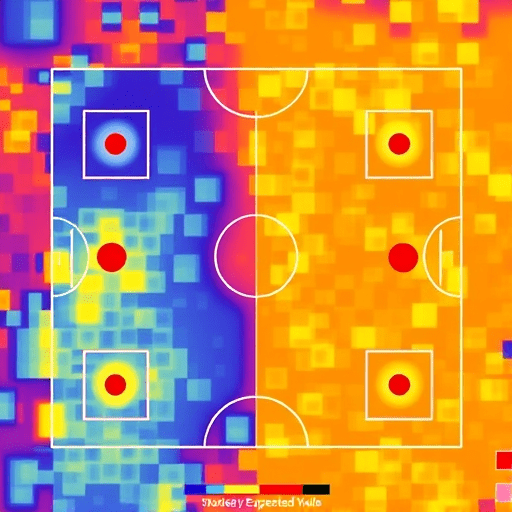
Now that shot selection data is widely understood, the next frontier is pre-shot data. In basketball, teams are already using “driving pass probability” and “ghost screens” to quantify how much defensive gravity a player creates. In soccer, expected threat (xT) tracks how a pass increases the probability of a goal a few moves later. The common denominator is spatial value: a run that pulls a defender away from the basket, or a through-ball that splits the last line, is now more valuable than a contested 3-pointer or a half-chance from a tight angle.
By 2026, the most innovative teams are looking beyond individual shot attempts. They are measuring the threat of a possession in real time, updating a “spatial coefficient” for every player and pass. This will eventually lead to the next tactical shift: positionless spacing. In basketball, that might mean playing five shooters who all pass and cut, making defenses guess who is the scoring threat. In soccer, it could mean a return to positionless pressing, where any player can act as a false nine if the data says their movement will pull the opponent out of shape. The old mantra was “take the best shot available”; the new one is “create the best space so that every pass becomes a better shot.”
Why is this the natural progression? Because the fan’s expectation has already evolved. A viewer in 2026 cannot watch a blind cross into the box without muttering “that’s a 0.04 xG.” The same viewer is also beginning to appreciate the pass that comes before the assist—the “second-assist” trend. Once the mainstream audience understands spatial value, the teams that exploit it will gain a significant edge.
How Data Shapes Fan Expectations: The New Watchability
This data revolution is not just for analysts; it is changing the gut-level experience of watching sports. Twenty years ago, a fan would cheer a spectacular long-range strike in soccer. Now, that same fan might pause and ask if the striker had a better option. In basketball, a player who takes a mid-range pull-up with 18 seconds on the shot clock is openly criticized on social media, even if the shot goes in. The 3-point revolution made fans efficiency snobs; xG made them probability nerds.
What comes next? Expect the next generation of fans to judge players not just on how many points or goals they produce, but on how many expected points or goals they create for the whole team. Advanced metrics like “box creation” in soccer and “spacing efficiency” in basketball will become as common as batting average and QB rating are today. The fan’s vocabulary is expanding, and with it, the tactical decisions of coaches and executives. The shot is simply the final expression of a chain of spatial decisions, and that chain is now under the microscope.
The comparison of shot selection data across sports has shown us one universal truth: raw volume no longer impresses anyone. What impresses is the intentional creation of high-quality opportunities through movement, timing, and space. This is not a trend that will fade; it is the backbone of modern sport. The next revolution will not be about shooting more or less—it will be about attacking space that does not yet exist.
Conclusion
From the 3-point revolution in basketball to the xG-driven debates in soccer, shot selection data has rewired fan expectations and coaching tactics in every major sport. The next tactical trend lies in applying the same data-driven logic to the moments leading up to the shot: quantifying space, movement, and threat. As fans become more fluent in pre-shot metrics, teams that embrace spatial analytics will define the next era of tactical innovation. The shot is just the end of the story; the data is now helping us read the entire book.