Ask any martial arts instructor, and they’ll tell you the same uncomfortable truth: the person who lands a perfect punch on a heavy bag can become a statue in a real threat. The question of why you freeze in self-defense isn’t about weakness or lack of will. It’s about how your nervous system processes sudden danger. In 2026, with more people than ever carrying pepper spray and taking weekend seminars, the gap between knowing and doing remains the core problem. This case study looks at how a targeted program of scenario-based drills can rewire the startle response, turning that infamous freeze into a learned trigger for action.
The Startle Response: A Biological Shortcut Gone Wrong
Your brain has a rapid alert system called the amygdala, which scans for threats faster than your conscious mind can think. When a threat appears, it signals the hypothalamus to dump adrenaline into your bloodstream. This is the fight-or-flight mechanism—but there’s a third, lesser-known option: freeze. In primal terms, freezing can be smart. A tiger may not see a motionless deer, or a predator loses interest in an opponent that doesn’t move. Your body inherits this ancient programming, and it triggers in milliseconds.
Here’s the problem: in a modern parking lot or a busy street, freezing doesn’t help. Meanwhile, your motor cortex shuts down voluntary movement. Muscles tense, breathing shallowens, and your hands feel like lead. This response is not a moral failure. It’s a neural pathway forged over millennia. Yet, unlike reflexes like blinking, the startle response can be modified through deliberate training. The key is repetition under realistic conditions, not just physical technique.
Case Study: The Parking Garage Moment
Let’s look at Nadia, a 34-year-old software developer who had trained in Krav Maga for two years. She could knee a pad, defend a choke, and disarm a fake knife with confidence. But one Tuesday night, a man blocked her path near a covered stairwell. He wasn’t armed. He just yelled, “Give me your phone,” and stepped forward. Nadia didn’t punch. She didn’t run. She stood frozen, looking at his shoes, until a passing car headlights made the man retreat. The whole thing lasted forty seconds. Later, she described it as “watching myself from outside my own body.”
Nadia’s case is textbook. Her muscle memory was real, but her brain had never practiced a threat with ambiguous cues, sudden loud noise, and a moving stranger. Drills in her gym involved predictable patterns: the attacker says step one, step two. In reality, the startle came before the attack. That early surge of adrenaline created an instant freeze. When she sought help from a scenario-based trainer, the first session was humbling. The trainer told her, “We’re not teaching you new moves. We’re teaching your nervous system to move through the freeze.”
What the Freeze Feels Like: A Window Into Motor Overload
During Nadia’s first realistic drill, the trainer asked her to walk through a narrow doorway while a padded attacker suddenly jumped out and shouted. Her response time was 2.1 seconds—an eternity in self-defense. She later described other symptoms: tunnel vision, a dry throat, and a strange urge to smile. This last one is common but rarely mentioned. The startle response can produce a nervous smile as a social appeasement gesture. Ironically, it’s often misinterpreted as a sign of fear, which can escalate an attacker’s confidence. Recognizing these physical signs is the first step toward normalizing them.
Scenario-Based Drills: Rewiring the Brain Through Controlled Chaos
How do you train away the freeze? Not by more technique repetition. Instead, you need to expose yourself to the startle response in a controlled, repeatable environment. This is the core of scenario-based self-defense training. The goal is to make your brain associate the rush of adrenaline with a familiar set of actions, rather than a state of paralysis. Related to this, your H2 content should cover distinct drill types.
1. Sound and Surprise Drills
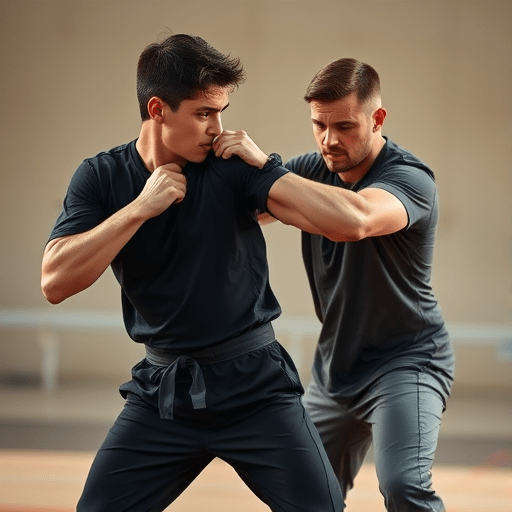
One effective drill involves a training partner initiating a loud clap, a shout, or even a push from behind while you’re mid-task. You start by walking, texting, or picking up a bag. The surprise triggers your startle. Your coach then coaches you to exhale sharply and take one deliberate step back. Exhaling breaks the freeze pattern because it forces your diaphragm to relax. Repetition builds a new habit: surprise leads to breath, not paralysis. Over time, the startle itself becomes a cue to move.
2. Positional Attack Drills
Another scenario begins with you already frozen. Your partner places a gloved hand on your chest or grips your wrist, then says, “Now break the freeze.” You practice small movements—step, pivot, raise your hands—while still in that stressed state. This mimics the real world, where you might feel a hand on your shoulder before you even see a threat. The drill teaches your body that motion is possible even during the early adrenaline surge. It’s not about a perfect technique; it’s about proving to your motor cortex that movement can begin before conscious thought.
3. Decision-Making Under Stress
Freeze also comes from cognitive overload. When there are too many possible actions, the brain chooses none. Scenario drills solve this by offering a simple rule set. For example, “If a stranger invades your arm’s length, your only job is to step back and raise your hands.” That single instruction eliminates decision fatigue. As you practice, you can add variables—a second attacker, a weapon, an obstacle—but always with one clear priority. This builds what sports psychologists call automatic self-efficacy. You start to believe, “I can do this” not because you’ve drilled a kick, but because you’ve drilled the decision-making loop hundreds of times.
Beyond Drills: How to Measure Progress and Avoid False Confidence
Training away the freeze isn’t linear. Nadia, for instance, showed great improvement in surprise drills but still froze when the attacker used a calm, soft voice. That’s another hidden trigger: social manipulation. A sweet voice can be more disarming than a shout. This is why realistic scenario work must vary not just the physical cues, but the emotional ones. A good program will include partners acting angry, confused, pleading, and eerily calm. This trains you to trust behavior, not tone.
Another important measure is your response time. You don’t need a high-tech sensor. You can video a training session and count the seconds between the initial stimulus and your first deliberate action. Aim to get from 1.5 seconds down to 0.5 seconds over a few months. That improvement is neurological, not muscular. It means your brain has started to catalog the startle as a beginning, not an end.
If you’re building your own training, you also need honest feedback. A partner who only tells you “good job” isn’t helping. You need someone who will point out when you’re still holding your breath or dropping your eyes. This is why many people join a dedicated scenario-based program rather than trying to cobble one together. The instructor’s role is to calibrate difficulty so you fail early, adapt, and eventually succeed. Every slight improvement is a small rewiring of your startle response.
What Research Says in 2026: Neuroplasticity and Stress Inoculation
The latest studies on motor learning confirm what scenario drillers have known for decades. The brain learns best when the task is complex, variable, and slightly beyond your comfort zone. Stress inoculation training, originally developed for soldiers and police, is now entering mainstream civilian self-defense. Its core principle is simple: expose yourself to controlled doses of stress so that your nervous system becomes less reactive over time. One 2025 study from a European university found that just six weeks of scenario drills reduced participants’ startle blink by 38%—a physiological marker of reduced panic.
These findings are driving a shift away from rigid choreography. The traditional drill where the attacker says “grab my neck” is being replaced by fluid, messy exchanges. The best modern training uses foam pads, protective suits, and ambiguous setups. You don’t always know when the partner will start or what they’ll say—just that the drill will be safe but uncomfortable. That discomfort is where the magic happens. The startle response is not erased; it’s repurposed.
Conclusion
The fear of freezing is more common than the fear of physical injury. But freezing is not a fixed destiny. By understanding the startle response and committing to scenario-based drills, you can turn that sudden rush of adrenaline into a signal for action. Nadia, after six months of training, no longer stares at shoes. She still feels her heart race, but now her breath follows, then her feet, then her hands. That sequence didn’t appear by accident. It was built one surprise at a time, in a safe room with a willing partner. The goal isn’t confidence in the absence of fear; it’s competence within it. That’s how you train the freeze away—not by eliminating the startle, but by teaching your body to move through it.