Packaging line defects are insidious. A missing label, a misaligned barcode, or an unsealed flap triggers a customer complaint today and a full recall tomorrow. For the average mid-sized factory, the standard remedy has long been an enterprise vision platform: proprietary cameras, locked-in software licenses, and integration fees that stretch deep into six figures. But there is a faster, cheaper path. This case study follows a 140-employee food packaging plant that built its own smart-camera inspection station, wired it directly to an existing PLC, and cut escaping defects by 90% — all without touching enterprise software. The key was a DIY vision approach built on off-the-shelf hardware, a small injection of Python, and a modest Ethernet connection.
The Problem: Human Inspection Has a Ceiling
The plant packs dry food products into printed cartons at a sustained rate of 80 cartons per minute. Quality control depended on two operators visually checking every carton for label presence, batch-code legibility, and proper flap closure. Humans cannot sustain that level of attention for eight-hour shifts, especially during changeovers and the post-lunch dip. Internal audits revealed a steady defect rate of 4.7 defective cartons per thousand reaching the warehouse — meaning more than 1,700 bad packages slipped through every month. Some were caught by distribution partners; others angered retail customers. Chargebacks alone added up to roughly $14,000 per month.
The plant initially requested quotes for a turnkey machine vision system. The best proposal came back at $86,000, with an additional $6,500 annual software maintenance fee and two weeks of onsite engineering time. That price was not in the budget. The controls team needed a solution that could be built and proven in under a month with existing staff.
Why We Skipped Enterprise Vision Software
Enterprise vision platforms bring a lot to the table: advanced algorithm libraries, robust packaging, and vendor support. But they also demand annual maintenance contracts, specialized training, and often a dedicated controls engineer who knows the vendor’s proprietary workflow. For a small team, using such a platform meant locking the plant into a vendor roadmap that rarely matches real production needs. The motivation here was not to build a general-purpose machine vision department. It was to solve one well-defined quality problem: flag cartons with a missing front label or an unreadable batch code before they reach the palletizer.
A low-cost smart camera with an onboard processor, a compact lens, and a few configurable I/O pins offered the same practical capability at a fraction of the cost. The only real work was writing the detection logic and mapping the camera’s outputs to the PLC. That work turned out to be manageable for a single automation technician with basic Python skills.
The Hardware: A Budget Smart Camera Stack
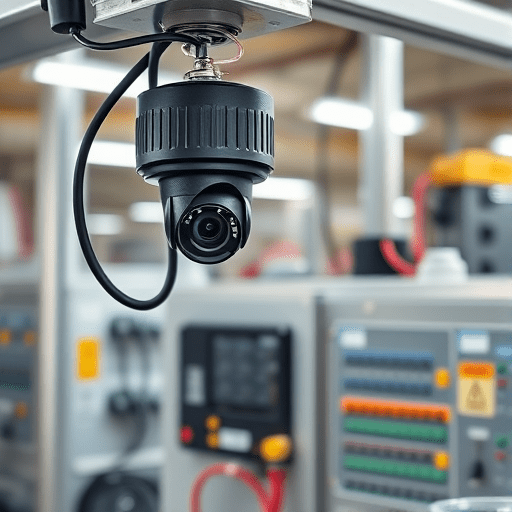
The centerpiece of the build was a $300 industrial smart camera with an integrated image sensor, a Linux-based processor, and a standard Ethernet port. No PC, no frame grabber, and no separate vision controller were required. The camera vendor provided a software development kit, so the plant’s technician could write custom inspection routines in Python and flash them directly to the device. A compact LED ring light was added to guarantee consistent illumination, and the camera was mounted 450 mm above the conveyor belt, looking through a 45-degree mirror bracket that allowed it to capture both the front label and the top flap in a single frame. The total hardware cost, including cabling and a DIN-rail power supply, came to $460.
Choosing the camera took longer than wiring it. The team compared three low-cost models and settled on one with two features that proved essential: a hardware trigger input that could be wired to the existing photo-eye, and a configurable GPIO output that could fire a discrete 24 VDC signal. The camera’s lens was fixed-focus, which eliminated any risk of technicians tampering with the aperture after setup.
Wiring the Smart Camera to the PLC
The most critical design decision was the communication path between the smart camera and the PLC. The plant’s existing controller was a mid-range unit with 24 VDC I/O modules and an Ethernet port, so the team had two viable options: discrete hardwired I/O for real-time pass/fail signals, or Modbus TCP over the local network for richer diagnostics. They implemented both.
A sinking GPIO output on the camera connected to a spare input card on the PLC, providing a low-latency reject trigger. When the camera detected a defective carton, it pulled the output high for 250 ms, and the PLC immediately fired a pneumatic reject lever that diverted the carton to a rework bin. In parallel, the camera pushed a status register over Modbus TCP containing the defect type, a failure code, and timestamp. The PLC was configured as a Modbus client, polling four holding registers every 50 ms and mapping the values to tags in the control program. The discrete wire delivered speed on the physical line; the Modbus data fed the plant’s traceability database.
Programming the Vision Logic
No machine-vision experts were hired. The inspection script relied on classic computer vision techniques: perspective correction, color thresholding, and template matching. When the photo-eye at the infeed detected a carton, it triggered the camera’s hardware input. The script cropped the region around the front label, converted the image to grayscale, and compared it against a stored reference template to check for presence, skew, and label orientation. A second region of interest was analyzed using an OCR pass to verify that the batch code was legible.
If either check failed, the camera set its output high, the PLC fired the reject lever, and the defective carton was sorted away. The team created ten template variants to account for different label designs, with the PLC selecting the correct template automatically from the product code entered at the HMI. Total development time was roughly 12 hours spread across three weeks, most of which went into tuning the lighting and the threshold values.
Results: Slashing Defects Without an Enterprise Payload
The results exceeded every projection. In the 30 days before the installation, the plant shipped an estimated 1,740 defective cartons. After the DIY vision system went live, the first month saw just 168 escaped defects — a reduction of 90.3%. The reject rate settled at a consistent 0.45% of production, and the OEE team quickly realized that the vision system’s data was valuable beyond simple inspection. The distribution of defect codes revealed that the labeling machine’s application roller was drifting out of alignment every few weeks. The plant began using the vision system’s counts as a preventive maintenance trigger, adjusting the roller before the defect rate ever approached an unacceptable threshold.
The financial case was even more compelling. Including the technician’s labor, the total project cost was roughly $3,200. With chargebacks and rework costs running at $14,000 per month, the system paid for itself in less than a week of avoided losses.
Lessons Learned for DIY Factory Vision
Several takeaways deserve emphasis for any team considering a similar project. First, light trumps resolution. The single largest improvement in detection accuracy came from the $70 LED ring light, not from the camera lens. Consistent overhead illumination made the template-matching routine far more stable and eliminated the false rejects that plagued early testing. Second, scope tightly. The project remained simple because the team refused to expand beyond label presence and batch-code legibility. Each additional inspection type would have multiplied the testing matrix and delayed the deployment.
Third, do not neglect network security. Because the smart camera lived on the plant’s production network, it was placed in a VLAN with firewall rules that restricted access to only the PLC’s IP address. Fourth, always handle the reject confirmation in the PLC. The camera should never be the final arbiter of a physical divert action. In this installation, the PLC verified that the reject lever actually fired before logging the event as a successful removal. Finally, prepare for changeovers. The template selection mechanism, driven by the existing product code at the HMI, was what made the system practical in a facility running six sku changes per shift.
Conclusion
This budget case study demonstrates that a motivated controls team can slash packaging errors by wiring a smart camera to a PLC without enterprise software. By combining a low-cost camera, open-source vision techniques, and a straightforward Modbus TCP connection, the plant achieved a dramatic quality improvement in under a month of engineering effort. The project did not require a six-figure budget or a dedicated software engineer — it required a clear problem definition, a willingness to experiment on the bench, and a disciplined approach to wiring and programming. Any facility still relying on human eyes to catch packaging defects has a cheaper option than it thinks.