You’ve paid for the ticket, taken the paper map, and promised yourself you’d follow the chronological route from founding relics to contemporary art. Ninety minutes later, you’re leaning against a display case, unable to remember whether the coin collection came before or after the maritime room. That is museum fatigue—and in big cities, where museums sprawl across entire blocks, it arrives early and stays late. The 3-Room Rule for beating museum fatigue is a deliberate counter-move: choose three rooms that tell the city’s story, skip the chronological drag, and leave with a sharper memory of the place than any four-hour march could give you.
The Chronological Drag Is the Real Exhibit Problem
Most flagship city museums are arranged as timelines, with the assumption that understanding means moving from oldest to newest. Cognitive research on museum fatigue suggests otherwise: after about thirty minutes, attention shifts from looking to scanning, and memory retention drops sharply. A linear route buries the city’s real character under an equal-weight stream of objects. A city is not a timeline; it’s a collision of geography, migration, money, disaster, and reinvention. The 3-Room Rule aligns with the way the brain actually builds narrative—there is a founding condition, a rupture, and a present—rather than fighting the mind with an endless corridor of display cases.
Step One: Define the City’s Story in Three Beats
Before you consult the museum map, define three questions. Almost every major museum in a big city has rooms that answer them:
- Where did this city begin? Look for the origin gallery: founding maps, ship models, street-grid plans, early photographs, and tools from the first settlement.
- What broke the city’s old shape? Find the rupture gallery: industrialization, war, fire, earthquake, migration surges, or political upheaval.
- How does the city see itself now? Head to the reflection gallery: contemporary art, urban-planning displays, current documentary photography, or rooms where local artists respond to today’s conditions.
The Origin Room: Where the City Was Born
The origin room is often small, dimly lit, and mercifully quiet, because most visitors have been funneled toward the blockbuster temporary exhibition. That’s a gift. In Lisbon, the Museu de Lisboa keeps a tile-covered pre-earthquake model of the city—a single object that explains everything that follows. In Mumbai, the maritime and natural history galleries of the Chhatrapati Shivaji Maharaj Vastu Sangrahalaya convey what it meant to be a port before becoming a metropolis. Sit in the origin room for ten silent minutes; it gives you the baseline against which every later transformation becomes legible.
The Rupture Room: The Crucible That Remade Everything
Every major city has a hinge moment, and the rupture room is where museum curators do their most incisive work. For Berlin, it might be the gallery dealing with a divided city; for San Francisco, a room of earthquake and fire; for Mexico City, a hall where colonial violence and indigenous resilience are given equal weight. You don’t need a sensational reconstruction—just a room where the city’s population, infrastructure, and self-image permanently changed. This is the material that separates a genuinely urban museum from a generic cabinet of curiosities.
The Reflection Room: The City Looking at Itself
End with the present. In art museums, this is usually the contemporary floor; in history and city museums, it may be a photography gallery or a “city now” display with audiovisual interviews, neighborhood maps, and objects donated by today’s residents. The reflection room should not confirm what you already know. It should complicate it. If the city is in the middle of a housing crisis, a technology boom, or a cultural rebirth, this is where the museum makes its most honest admission of tension and pride.
How to Locate the Three Rooms in Any Big-City Museum
Arriving without a plan allows the museum’s own logic to dominate—and that’s exactly how museum fatigue wins. Spend the first ten minutes reading the floor plan like a menu, and use a few contrarian cues:
- Ask a guard for the room that isn’t on the tour path. Information desk staff have heard every question; asking “Which gallery best explains how this city changed?” gets an honest answer.
- Ignore the “Highlights” and “Collection” halls. They are the chronological drag in a different costume.
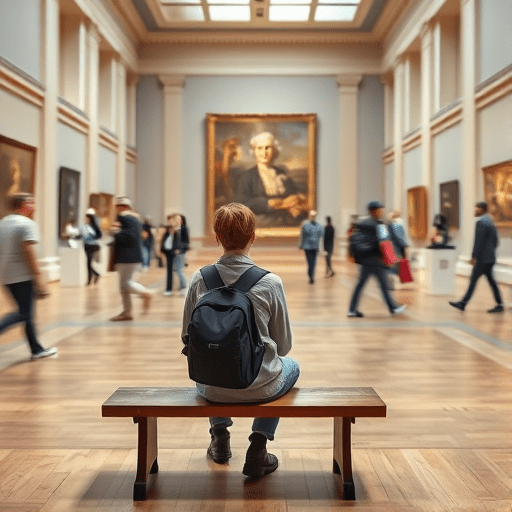
- Follow the benches. Rooms with benches, natural light, and no audio guide are where locals sit to think. That’s a reliable signal of deep curation.
- Browse the gift shop as a Rosetta Stone. If the bookshop has an entire shelf on a single neighborhood or industry, find the corresponding gallery; the shop literally tells you what the curators care about most.
A 90-Minute Three-Room Itinerary
You can implement the rule immediately, with no prior research, by dividing a 90-minute visit into a tight sequence:
- Minutes 0–10: Mark the origin, rupture, and reflection rooms on the floor plan. Resist everything else.
- Minutes 10–30: Tour the origin room, make one full loop, then sit and watch the objects for five minutes.
- Minutes 30–50: Walk directly to the rupture room, ignoring corridor cases. Select one object that symbolizes the moment of change and study it closely.
- Minutes 50–75: Finish in the reflection room. Don’t try to see everything; look for two or three pieces that feel like direct conversations with the city today.
- Minutes 75–90: Return to the café or courtyard and write a three-sentence story connecting the rooms. That story is your entire visit—and it will outlast every blurry selfie from the galleries you skipped.
What You Trade — and What You Gain
The obvious cost of the 3-Room Rule is the fear of missing out. You’ll pass famous paintings and vast decorative arts halls. But visitors typically recall only three to five objects from any museum trip, no matter how long they stay; the rest is a haze of labels and exhaustion. The rule deliberately concentrates your memory allowance into a meaningful arc. You trade the illusion of completeness for the reality of a coherent narrative, and in a big city that trade matters enormously. In 2026, as crowds reclaim major museums, the quietest act of rebellion is choosing fewer and better rooms.
Museum fatigue is not a personal failing; it’s the predictable result of asking your brain to process an entire biography in one afternoon. The 3-Room Rule gives you permission to walk past three-quarters of the building without guilt, to commit deeply to three rooms, and to leave with the city—not just its artifacts—fixed in your mind. Pick the origin, the rupture, and the reflection. Let the chronological drag stay behind you, exactly where it belongs.