In open-world design, pacing a story without breaking tension remains one of the hardest challenges. When players can wander off for hours, the main plot’s urgency often evaporates. The solution lies in a technique called a ticking world status board, combined with time-gated side quests. This approach preserves narrative momentum while still offering the exploration players crave.
The Open-World Pacing Paradox
Open worlds sell themselves on freedom. The player can climb mountains, chase collectibles, or spend entire sessions perfecting a fishing minigame. But that same freedom works against the story. A world on the brink of annihilation becomes suspiciously calm when the player decides to ignore it for forty hours. The villain waits patiently. The army never advances. The plague never worsens. This disconnect between narrated stakes and mechanical reality is what destroys tension.
Traditional solutions include level gates, locked story missions, or cutesy dialog where NPCs remind the player to come back. These feel artificial. A better approach treats time as a first-class mechanic. The world doesn’t wait for the player; it reacts to the passing of hours and days, both in real time and in game logic. That’s where the ticking world status board enters the scene.
What Is a Ticking World Status Board?
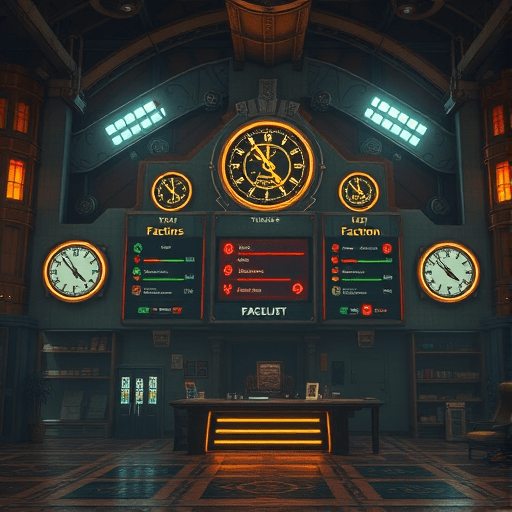
A ticking world status board is a persistent, visible representation of the current state of the central conflict. Unlike a simple quest tracker, it tracks the health of factions, military fronts, political alliances, or even emotional states of key characters. The board changes based on two inputs: the player’s actions and the passage of time. For example, if the main story involves a resistance movement, the board might show enemy patrol zones expanding each day, supply drops getting smaller, or safe houses being discovered.
The “ticking” part means that time itself moves the narrative forward. The board’s updates are not tied only to completed quests. They happen hourly or daily according to a set schedule, often driven by internal game clocks. This design signals to the player that the world is alive. It doesn’t matter whether the player is standing there staring at the board or off doing side content — the conflict will progress, for better or worse.
A well-designed status board also creates feedback loops. If the player ignores a pressing threat, the board visually degrades. Icon colors shift from green to yellow to red. Sound cues might intensify. This constant reminder keeps the main story’s urgency simmering in the background without interrupting exploration. It is not a pop-up nagging the player; it is a subtle, elegant pressure mechanism.
Designing Time-Gated Side Quests That Support the Main Story
Time-gated side quests are the natural companion to a ticking world status board. These are optional activities that only become available during certain time windows or before a specific narrative event. Critically, they are not separate from the main plot. Instead, they feed into it. Completing a time-gated side quest can slow the enemy advance, unlock a new safe route, or gather crucial intelligence. Failing to do so makes the main story harder — not impossible, but more punishing.
For example, imagine a side quest that requires the player to repair a bridge before an incoming army arrives. The status board shows the army’s estimated arrival in three in-game days. If the player repairs the bridge in time, the main assault changes: troops arrive from a different direction, or reinforcements get through. If not, the player faces a tougher battle and sees the consequences reflected on the board.
These quests work best when their time windows are generous enough to allow exploration but strict enough to maintain urgency. A 48-hour window in game time is usually plenty. The player can finish one or two moderate side activities and still make it. This design respects player autonomy while creating a natural rhythm: explore, check the board, gated quest, return to the critical path. It paces the story in a way that feels organic.
Where to Place the Board and How to Update It
Placement matters. The status board should be highly accessible, ideally in a central hub the player returns to regularly — a base camp, a hidden hideout, a personal ship. Physical boards in the world are more immersive than menus, but they require player travel. Consider both: a physical board for role-playing and a minimal UI widget for convenience that mirrors its data.
Updating the board shouldn’t be overdone. A mountain of tiny changes every minute creates noise. Instead, update it at meaningful intervals: after a major story beat, at the start of each in-game day, or when a time-gated quest expires. Use simple visual language — bar graphs, icons, weather symbols — so the player can glance at it and understand the global situation in two seconds.
The board also needs to reflect player agency. If the player succeeds in a time-gated side quest, the board should visibly improve. If they ignore it, the board worsens. That cause-and-effect loop is what makes the ticking world feel fair. Players can see exactly where their efforts went and what they missed.
Avoiding Player Frustration: Communicate Urgency Clearly
Time mechanics can be dangerous. If the player feels cheated by missing a quest because they had no warning, resentment builds. Clear communication is the cure. The status board must include explicit deadlines tied to each time-gated quest. Use in-game clocks, day-night cycles, or analog systems like “sunrise on the third day.” Never rely solely on real-world hours, because players pause, sleep, or leave the game. An in-game calendar is far more reliable and fair.
Also consider allowing the player to save before a deadline. Some games use a special indicator, like an icon next to a quest that signals “ends soon.” Others use a journal with checkboxes. The goal is to let the player make informed choices. The tension comes from trade-offs, not from confusing mechanics.
Finally, build in forgiveness. Not every side quest needs to be time-gated. Reserve that pressure for a handful of high-impact activities. The rest can remain evergreen. This balances the emotional weight of the ticking world with the relaxation that makes open worlds appealing.
Example in Action: A City Under Siege
Picture an open-world game where the main story is defending a city from a siege. The ticking world status board shows four key fronts: eastern wall, western supply road, northern hospital, and southern refugee camp. Each has a defense rating. A countdown on the board announces the grand assault in ten in-game days. The player is free to explore, but the board slowly shifts. Every evening, the enemy raids a different front.
Time-gated side quests are scattered across the city and its surroundings. One quest asks the player to secure a weapon cache before the next sunset. Another requires joining a patrol in two days to ambush an enemy scout. Each quest takes a few hours of game time and directly boosts one of the four ratings. The player must choose which front to support, knowing they can’t do everything. This is decision-driven pacing.
As the assault day approaches, the board updates faster. Defenses decay if unmaintained. Morale drops when food stalls are destroyed. The player feels the story accelerating. The final battle isn’t just a scripted cutscene; it’s a payoff shaped by every time-gated choice they made. That’s how tension stays intact, even after hours of open-world wandering.
For other narrative design tricks that respect player agency, consider how environmental storytelling and quest chains interact with time.
Balancing Freedom and Pressure
Not every open-world game needs a ticking clock. But for those that feature high-stakes plots, the status board plus time-gated side quests offer a surgical fix. They create pressure without removing player choice. They also solve the “ludonarrative dissonance” problem — the mismatch between story urgency and gameplay freedom.
The trick is moderation. After a major story arc, give the board a slow period. Let the player breathe for a few in-game days. Then introduce a new threat. This creates a wave pattern of tension: build, peak, release. A constantly screaming board makes players numb. A silent board makes them forget. The rhythm matters as much as the mechanism.
When done right, the world feels truly alive. The player isn’t simply following quest markers; they are reading a living system, making meaningful choices, and feeling the consequences on a visible canvas. That is the heart of good pacing.
In conclusion, pacing a story in open-world games without breaking tension requires turning time into a narrative tool. A ticking world status board keeps the main conflict visible and meaningful, while time-gated side quests give players reasons to engage with it. This technique converts the open world from a distraction into a story engine, ensuring that even the most meandering journey never loses sight of what’s at stake.