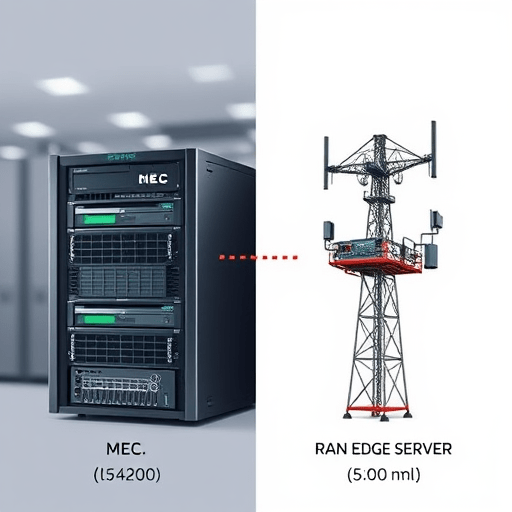
The promise of 5G was never just speed—it was the ability to connect machines, vehicles, and instruments with near-instantaneous response. Yet for real-time applications, the network path still gets in the way. Choosing between MEC vs. RAN edge isn’t a matter of picking the closest server; it’s about understanding where compute should live so that the latency budget actually balances. The question is not “which is faster,” but “which is the right layer for the workload.” As 5G-Advanced networks emerge in 2026, the answer is becoming more nuanced than ever.
Revisiting the Latency Budget: Why the “Closest Compute” Takes Too Long
A 1-millisecond radio round trip is impressive, but it becomes meaningless if the application’s brain is 30 milliseconds away. The widely cited 1 ms to 10 ms 5G latency targets assume that the data center is co-located at the aggregation point or even within the radio access network. However, physical distance, routing hops, queuing, and protocol processing consume the budget faster than most architecture diagrams suggest.
In practice, for a telesurgery controller or a synchronized robotic swarm, the total end-to-end latency matters, not just the air interface. That total includes sensor processing, edge inference, and command generation. The placement of compute—whether in a regional MEC node or inside the RAN’s far edge—changes the equation significantly. A regional MEC site at the metro aggregation point might add 10 to 15 ms round trip. A RAN edge server, embedded in the baseband unit or co-located at the cell site, could cut that to 2 to 5 ms. But that reduction comes with steep tradeoffs in capacity, management, and cost.
MEC vs. RAN Edge: Defining the Two Layers
Before diving into tradeoffs, it is useful to clarify what each term means in a 5G context. Multi-access edge computing (MEC) is a network architecture that places IT services at the edge of the operator’s network, typically at aggregation points, metro data centers, or even enterprise premises. It is not tightly coupled to the radio layer. In contrast, RAN edge—sometimes called “far edge” or “radio edge”—places compute and storage directly within the base station or at the distributed unit (DU) / central unit (CU) boundary. This layer is aware of radio resource states and can react to them in real time.
MEC: The Flexible, Distributed Middle Ground
MEC nodes are easier to deploy on standard x86 or ARM hardware. They support multi-tenant use cases, run VMs or containers, and integrate well with 5G core network functions. For many over-the-top real-time applications—such as cloud gaming, live video analytics, or AR/VR streaming—a MEC node located at the regional point of presence is sufficient. It keeps traffic out of the backhaul, but it still requires a fixed route through the transport network. MEC is the pragmatic choice when you need high compute density, massive storage, and broad coverage without rewriting the RAN.
RAN Edge: The Ultra-Low-Latency, High-Stakes Layer
RAN edge compute is embedded inside the radio infrastructure itself, often using a PCIe card or an integrated accelerator in the base station. Because it can inspect radio scheduling decisions and synchronize with TTI (transmission time interval) boundaries, it offers the lowest possible latency for time-critical control loops. But it is also a scarce resource. You cannot run a general-purpose Kubernetes cluster at every cell site without huge power budgets and space requirements. RAN edge is primarily designed for limited, deterministic workloads: real-time beamforming, intelligent scheduling, physical-layer AI, or localized safety functions.
Key Deployment Tradeoffs for Real-Time Applications
When comparing MEC vs. RAN edge for a particular use case, engineers and operators must evaluate six core tradeoffs. The right answer usually depends on a weighted combination of them.
- End-to-end latency: RAN edge consistently delivers lower round-trip times (under 5 ms), while MEC often sits between 10 and 30 ms depending on the transport network.
- Compute capacity: MEC offers far larger CPU, GPU, and memory pools. RAN edge is constrained by thermal limits and physical space, making it unsuitable for heavy inference workloads.
- Network context awareness: RAN edge can access radio-level metrics like channel quality, interference, and handover events. MEC relies on network functions northbound, which lose that granularity.
- Scalability and elasticity: MEC can scale horizontally by adding nodes at aggregation sites. RAN edge scaling requires deploying at every cell site—an expensive and operationally heavy task.
- Application management: MEC supports a broader ecosystem of lifecycle management tools, service meshes, and observability stacks. RAN edge often requires vendor-specific SDKs or a dedicated real-time operating system.
- Total cost of ownership: MEC benefits from shared infrastructure and off-the-shelf hardware. RAN edge requires ruggedized, hardware-accelerated platforms and more frequent physical maintenance.
Real-Time Use Cases That Favor MEC
Many real-time applications do not actually need radio-orchestrated latency. They need predictable low latency with a manageable backhaul and enough compute for AI models. For these, MEC is the right layer.
- Cloud-controlled robotics: Factories and warehouses can use MEC with local Wi-Fi or 5G and still achieve 20 ms control loops, which is sufficient for many industrial arms and autonomous mobile robots.
- Video analytics for safety: A MEC node at a campus edge can process multiple security streams with AI models, alerting operators in under 50 ms—a latency budget that does not require RAN-level awareness.
- AR/VR live events: Spatial audio and 3D rendering offload works well at a metro MEC node; the network path is stable and the required compute is too heavy for cell-site servers.
- Edge gaming: Cloud streaming platforms already use regional edge nodes to keep round-trip time under 30 ms, balancing player experience with compute utilization.
Real-Time Use Cases That Demand RAN Edge
There is a smaller but growing set of applications where every millisecond is sacred and the radio network itself must participate in the decision loop. These are the scenarios where RAN edge is becoming unavoidable.
- AI-based beamforming and radio sensing: The RAN edge can run inference on channel state information to adapt the antenna array in real time, improving spectral efficiency and reducing retransmission latency.
- Time-sensitive networking for industrial control: Synchronized motor drives and CNC machines require deterministic sub-10 ms traffic, with both data plane enforcement and application logic co-located inside the RAN edge.
- Autonomous vehicle collision avoidance: In a platoon of connected trucks, the vehicle-to-infrastructure decision needs near-zero variance. Placing the collision prediction model at the RAN edge allows the network to act as a reflex arc, bypassing the core.
- Emergency service multicast: First responders rely on low-latency push-to-talk and telemetry; RAN edge can prioritize these packets based on radio resource awareness, while MEC cannot impact scheduling.
Making the Call in 2026: A Pragmatic Framework
The “right” layer is rarely static. In 2026, operators are adopting a layered edge model where applications can migrate between MEC and RAN edge based on network conditions and workload characteristics. The decision should start with a latency budget test: if the required round-trip time is under 10 ms with strict jitter limits, start evaluating RAN edge. If the budget exceeds 10 ms or the workload needs substantial compute resources, MEC is the better fit.
Another shift changing the equation is the adoption of RAN intelligent controllers (RICs). The near-real-time RIC at the edge can expose certain control capabilities to MEC applications, blurring the line. In 2026, the most effective systems combine both layers: a RAN edge node for the time-critical control loop and a MEC node for heavy data processing, model training, and user-facing services. The two layers are no longer competitors; they are partners in a distributed compute fabric.
Conclusion
Choosing between MEC and RAN edge is ultimately about matching application requirements to physical and economic reality. MEC offers scalability, manageability, and general-purpose compute, while RAN edge provides deterministic low latency and radio-aware control. For real-time apps in 2026, the most resilient design will treat both as complementary tiers, allowing traffic to flow to the appropriate layer as latency demands change.