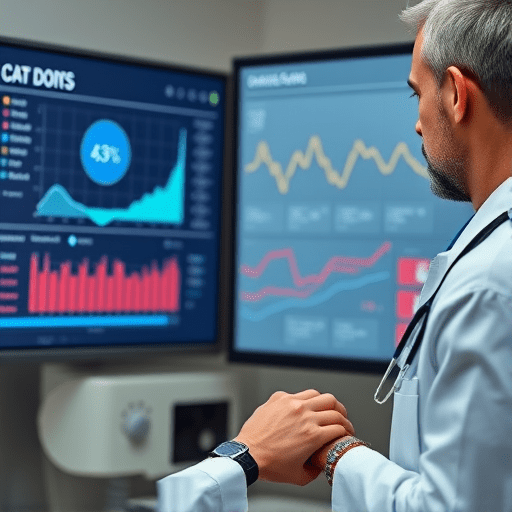
In 2026, the convergence of continuous wearable monitoring and electronic health records (EHR) is transforming cardiology practice. By embedding raw physiologic streams into the EHR, clinicians can access AI-driven medication dosing recommendations and receive early warnings of arrhythmia—all in real time. This article outlines a practical, step‑by‑step workflow that clinicians can adopt to merge wearable metrics with the EHR, enabling precision therapy and proactive patient safety.
Why Real-Time Integration Matters in Cardiology
Traditional cardiology workflows rely on sporadic ECGs and lab results, often spaced days apart. In contrast, wearables capture heart rate, rhythm, blood pressure, and oxygen saturation continuously. When these data are streamed into the EHR, AI models can:
- Generate dynamic drug dosing schedules that adapt to the patient’s current physiology.
- Identify subtle arrhythmic patterns before they manifest clinically.
- Provide clinicians with actionable alerts that fit seamlessly into their chart‑review routine.
Clinicians, therefore, gain a powerful toolset that elevates patient care from reactive to predictive.
Core Architecture: Building the Data Ingestion Pipeline
The first step is to establish a robust data pipeline that can handle high‑volume, time‑stamped streams. A typical architecture includes:
- Device SDKs and Gateways – Wearables expose APIs; gateways translate raw data into FHIR resources.
- Message Queues (e.g., Kafka, RabbitMQ) – Buffer bursts of telemetry and ensure fault tolerance.
- FHIR Endpoint – The EHR’s FHIR server ingests Observations, Vital Signs, and Arrhythmia alerts.
- Security Layer – TLS, OAuth 2.0, and role‑based access control protect data in transit and at rest.
By decoupling the ingestion layer from the EHR, hospitals can upgrade devices or add new data sources without overhauling their clinical infrastructure.
Data Harmonization: Standards and Interoperability
Uniformity is essential for AI to draw meaningful conclusions. Implement the following harmonization practices:
- FHIR Coding Systems – Use LOINC for vitals, SNOMED CT for observations, and RxNorm for medications.
- Time Alignment – Convert device timestamps to UTC and tag each observation with a sequence number.
- Missing Data Handling – Impute gaps using interpolation or model‑based techniques, ensuring transparency.
- Device Provenance – Record manufacturer, firmware version, and sensor calibration data in the Provenance resource.
These steps guarantee that downstream analytics receive clean, comparable data regardless of device brand.
AI-Driven Dosing Engine
Medication titration is a perennial challenge for heart failure, arrhythmia, and hypertension management. An AI dosing engine leverages continuous vitals to recommend dosage adjustments in real time.
Key components include:
- Clinical Rules Engine – Hard‑coded safety constraints (e.g., max dose, contraindications).
- Predictive Models – Gradient‑boosted trees or deep learning networks that estimate drug response from time‑series data.
- Optimization Layer – Multi‑objective algorithms balancing efficacy, side‑effect risk, and patient preference.
- Feedback Loop – Clinician overrides are logged and fed back to retrain the model, ensuring continuous improvement.
When the engine outputs a dosing suggestion, the EHR presents it in the medication reconciliation view, accompanied by a confidence score and a brief rationale. This empowers clinicians to make evidence‑based decisions quickly.
Early Arrhythmia Alert System
Detecting atrial fibrillation or ventricular ectopy before they become symptomatic can prevent strokes and sudden cardiac death. An AI alert system operates as follows:
- Signal Preprocessing – Filtering, baseline wander removal, and artifact detection.
- Feature Extraction – RR interval variability, QRS morphology, and heart rate turbulence.
- Classification – Real‑time neural networks trained on millions of annotated ECG snippets.
- Alert Generation – If probability exceeds a clinician‑defined threshold, the system pushes a Level‑2 alert to the EHR.
Alerts appear within the patient’s chart as a dynamic “Arrhythmia Tracker” widget, showing a sliding window of events and trend analysis. Clinicians can drill down to raw data or export a report for multidisciplinary review.
Clinician Workflow Integration
Seamless adoption hinges on integrating wearable insights into the clinician’s existing workflow. Consider the following design principles:
- Non‑Disruptive Dashboards – Place the wearable summary panel on the patient overview screen, allowing quick scan without leaving the chart.
- Smart Notifications – Push alerts only when they pass a double‑check threshold or when a clinician has paused for the patient’s visit.
- Actionable Links – Each alert includes a “Review Dosing” button that launches the AI dosing engine, and a “View Arrhythmia Detail” link that opens the full waveform.
- Audit Trail – Every AI recommendation and alert includes metadata (timestamp, model version, confidence) for legal compliance.
By embedding the wearable analytics into the familiar EHR interface, clinicians can interpret and act on real‑time data without learning new systems.
Data Governance & Privacy
Wearable data pose unique privacy concerns. Ensure compliance through:
- Patient Consent Workflows – Embedded consent forms in the app and the EHR, detailing data use and sharing.
- Data Minimization – Store only the essential fields required for AI inference.
- Encryption & Masking – Apply AES‑256 encryption for stored data and mask identifiers before model training.
- Audit Logging – Maintain tamper‑evident logs for all data access events.
These measures align with HIPAA, GDPR, and emerging U.S. federal guidelines on wearable health data.
Case Study Snapshot: Heart Failure Patient at St. Mary’s Hospital
Dr. Liu, a cardiologist at St. Mary’s, oversees a 68‑year‑old patient with reduced ejection fraction. The patient wears a multi‑sensor patch that streams heart rate, rhythm, and blood pressure every minute. In the EHR, the AI dosing engine flags that the patient’s daily average systolic BP is 120 mmHg, yet the patient’s LVEDP suggests fluid overload. The system recommends increasing the diuretic dose by 25 mg, with a confidence score of 0.87.
Simultaneously, the arrhythmia alert detects intermittent nonsustained ventricular tachycardia. Dr. Liu reviews the 10‑minute ECG segment within the chart, confirms the arrhythmia, and orders a telemetry monitor. Over the next week, the patient’s symptoms improve, and the AI engine downgrades the dosing recommendation to 5 mg once the biomarkers normalize.
Key takeaways:
- Real‑time data accelerated therapeutic decisions.
- AI provided transparent, evidence‑based dosing rationale.
- Clinician oversight maintained patient safety and trust.
Future Outlook: From Precision to Predictive Care
By 2030, we anticipate several evolutions:
- Federated Learning – Models trained across multiple hospitals without sharing raw data.
- Cross‑Device Analytics – Integrating data from smart watches, implantable monitors, and even home spirometers.
- Patient‑Centered Dashboards – Allowing patients to view their own data streams and receive AI‑generated recommendations directly.
- Regulatory Harmonization – Standardized AI validation protocols and clearer guidance on algorithmic transparency.
These advances will further tighten the loop between continuous monitoring and clinical action, solidifying wearable‑EHR integration as a cornerstone of cardiology precision medicine.
In summary, merging wearable metrics with the EHR in real time equips clinicians with AI‑driven dosing tools and early arrhythmia alerts, enabling proactive, data‑guided care. By adopting a modular, standards‑based architecture, harmonizing data, embedding AI insights into familiar workflows, and maintaining rigorous governance, healthcare organizations can unlock the full potential of wearable health technology in cardiology practice.