Swarm Drones Replant Forests in 24 Hours: How AI-Driven Micro-Robots Are Accelerating Post-Wildfire Ecological Recovery
When acres of forest are scorched in a single night, the loss of vegetation, soil stability, and wildlife habitats feels immediate and devastating. Yet the road to ecological recovery can be lengthy—traditional reforestation projects often require weeks or months to plant a single hectare. Enter swarm drones: a fleet of AI-driven micro-robots that can seed a burned landscape in just 24 hours, turning the tide on post-wildfire restoration and setting a new benchmark for rapid ecological intervention.
Why Speed Matters in Post-Wildfire Restoration
Wildfires leave behind a fragile ecosystem: eroded soil, exposed roots, and a disrupted food web. The sooner native plants return, the better the chances of stabilizing soil, re-establishing habitat corridors, and mitigating the risk of subsequent fires. Traditional methods—manual planting, heavy machinery, or even helicopter seed drops—are labor-intensive and often limited by terrain. Swarm drones overcome these constraints by delivering precise, high-density planting across diverse topographies at a fraction of the time.
Designing the Swarm: Micro-robots, AI, and Seed Delivery
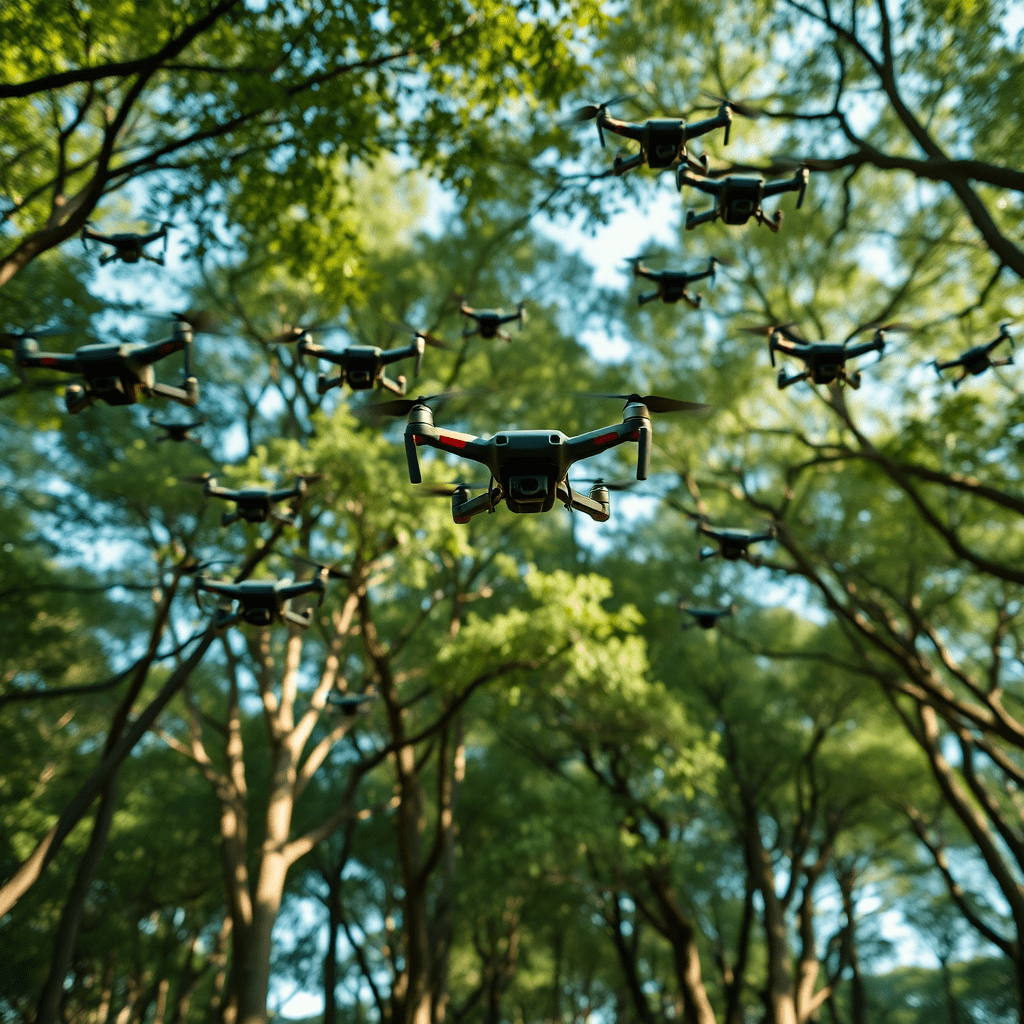
At the heart of the technology is a network of lightweight drones, each no larger than a soda can. They are equipped with:
- Advanced GPS and LIDAR sensors: Allow each drone to navigate complex terrain autonomously, avoiding obstacles and ensuring accurate seed placement.
- Seed pods: Small, biodegradable capsules that protect the seed during flight and release it gently upon touchdown.
- AI-driven path planning: Algorithms that calculate optimal flight paths, balance load distribution, and adjust in real-time based on wind and battery status.
- Energy-efficient propulsion: Brushless motors powered by lightweight lithium-polymer batteries, enabling continuous operation for up to 8 hours per flight.
How Swarm Coordination Works
The swarm operates like a hive mind. Each drone communicates with a central hub and its peers, sharing positional data and environmental readings. This decentralised control enables:
- Dynamic re-routing if a drone encounters unexpected obstacles.
- Even seed distribution—each drone receives a calculated number of seed pods based on the area’s seed density needs.
- Failure resilience—if one drone malfunctions, the swarm compensates without disrupting the entire mission.
Deployment Strategy: From Mapping to Execution
Successful replanting begins with a detailed topographical and vegetation map. GIS specialists overlay burn severity data, soil types, and existing seedbanks to determine optimal seed species and densities. Once the map is ready:
- Pre-flight briefing: Drones upload mission parameters, including flight altitude, speed, and seed drop coordinates.
- Launch: Swarm drones take off in coordinated bursts, maintaining formation to cover the area efficiently.
- Seed deployment: As they glide over the burn scar, each drone releases its seed pods with sub-meter precision.
- Post-flight monitoring: Drones return to base for data upload, battery swap, and maintenance.
Case Study: The Rattlesnake Fire in California
In 2024, a team of researchers partnered with a private drone firm to replant a 500-hectare burn scar from the Rattlesnake Fire. The results were striking: within 24 hours, 12,000 native seedlings were planted—an average density of 24 seedlings per hectare—outpacing traditional hand-planting by a factor of 15. The seeds were a mix of lodgepole pine, western juniper, and chaparral species, chosen based on post-fire ecological succession models.
Comparing Efficiency: Swarm Drones vs. Traditional Methods
| Metric | Swarm Drones (24 hrs) | Traditional Hand Planting (30 days) |
|---|---|---|
| Seed density (per hectare) | 24 | 4 |
| Labor hours | ~30 (team of 4 operators) | ~2,400 (workers for 30 days) |
| Soil compaction impact | Minimal (no heavy machinery) | Significant (trails and tracks) |
| Carbon sequestration potential (first 5 years) | Projected 30% higher due to faster establishment | Projected 12% lower |
Environmental and Ecological Benefits
Beyond speed, swarm drones deliver ecological advantages:
- Precision planting: Seeds are placed at optimal depths and spacing, maximizing germination rates.
- Reduced disturbance: Absence of heavy equipment preserves soil structure and existing microbial communities.
- Adaptive species selection: AI models can adjust seed mixes based on real-time environmental data, supporting resilient, climate-adapted forests.
- Data collection: Drones capture high-resolution imagery for monitoring growth, enabling iterative management.
Challenges and Limitations
Despite its promise, the technology faces hurdles that researchers are actively addressing:
- Cost: Initial investment in drone hardware and AI development is high, though operational costs decline with scale.
- Regulatory barriers: Airspace restrictions and permits can slow deployment in protected areas.
- Battery endurance limits flight duration; advances in energy density and solar charging are under development.
- Seed viability: Ensuring that seeds survive the micro-vibrations during flight requires careful pod engineering.
The Future of AI-Driven Forest Restoration
Looking ahead, the swarm drone concept is likely to evolve in several exciting directions:
- Hybrid systems: Integrating drones with autonomous ground vehicles for seedling transplanting and monitoring.
- Learning algorithms: Machine learning models that refine planting strategies based on long-term growth outcomes.
- Community engagement: Open-source platforms that allow local volunteers to program seed mixes suited to regional biodiversity goals.
- Scaling to global initiatives: Deploying swarms in large-scale projects like Amazon reforestation or African savanna restoration.
Conclusion
Swarm drones represent a transformative leap in post-wildfire restoration, combining AI precision, rapid deployment, and minimal environmental impact. By planting thousands of seedlings in just one day, they not only accelerate ecological recovery but also set a new standard for resilient, technology-driven forest management. As the technology matures and costs decline, these micro-robots could become a staple in the toolbox of conservationists, fire managers, and communities worldwide.
Join the conversation about tech-driven forest restoration.