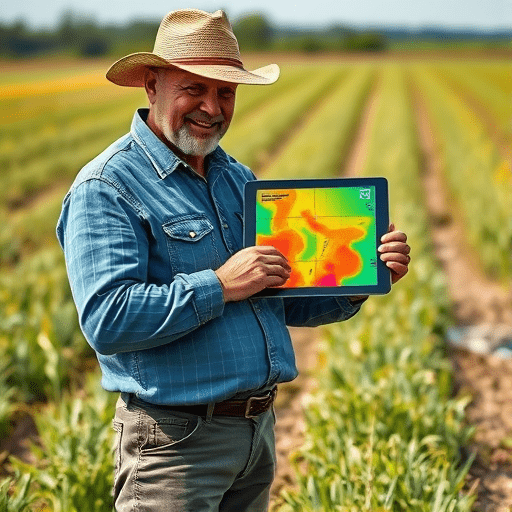
In 2026, precision agriculture moves beyond simple sensor arrays to integrated, AI‑driven dashboards that translate raw data into instant, field‑level decisions. An AI‑Enabled Soil Health Dashboard fuses satellite imagery, on‑ground IoT, and farm history to produce real‑time maps of nutrient status, moisture dynamics, and microbial activity—all designed to maximize yield while preserving soil integrity. This guide walks you through the architecture, data pipelines, machine learning strategies, and deployment choices that make such dashboards practical for today’s growers.
Why Real-Time Soil Health Matters in 2026
Soil is the linchpin of sustainable production, yet its complexity makes it one of the hardest variables to manage. Traditional soil testing takes weeks, producing static snapshots that quickly become obsolete under rapid weather shifts. Modern growers need continuous, high‑resolution insight to adjust fertilizer rates, irrigation schedules, and crop rotations in the moment. Real‑time dashboards provide that immediacy, enabling:
- Targeted input applications that cut costs and runoff.
- Dynamic field zoning that responds to micro‑climate changes.
- Early detection of nutrient deficiencies or salinity hotspots.
- Data‑driven evidence for compliance with environmental regulations.
Core Data Streams for a Smart Dashboard
Satellite and UAV Imaging
2026 satellite constellations deliver 30‑cm to 10‑cm imagery every 3–4 days, while commercial UAVs can fly daily and capture multispectral or hyperspectral data at sub‑meter resolution. These feeds are the foundation for spectral indices like NDVI, Soil Moisture Index, and Chlorophyll‑a proxies, which are converted into predictive soil health metrics.
On‑Ground IoT Sensors
Low‑power, battery‑backed sensors provide continuous readings of volumetric water content, electrical conductivity (EC), temperature, and dissolved oxygen. Soil microbial probes now include CO₂ and CH₄ flux meters, giving early clues about biotic activity. Edge computing nodes preprocess this data, performing sanity checks and aggregating values before transmitting to the cloud.
Farm Management Systems & Historical Records
Farmers’ existing crop‑management software stores planting dates, seed varieties, past yields, and input histories. By ingesting these records, the dashboard can correlate current soil conditions with previous management decisions, creating a feedback loop that refines future recommendations.
Architecting the AI Pipeline
Data Ingestion & Edge Processing
Incoming data streams are normalized into a common schema. Edge nodes run lightweight anomaly detection to flag sensor failures or abrupt environmental changes, ensuring only clean data reaches the central ML layer. Time‑series buffering allows for interpolation where sensor gaps exist.
Feature Engineering: From Pixels to Nutrient Maps
Spectral indices are derived from raw imagery, then calibrated against ground truth samples using regression models. Multi‑modal fusion techniques combine optical, thermal, and radar signatures to predict soil moisture, organic matter, and texture classes. Feature stacks include:
- Normalized Difference Soil Index (NDSI)
- Thermal Derivative Soil Moisture (TDSM)
- EC‑Weighted Microbial Activity (EWMA)
Model Selection: Deep Learning Meets Explainability
Convolutional Neural Networks (CNNs) map high‑resolution imagery to nutrient concentration heatmaps. Recurrent Neural Networks (RNNs) capture temporal trends in sensor data, feeding into a Gradient Boosting model that predicts upcoming yield. Layer‑wise relevance propagation (LRP) is employed to trace model outputs back to specific inputs, allowing growers to understand why a recommendation is made.
Continuous Learning Loop
At the end of each growing season, the dashboard ingests yield and quality data, feeding it back into the training pipeline. Federated learning protocols enable multiple farms to update shared models without sharing raw data, preserving privacy while accelerating model convergence.
Visualization & Decision Support
Interactive Heat Maps & Drill-Down Analytics
The front‑end employs WebGL for rendering large geospatial rasters in real time. Users can pan, zoom, and toggle layers such as “Nitrogen Status,” “Moisture Trend,” and “Microbial Heat.” Hovering reveals numeric values, while right‑clicking initiates a drill‑down to sub‑field plots and historical comparisons.
Predictive Yield Forecasting
A dedicated forecasting module uses the latest soil and weather inputs to project 7‑ and 30‑day yield potentials. Confidence intervals are visualized as shaded bands, giving growers a risk‑aware picture of performance expectations.
Alerting & Actionable Recommendations
Rule‑based thresholds trigger alerts (e.g., “Soil N below 8 ppm in Zone 3”). Machine‑generated action plans suggest precise fertilizer rates, irrigation volumes, and timing, all calibrated to the specific sub‑field and expected crop response.
Deployment Strategies for Field-Ready Dashboards
Hybrid Cloud / Edge Architecture
Critical latency‑sensitive tasks—like edge anomaly detection and real‑time visualization—run on local gateways, while heavy model inference is offloaded to a low‑latency cloud instance. This hybrid approach keeps the dashboard responsive even in remote regions.
Scalability & Latency Considerations
Containerized microservices orchestrated by Kubernetes enable horizontal scaling as data volume grows. GraphQL endpoints provide flexible, low‑bandwidth queries for mobile clients, ensuring that even smartphones can render complex maps without long waits.
Security & Data Governance
Data encryption at rest and in transit, role‑based access controls, and compliance with GDPR and CCPA safeguard farmer privacy. The dashboard logs all actions to an immutable audit trail, satisfying audit requirements for high‑value crops.
Case Study: A Midwestern Corn Belt Farm
GreenFields, a 1,200‑acre corn operation, implemented the AI‑Enabled Soil Health Dashboard over two growing seasons. By integrating a constellation of Sentinel‑2 imagery, 50 on‑field EC sensors, and their existing agronomic software, they achieved a 12 % yield increase while reducing nitrogen fertilizer use by 18 %. Real‑time alerts prevented a 4 % loss in a drought‑prone year by prompting early irrigation in moisture‑depleted zones.
Challenges & Mitigation
Data Quality & Standardization
Inconsistent sensor calibration and missing imagery can bias models. A robust data governance framework, including periodic calibration checks and automated metadata tagging, mitigates these risks.
Model Drift & Environmental Variability
Soil‑climate interactions evolve with each season. Continuous retraining, supported by federated learning, keeps models aligned with current conditions. Monitoring performance metrics (MAE, R²) on a rolling basis flags drift early.
Farmer Adoption & Usability
Complex dashboards can overwhelm users. Incorporating guided tours, contextual help bubbles, and customizable layouts ensures that growers of all technical backgrounds can harness the system effectively.
The Road Ahead: AI Trends Transforming Soil Health
Federated Learning Across Farms
Collaborative training across diverse operations accelerates model accuracy without compromising data sovereignty. Farmers can share insights indirectly, benefiting from a broader knowledge base.
Blockchain for Provenance & Trust
Immutable ledgers record each data point and recommendation, providing verifiable traceability for supply chain partners and regulatory bodies. This enhances trust and unlocks premium market segments.
Integration with Autonomous Machinery
AI dashboards are evolving into orchestration hubs for autonomous sprayers, precision planters, and robotic weeders. Real‑time soil maps can direct these machines to apply inputs with centimeter accuracy, further tightening input efficiency.
As the digital layer of agriculture matures, an AI‑Enabled Soil Health Dashboard is not just a tool but a strategic asset that translates data into higher yields, lower costs, and sustainable stewardship of the soil foundation.