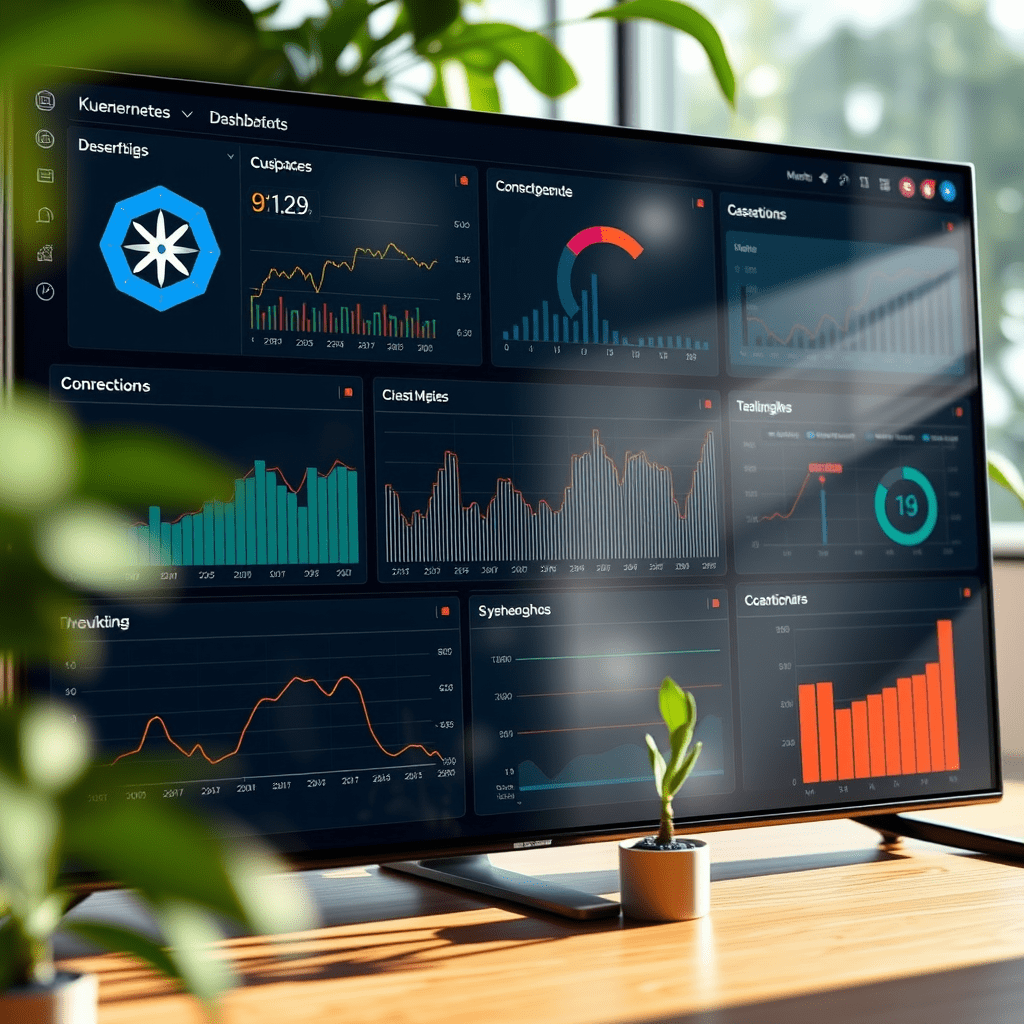
AI‑Driven Container Auto‑Scaling: Predicting Demand with Time‑Series Models
In the era of microservices, the demand for agile, cost‑efficient scaling solutions has never been greater. Traditional rule‑based Kubernetes Horizontal Pod Autoscalers (HPAs) react to instantaneous metrics like CPU or memory usage, but they often struggle to anticipate future spikes or troughs. By leveraging AI‑driven time‑series models, operators can predict container demand ahead of time, enabling proactive scaling decisions that reduce latency, improve utilization, and cut cloud spend.
Why Rule‑Based Scaling Falls Short
Rule‑based HPAs use thresholds (e.g., “scale up when CPU > 80%”) to trigger scaling actions. While simple to configure, this approach has several shortcomings:
- Reactive, not predictive – Scaling occurs only after a metric breach, often after a delay caused by the HPA’s polling interval.
- Oscillation – Sudden spikes can cause pods to scale up and down rapidly, leading to thrashing.
- Resource waste – Over‑provisioning to hedge against peaks keeps idle resources running.
- Limited context – Thresholds cannot account for factors like scheduled batch jobs, day‑of‑week effects, or external traffic patterns.
AI‑driven autoscaling addresses these issues by learning patterns from historical data and providing a forecast that guides scaling decisions before load actually changes.
Time‑Series Forecasting Foundations
At its core, time‑series forecasting predicts future values of a metric (e.g., CPU load, request count) based on its past observations. The main classes of models used in AI‑driven autoscaling include:
- Statistical Models – ARIMA, SARIMA, and Prophet capture seasonality, trend, and autocorrelation.
- Machine Learning Models – Random Forests, Gradient Boosting regressors, and ElasticNet can model non‑linear relationships when engineered features are supplied.
- Deep Learning Models – LSTM, GRU, and Temporal Convolutional Networks (TCN) excel at learning long‑term dependencies in sequential data.
Choosing the right model depends on data volume, required prediction horizon, interpretability, and available compute.
Data Collection & Preprocessing
Successful forecasting starts with robust data ingestion. Typical steps include:
- Metric aggregation – Pull metrics from Prometheus, CloudWatch, or custom exporters at a consistent sampling interval (e.g., 30 s).
- Handling missing values – Impute gaps using forward fill or interpolation to maintain sequence continuity.
- Outlier detection – Flag sudden spikes due to misconfigurations or monitoring noise; optionally remove or cap them.
- Normalization – Scale metrics to a 0–1 range to aid model convergence, especially for neural networks.
Feature Engineering
Beyond raw metrics, enrich the input space with:
- Temporal features – Hour of day, day of week, month, and holiday flags capture recurring patterns.
- Lagged variables – Previous values (CPU_1h ago, CPU_30min ago) serve as predictors for the near future.
- External signals – Weather data, marketing campaign schedules, or third‑party API usage can influence traffic.
- Statistical summaries – Rolling mean, variance, and percentiles provide context about volatility.
Model Training Pipeline
Automating the training cycle ensures the forecast stays accurate as traffic evolves:
- Data pipeline – Use Airflow or Prefect to orchestrate nightly ingestion, preprocessing, and feature extraction.
- Model training – For statistical models, fit parameters nightly. For deep learning, train over a sliding window (e.g., last 30 days) with early stopping.
- Validation – Split data into train/validation/test sets; evaluate using MAE, RMSE, and coverage of prediction intervals.
- Model registry – Store model artifacts in MLflow or S3 with versioning and metadata.
- Deployment – Expose the trained model via a lightweight inference service (e.g., FastAPI or TensorFlow Serving).
Integrating Forecasts with Kubernetes HPA
Once predictions are available, the next step is to translate them into scaling actions. There are two common integration patterns:
- Custom Metrics Adapter – Implement a Prometheus Adapter that exposes a
predicted_cpu_utilizationmetric, which the HPA can consume just like any other metric. - External Autoscaler – Use the Kubernetes External Autoscaler API to programmatically create or delete replicas based on forecast outputs.
In both cases, a safety margin should be applied (e.g., predicted value × 1.2) to buffer against forecast errors. Additionally, cool‑down periods prevent rapid successive scaling actions, maintaining cluster stability.
Decision Logic Example
# Pseudocode for an external autoscaler
for each deployment:
    forecast = model.predict(30min ahead)
    desired_replicas = ceil(forecast / target_cpu_per_pod)
    desired_replicas = max(desired_replicas, min_replicas)
    desired_replicas = min(desired_replicas, max_replicas)
    apply_scale(deployment, desired_replicas)
Cost Optimization & Resource Efficiency
AI‑driven autoscaling yields tangible savings:
- Reduced over‑provisioning – Forecasts match demand more closely, trimming idle CPU and memory.
- Spot instance utilization – Predictive models can schedule non‑critical workloads on spot instances during expected low‑load periods.
- Right‑sizing pods – By forecasting peak usage, operators can choose optimal container resource requests and limits, reducing waste.
- Dynamic budget allocation – Combine forecasts with cost budgets to auto‑scale within a predefined spend envelope.
Monitoring, Rollback, and A/B Testing
Even the best model can err. Continuous monitoring ensures reliability:
- Prediction error dashboards – Track MAE over time; high errors trigger model retraining.
- Canary releases – Deploy the AI autoscaler to a subset of deployments; compare performance against rule‑based HPA.
- Rollback triggers – If predicted load is consistently off by more than X%, revert to manual scaling or a safety baseline.
- Alerting – Use Prometheus alerts to notify operators of sustained under‑ or over‑provisioning.
Case Study: E‑Commerce Platform Scaling for Black Friday
One mid‑size e‑commerce company deployed an AI autoscaler to manage its checkout microservice. The model used 6 months of request‑per‑second data, engineered with hourly and day‑of‑week features. Forecasts 30 minutes ahead were fed into a custom metrics adapter. Over the Black Friday weekend, the platform maintained 99.8% request latency under 200 ms, while reducing peak resource usage by 35% compared to its legacy rule‑based scaler. The saved cloud bill amounted to approximately $12,000 for the weekend.
Best Practices & Common Pitfalls
- Start with simple models – A well‑tuned SARIMA can outperform a complex neural net if seasonality dominates.
- Respect the data pipeline – Inconsistent sampling intervals corrupt forecasts; enforce strict ingestion schedules.
- Avoid model drift – Retrain at least weekly or whenever traffic patterns shift.
- Incorporate confidence intervals – Use prediction intervals to decide how much margin to add.
- Consider multi‑cluster or multi‑region setups – Forecasts may differ across regions; use localized models.
- Document assumptions – Future maintainers need to know why certain features were chosen.
Future Trends: Reinforcement Learning & Serverless Autoscaling
While supervised time‑series forecasting is the current de‑facto standard, emerging techniques promise further gains:
- Reinforcement Learning (RL) – RL agents can learn scaling policies by interacting with the environment, potentially optimizing for complex objectives like cost versus latency simultaneously.
- Serverless scaling – Functions like AWS Lambda can benefit from predictive scaling to pre‑warm containers, reducing cold‑start times.
- Edge‑to‑Cloud scaling – Forecasting across edge nodes and cloud back‑ends can ensure consistent performance for globally distributed workloads.
Conclusion
AI‑driven container auto‑scaling transforms Kubernetes from a reactive platform to a predictive, cost‑efficient powerhouse. By harnessing time‑series models, teams can anticipate demand, allocate resources just in time, and eliminate the inefficiencies of rule‑based scaling. Implementing such a system requires disciplined data pipelines, thoughtful feature engineering, and robust integration with Kubernetes’ autoscaling APIs. Yet the payoff—improved performance, reduced spend, and smoother user experiences—makes the effort worthwhile for any organization running microservices at scale.
Start building your predictive autoscaler today, and let data, not guesswork, dictate your cluster’s future.