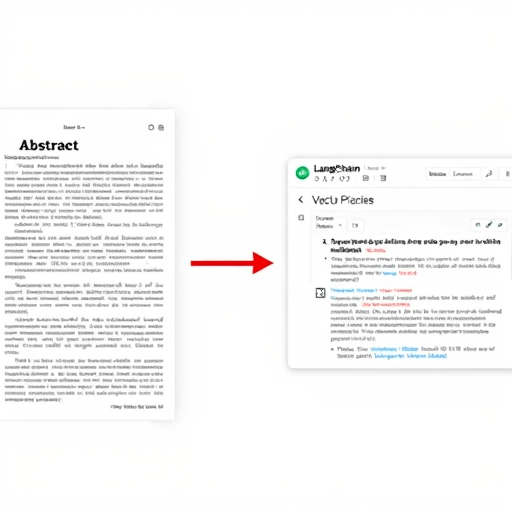
If you have ever tried to pull drug-target evidence from PubMed, you know the pain: a thousand abstracts come back, but the one sentence that states “Compound X inhibits kinase Y at nanomolar concentrations” is buried somewhere on page 47. A RAG tool for biomedical papers changes the game. By combining vector embedding with LangChain, you can build a retrieval-augmented generation system that answers specific drug-target questions with cited evidence, not just a list of loosely matched papers. This article walks through the architectural decisions and practical steps to create such a tool in 2026.
Why Boolean Search Falls Short for Drug-Target Evidence
PubMed’s own search engine is remarkably fast, but it operates on lexical matching. You might query “drug X target Y”, and the engine returns papers where those terms appear — not necessarily papers where the relationship is demonstrated. Worse, synonyms, acronyms, and context such as “phosphorylates”, “inhibits”, or “binds to” are lost in a Boolean query. A clinician or a researcher needs the actual evidence sentence, not a list of citations. This is the exact problem that a RAG tool solves.
Traditional NLP approaches like named entity recognition can identify drug and target mentions, but they do not reason across a large collection. Vector embedding, however, maps both queries and sentences into the same semantic space, so a query about “inhibition of BRAF by dabrafenib” can retrieve abstracts that use phrases like “BRAF kinase activity is blocked by dabrafenib” without requiring identical wording.
Anatomy of a Biomedical RAG Pipeline
Building a RAG tool for biomedical papers is not about outsourcing your whole search to a large language model. It is about creating a deterministic retrieval layer that feeds the right context to a generative layer. In 2026, the standard stack includes five components: ingestion, chunking, embedding, vector storage, and generation orchestration. LangChain ties them together.
Ingesting and Chunking PubMed Abstracts
Start with the PubMed API and the Entrez utilities. You can query by organism, disease, or a curated list of drug-target pairs. Unlike generic RAG systems, PubMed abstracts have a natural boundary: the abstract itself. But you should not embed an entire 300-word abstract as one vector. Many drug-target relationships are confined to a single sentence or a pair of adjacent sentences. Chunk at the sentence level, and then group with a small window of two sentences before and after to preserve context.
Be mindful of abbreviation expansion. A sentence that starts with “EGFR” may refer to the protein in one abstract and the gene in another. A lightweight pre-processing step that expands common biomedical abbreviations before embedding can improve retrieval accuracy. You can also remove boilerplate phrases like “Results indicate” or “in conclusion” that contribute nothing to semantic similarity.
Generating Vector Embeddings for Biological Text
Not all embedding models are created equal for biomedical text. Generic models trained on Wikipedia or web crawls mangle the difference between “HER2” (a receptor) and “HER-2” (a human epidermal growth factor receptor). For your RAG tool, choose an embedding model fine-tuned on scientific literature, such as those based on PubMedBERT, BioBERT, or a specialized contrastive biomedical model. In 2026, the default is often a transformer in the sentence-transformers family, but you need to evaluate your shortlist against a small gold set of drug-target queries.
Your embedding dimension matters for the vector database. A model like all-MiniLM-L6-v2 gives 384 dimensions, while newer biomedical models produce 768 or 1024. The tradeoff is storage cost versus retrieval fidelity. For a corpus of 50,000 abstracts, even a 1024-dimensional vector is trivial. Do not let hardware constrain the quality of your embeddings.
Storing and Retrieving with a Vector Database
Once you have embeddings, push them into a vector database that supports metadata filtering. Popular choices include Pinecone, Weaviate, and pgvector. For a local, open-source setup, Qdrant is a solid companion for LangChain. Store the chunk text, the PubMed ID, the title, the publication year, and the sentence position as metadata.
At query time, you want not only semantic similarity but also temporal relevance. A 20-year-old abstract may be less trustworthy for a drug-target interaction than a recent, peer-reviewed study. Use metadata filtering to restrict retrieval to a range of years, or apply a re-ranking step with a cross-encoder after the initial vector search. This is one way to keep your RAG tool from surfacing stale evidence.
LangChain as the Orchestration Layer
LangChain gives you a uniform interface for the entire pipeline. In a single chain, you can connect the PubMed retriever, the vector store, and an LLM for answer synthesis. But be careful: for a biomedical use case, the LLM should not be allowed to hallucinate. You need the prompt to insist on using only the retrieved context and to provide citations by abstract ID and sentence index.
In 2026, the landscape has shifted from LangChain’s older APIs to LangGraph-style workflows. Still, the core concepts remain. Use a RetrievalQA chain or define a more granular chain that first fetches candidate chunks, then reranks them, and then passes the top-k to the generator. The generator can be GPT-4o, Claude, or a local llama.cpp model if your institution requires data privacy. LangChain abstracts away the provider, so you can switch without rewriting the retrieval code.
Making the RAG Tool Understand Biological Relationships
Vector similarity alone cannot distinguish between a drug that inhibits a target, a drug that activates a target, and a drug that simply binds without a functional effect. This is the biggest challenge for a RAG tool for biomedical papers. A well-engineered approach uses two-tier retrieval: the vector store finds likely abstracts; then a relationship classifier tags the evidence sentences.
LangChain can host this classifier as part of the pipeline. For example, you can define a chain that, for each retrieved sentence, asks the LLM: “What is the relationship between the chemical entity and the protein entity? Choose from: inhibitor, activator, binder, no relationship.” The response can be structured as JSON. Only sentences that contain the desired relationship are passed on to the final answer. This reduces false positives and makes your tool genuinely useful for drug discovery teams.
An even richer system incorporates public knowledge bases like DrugBank or ChEMBL as a pre-filter. If your query is about a known drug-target pair, you can first pull the known interaction metadata, then use that as a guide for what to look for in the abstracts. This hybrid approach, combining structured databases with vector search, is the current best practice in biomedical RAG.
Practical Steps for Your 2026 Build
Let’s walk through a concrete blueprint. You can achieve a functioning prototype in a single afternoon, given the maturity of the ecosystem.
- Step 1: Use Biopython’s
Entrezmodule to query PubMed and fetch abstracts. Store them in a local JSON file with fields such aspmid,title,abstract, andpub_date. - Step 2: Chunk each abstract into sentences using SciSpacy’s sentence boundary detection. Add the two preceding and following sentences as context, but store the sentence text separately.
- Step 3: Embed each chunk with a biomedical sentence embedding model. A solid choice is
pm-ai/bio-embeddingfrom Hugging Face. You can also use theBGE-Bioseries fine-tuned for scientific documents. - Step 4: Load the vectors into Qdrant or Pinecone. For each vector, store metadata:
source_pmid,sentence_index, and apub_year. - Step 5: Define a LangChain retriever that performs a vector search, returns top-20 chunks, then applies a cross-encoder to rerank and select top-5.
- Step 6: Create a prompt that instructs the LLM to answer a question like “Which drugs inhibit protein kinase B?” with an evidence table listing the PMID, sentence, and a confidence score.
Evaluating Your RAG Tool Beyond Accuracy
Accuracy is only one dimension. In the biomedical domain, you also need to know coverage. Did your tool miss a key drug-target interaction because the abstract uses an uncommon synonym? Build a small gold set of 50 known interaction pairs from a curated database, and measure recall. If recall is below 70%, you need to expand your synonym generation during the query expansion step.
Another critical metric is citation fidelity. The LLM should never output a sentence about a drug-target interaction without pointing to a specific PubMed ID. In 2026, many teams use a two-stage generation: first, the LLM extracts the answer from the retrieved context, and second, a “verifier” LLM checks that every factual claim in the answer appears in one of the cited chunks. This is overkill for a prototype, but essential if the tool is used in a regulatory or clinical setting.
Also evaluate the latency. A researcher expects answers in seconds, not minutes. Caching frequently asked queries at the embedding level can cut response time in half. For example, if the same drug name appears in many queries, pre-compute the top-100 relevant chunks.
Conclusion
Building a RAG tool for biomedical papers is no longer an experimental exercise. With vector embedding, a purpose-built embedding model, and LangChain orchestrating retrieval plus generation, you can turn PubMed’s overwhelming quantity of abstracts into a concise, evidence-backed answer engine. The key is to design your retrieval layer to understand biomedical semantics, to integrate relationship filters, and to evaluate rigorously for both precision and citation fidelity. That approach delivers a reliability that researchers can actually trust.