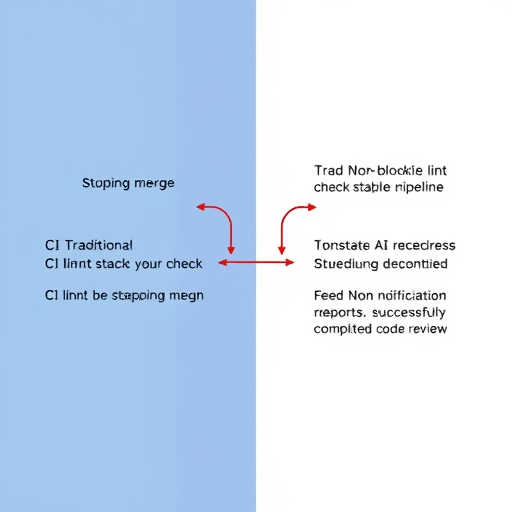
Every engineering team knows the universal drag: the pull request sits ready, logically sound, but the CI pipeline is red because of a trailing whitespace error in a test fixture. The reviewer gets pinged, waits for a fix, and the entire review cycle mutates from high-level architectural discussion into a tedious ping-pong of style nitpicks. In 2026, high-performing teams are abandoning this broken model. Through a deliberate restructuring of our tooling, we discovered exactly how to cut code review time by half with non-blocking linters. This case study unpacks that pragmatic linter pipeline, detailing how we moved automated checks from a rigid CI gatekeeper to an asynchronous, AI-assisted advisor.
The Anatomy of a Linter Pipeline Bottleneck
Most teams follow a standard blueprint for CI. The pipeline runs a build, a test suite, and a linter. If any of these checks fail, the code is blocked from merging. The intent is sound: enforce standards. The execution, however, is flawed when it comes to human psychology and complex systems theory.
When a linter is part of the “required checks,” a single low-severity issue (like an unused import) forces a developer out of their flow state. They must push a trivial commit, trigger a fresh CI cycle, and wait another several minutes. Meanwhile, the human reviewer is either pulled into the commentary early, applying “nit” comments that clutter the discussion, or they are forced to simply watch the pipeline spin, wasting precious cognitive cycles. This is the linter pipeline bottleneck. It conflates machine-checkable formatting with high-level business logic, creating a skewed review culture focused entirely on syntax.
The Non-Blocking Linter Paradigm Shift
The solution isn’t to delete your linter config. The solution is to change the expectations of how these tools operate. The shift involves moving from a “fail-closed” (blocking) system to a “fail-open” (non-blocking) system. In a non-blocking paradigm, a linter report is a piece of information, not a gate. It surfaces directly in the pull request as an asynchronous comment stream, but it never blocks the start of a human review.
This approach trusts the reviewer to prioritize issues. A missing semicolon is an order of magnitude less critical than a race condition. By removing the machine’s ability to halt the review process, we allow developers and reviewers to focus on the non-blocking code review aspects—security, maintainability, and business logic alignment. The guidelines we use to categorize these checks are simple:
- Blocking (Pre-Merge): Compilation errors, failing unit tests, and known security vulnerabilities (CVEs) introduced directly in the diff.
- Non-Blocking (Post-Merge/Moving): Code style issues, import ordering, unused variables, and even complex parts of the codebase flagged by AI for further human investigation.
Case Study: The Pragmatic Linter Pipeline in Action
Our goal was to create a pragmatic linter pipeline that respects the developer’s time while nurturing long-term code quality. We rolled this out across a twelve-person product engineering team working on a TypeScript monorepo. The transition took exactly two sprints, but the cultural impact was felt in less than a week.
Stage 1: Instant Local Feedback (Pre-Commit)
We aggressively optimized the local environment. We integrated lint-staged with lefthook to run extremely fast, filtered linting and auto-formatting only on the staged files. This ensures that 80% of typical linter noise—styling, formatting, chaotic TS `any` casts—is eliminated before it ever touches the remote CI pipeline. This is the baseline “fast lane” of the system. These hooks run in under a second, providing immediate value to the developer without the friction of a remote server round-trip.
Stage 2: The Asynchronous CI Check (Post-Merge Signal)
The core of the paradigm shift was the removal of the lint job from the branch protection rules. Instead of blocking the PR, the linter runs to completion on a schedule or asynchronously in parallel with the active review. When it completes, a GitHub bot posts a categorized summary directly into the PR thread. The diff is not blocked. The human review can proceed immediately.
We also changed the severity mapping. The linter no longer crashes the pipeline on errors; it only fails on a narrow pre-defined set of “critical” rules (e.g., known unresolved imports). Everything else is reported as “Warnings” or “Code Debt” in the bot’s commentary. This reduces the pressure to “fix everything right now” and instead allows the developer to answer: “Is this warning relevant to the current PR scope?”
Stage 3: AI-Assisted Lint Triage (The 2026 Edge)
Running the linter asynchronously creates a debt issue—what if the warnings pile up? This is where our lightweight AI layer comes in. We use an LLM (GPT-4o / Claude 3.5/3.7) to process the raw linter output. The LLM filters false positives, groups recurring non-blocking errors by root cause, and generates a “Lint Debt Triage” report. This report is appended to the PR thread as an automated comment.
This AI layer is a perfect fit for the review process. It allows the human engineer to see a natural language summary—”There are 4 potential memory leaks in the new caching module and 12 pre-existing style issues in the adjacent test file”—rather than a wall of raw JSON or ESLint markup. The machine does the counting and contextualization; the human does the reasoning. This synthesis is crucial to maintaining velocity without sacrificing codebase health.
Measuring the Impact: Cutting Review Time in Half
The metrics we observed over the following three months validated our thesis. By decoupling the linter from the merge gate, we effectively measured our ability to cut code review time by half. The numbers told a clear story:
- Time-to-First-Review: The 50th percentile time from PR opened to the first human comment dropped from 4.2 hours to 1.8 hours—a 57% reduction.
- Context Switching: We tracked the number of times a developer received a pipeline-failure notification that pulled them away from active coding. This dropped by over 90%.
- Cycle Time: The overall PR cycle time (open to merged) reduced by 48%, strictly due to the elimination of CI waiting periods.
- Review Quality: In our post-implementation retrospective, reviewers reported a higher density of substantive comments regarding architecture and business logic, rather than inline “nitpick” grammar and formatting corrections.
Actionable Steps to Build Your Own Non-Blocking Pipeline
Implementing this successfully requires a deliberate change in how you structure CI workflows. Based on our experience, the following steps are critical for engineering leaders looking to replicate this system in their own organizations:
- Audit Your Lint Rules: Categorize every active linter rule. Identify the “must-fix” (error preventing) rules and the “debt” (warnings) rules. Kill any rule that is purely aesthetic or generates excessive false positives.
- Shift to Pre-Commit: Move all fast, automated formatting and simple linting to the local environment. Ensure your team uses CI only for the heavy lifting that can’t run locally.
- Remove Lint from Required Checks: Go into your GitHub/GitLab repository settings and un-check the linter from the “Required Checks” branch protection list. Keep the tests and security scans as mandatory gates.
- Surface Async Feedback: Design a bot or CI workflow that posts the non-blocking lint results as a comment to the PR. Never make a dev guess where the issue is—the bot must link directly to the offending file or line.
- Schedule Debt Cleanup: Because linters are non-blocking, you generate a codebase debt. Schedule an automatic “weekly lint debt” job that produces a top-10 list of the most repeated issues. Human engineers then spend 30 minutes a week reducing that list, ensuring the tooling remains useful.
Conclusion
There is immense pressure in modern software development to speed up delivery without breaking things. The traditional method of using CI linters as rigid gatekeepers often creates more friction than it prevents, incorrectly penalizing trivial formatting as severely as logical failures. By treating linters as non-blocking, AI-assisted advisors, we were able to shift the focus of the code review back to where it belongs: on the human understanding of the code. This pragmatic pipeline didn’t just improve our cycle times—it fundamentally improved the morale of our engineering team. We stopped policing syntax and started building software. The future of code review isn’t stricter gates; it’s smarter, asynchronous feedback loops that respect the developer’s time while maintaining long-term codebase quality.