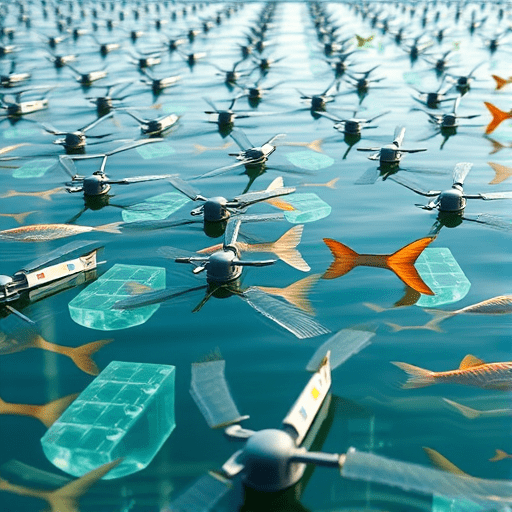
Feed consumption accounts for more than 40% of operating costs in aquaculture, and inefficiencies can translate into significant losses. By leveraging 5G‑edge AI, small fish farms can now monitor water quality, fish behavior, and feed distribution in real time, enabling precise adjustments that reduce waste by up to 30%. This article explores how the convergence of 5G connectivity and edge computing is reshaping precision aquaculture, and provides practical guidance for farm owners looking to implement this technology.
Why 5G‑edge AI Matters for Small‑Scale Aquaculture
Traditional aquaculture operations rely on periodic manual checks or bulk data uploads to cloud servers, creating a latency gap that hampers timely decision‑making. 5G’s ultra‑low latency (<20 ms) and high bandwidth (>1 Gbps) eliminate this delay, allowing sensors to feed data directly into AI models running on local edge devices. The combination offers several critical advantages:
- Real‑time Feed Optimization – AI can instantly adjust feed rates based on fish activity and water parameters.
- Scalable Infrastructure – Edge devices require minimal power and can be deployed even in remote locations.
- Data Sovereignty – Sensitive farm data stays on-site, protecting intellectual property and ensuring compliance with local regulations.
- Cost Efficiency – Lower bandwidth consumption reduces operating expenses compared to continuous cloud uploads.
Building the 5G‑edge AI Stack
Implementing 5G‑edge AI involves three core layers: sensor networks, edge compute nodes, and AI models. Each layer must be carefully selected to align with farm size, budget, and environmental conditions.
Sensor Network Design
High‑frequency data streams form the backbone of any precision aquaculture system. Key sensors include:
- Temperature and dissolved oxygen probes
- pH and salinity meters
- Video cameras and acoustic tags for fish movement tracking
- Feed pellet dispensers with weight sensors
For small farms, a modular sensor kit can be deployed across each tank or pond, with wireless links to the 5G network. Low‑power, battery‑backed sensors reduce maintenance downtime.
Edge Compute Nodes
Edge nodes host the AI inference engine and serve as the gateway between sensors and the 5G network. Recommended hardware includes:
- NVIDIA Jetson Nano or Xavier NX for GPU‑accelerated inference
- Raspberry Pi 4 with Intel Neural Compute Stick for lightweight deployments
- Industrial PCs with 5G modem integration
Key design considerations are thermal management (especially in humid aquaculture settings) and rugged enclosures to protect against water splashes.
AI Model Selection and Training
Two primary AI tasks drive feed optimization: feed intake prediction and behavioral anomaly detection. Model families that work well in this context include:
- Recurrent Neural Networks (RNNs) for time‑series prediction of feed demand based on historical consumption and environmental data.
- Convolutional Neural Networks (CNNs) for image‑based classification of fish density and health status.
- Autoencoders for anomaly detection, flagging sudden changes in feeding patterns that may indicate disease or equipment failure.
Training data can be sourced from the farm’s own sensor logs, supplemented by publicly available aquaculture datasets to improve model generalization. Transfer learning reduces the amount of on‑farm data needed, accelerating deployment.
Operational Workflow: From Data to Decision
Once the system is live, a typical feed‑management cycle unfolds in real time:
- Data Capture – Sensors stream readings to the edge node at 1 Hz.
- Pre‑processing – Raw signals are filtered and normalized.
- Inference – The feed‑intake RNN predicts optimal pellet volume for the next 30 minutes.
- Actuation – The feed dispenser adjusts pellet release accordingly.
- Feedback Loop – Post‑feed consumption data refines the model via online learning.
Because all steps occur within milliseconds, the system can react to sudden temperature drops or oxygen spikes by pausing feeding, thereby preventing over‑feeding during stressful conditions.
Case Study: A 10‑turbot Farm in Maine
In 2025, a small turbotiary farm in Maine implemented a 5G‑edge AI system to tackle high feed waste rates. Prior to deployment, the farm lost roughly 18% of purchased feed to unconsumed pellets. After integrating real‑time feed prediction and adaptive dosing, waste dropped to 8%, translating to an annual saving of approximately $12,000. Additionally, fish mortality fell by 12% due to better environmental regulation.
Key takeaways from this case study include:
- Start with a pilot of one tank before scaling to the entire operation.
- Use cloud backup during initial learning phase to capture rare events.
- Train local staff on basic AI troubleshooting to maintain system uptime.
Addressing Common Implementation Challenges
Network Reliability
Although 5G promises robust coverage, rural farms may experience signal gaps. Solutions include:
- Deploying a dedicated 5G base station with beamforming capabilities.
- Using multi‑mode devices that fall back to LTE in weak zones.
- Incorporating mesh networking among edge nodes to route data through the strongest link.
Data Security and Privacy
Local farms often handle proprietary feed formulations and yield data. Edge AI keeps sensitive data on-site, but secure communication protocols (TLS 1.3, MQTT over TLS) should still be enforced to protect against eavesdropping.
Maintenance and Calibration
Regular sensor calibration is vital for model accuracy. A maintenance schedule that includes:
- Weekly calibration of temperature probes.
- Monthly inspection of feed dispenser mechanics.
- Quarterly software updates for edge firmware.
automated self‑diagnosis modules can flag out‑of‑spec sensors for timely intervention.
Future Directions: AI‑Driven Nutrient Cycling and Energy Efficiency
While feed waste reduction is the immediate benefit, 5G‑edge AI opens doors to broader sustainability initiatives:
- Dynamic Nitrogen Management – Predictive models can optimize aeration and filtration schedules, reducing energy consumption.
- AI‑based Fish Health Screening – Early detection of disease outbreaks via behavioral analytics saves costs and enhances welfare.
- Integration with Renewable Energy Sources – Edge AI can schedule high‑energy tasks during off‑peak renewable generation windows.
These extensions highlight how precision aquaculture can evolve from a cost‑saving measure to a comprehensive sustainability framework.
Getting Started: A Step‑by‑Step Guide for Farm Owners
- Assess Infrastructure – Verify 5G coverage and evaluate existing power supply.
- Define Objectives – Prioritize feed waste reduction, water quality control, or fish health monitoring.
- Choose a Vendor – Opt for a system that offers modular hardware and open APIs.
- Pilot Test – Deploy in one unit, monitor performance for 30 days.
- Iterate – Refine models based on pilot data before full rollout.
- Train Staff – Provide hands‑on workshops on sensor maintenance and data interpretation.
- Scale Gradually – Add edge nodes and sensors incrementally to avoid downtime.
Remember that successful implementation hinges on continuous learning and adaptive management. The more data the system ingests, the sharper its predictions become.
Conclusion
Deploying 5G‑edge AI in small fish farms is no longer a futuristic concept; it is a practical, cost‑effective solution that delivers tangible benefits. By harnessing real‑time data, adaptive algorithms, and low‑latency connectivity, farms can dramatically cut feed waste, improve fish health, and move toward more sustainable operations. As 5G networks expand and AI models become more efficient, the boundary between technology and aquaculture will blur further, offering even richer opportunities for small‑scale producers.