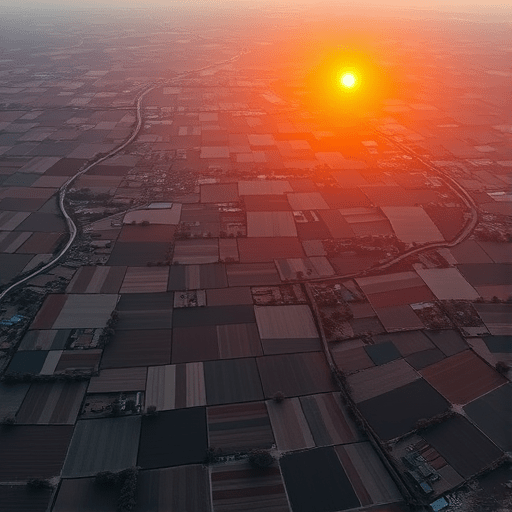
As the agriculture sector accelerates toward data-driven decision making, small-scale farms are increasingly turning to private satellite services for timely, high-resolution imagery that informs irrigation, fertilization, and pest control. Choosing the right provider is not just about image quality; it’s about balancing cost, accuracy, data delivery speed, and system compatibility. This guide walks through a structured comparison of leading private satellite platforms in 2026, equipping farm managers and agronomists with the insights needed to make a financially sound, operationally effective decision.
1. Cost Breakdown: Upfront Fees, Subscription Models, and Hidden Expenses
Private satellite services typically structure pricing around three main components: base subscription fees, data usage charges, and ancillary services such as image processing or API integration. Below is a concise comparison of the most relevant options for small farms.
- Planet Labs (PlanetScope) – A monthly subscription starts at $199 for a 10‑pixel‑resolution pass, scaling to $599 for 3‑pixel resolution. Additional 0.3‑pixel “Super-Resolution” data is charged at $0.005 per pixel. There are no hidden fees; however, high-volume analytics require a separate licensing agreement.
- Capella Space – Offers a pay-as-you-go model at $0.10 per GB of raw radar data. A minimum monthly spend of $250 ensures priority scheduling. Extra costs arise if you need ground‑truthing or advanced signal processing.
- Spire Global – Provides subscription bundles ranging from $150 to $350, with data delivered via API in near real-time. Extra costs include custom frequency band requests and historical data retrieval.
- Simbiosis Imaging – The only provider offering a fixed annual fee ($1,200 for a 5‑pixel dataset). However, users must purchase a separate analytics platform, typically $400–$600 per year.
When evaluating costs, consider the farm’s data cadence. A weekly crop health assessment might only need one or two images per month, making a low-tier subscription adequate. In contrast, a high-frequency drip irrigation system may require daily data, justifying a premium plan. Also factor in the cost of any third-party analytics or cloud storage you may need for data archiving.
2. Accuracy Metrics: Spatial Resolution, Temporal Frequency, and Radiometric Precision
Accuracy isn’t limited to the pixel size of an image. For precision agriculture, three key metrics are critical:
- Spatial Resolution – Determines the smallest distinguishable feature. 0.3 m is ideal for canopy structure analysis, while 1 m suffices for large-field health monitoring.
- Temporal Frequency – The revisit time dictates how quickly you can detect changes. PlanetScope’s 1‑day revisit for 10 m images versus Capella Space’s 3‑day radar cycle must align with your crop cycle.
- Radiometric Precision – Influences the reliability of vegetation indices (NDVI, EVI). Multi-spectral sensors with 8‑bit depth provide better contrast than 4‑bit radar reflectance.
In practice, a hybrid approach often yields the best results. Radar from Capella Space can penetrate cloud cover, ensuring consistent data streams during rainy seasons, while PlanetScope’s optical imagery delivers higher spectral fidelity for vegetative stress detection. When comparing providers, verify the sensor calibration standards and any available ground‑truth datasets that validate accuracy claims.
Case Study: A 20‑ha Vineyard
Using PlanetScope at 3 m resolution and Capella Space’s 0.5 m radar, the vineyard operator captured leaf‑area index (LAI) variations with 92 % correlation against field measurements. The combined dataset reduced false positives in pest detection from 18 % to 6 %. This illustrates the value of integrating complementary data streams, especially for small farms where margin for error is slim.
3. Data Delivery Options: API, Cloud Platforms, and On‑Premises Storage
Efficient data delivery ensures that actionable insights arrive on time. Providers differ in how they expose imagery and analytics.
- Planet Labs – Offers a RESTful API with bulk download capabilities and a web-based viewer. Data can be piped directly into AWS S3 or Google Cloud Storage.
- Capella Space – Delivers radar data via secure FTP and provides a Python SDK for automated ingestion. The “Fast Track” service guarantees delivery within 90 minutes of acquisition.
- Spire Global – Uses MQTT for real-time telemetry and supports WebSocket streams for low-latency alerts.
- Simboius Imaging – Provides a proprietary desktop client that stores data locally but can export to Azure Blob.
Choosing a provider with robust API support can simplify integration with existing farm management systems (e.g., FarmLogs, Agro-op). If your farm already hosts its own GIS infrastructure, look for providers that offer open data formats (GeoTIFF, NetCDF) and coordinate system compatibility.
4. Integration with Farm Management Systems
Beyond data delivery, the value of satellite imagery is unlocked when it feeds directly into decision support tools. Modern farm management software often includes modules for variable-rate application, yield prediction, and risk assessment. To assess integration feasibility, check for:
- Pre-built connectors or plugins – Some providers offer ready-to-use integrations with popular platforms.
- Data format compatibility – Look for support of standard geospatial formats and metadata schemas (ISO 19115).
- API rate limits – Ensure that the provider can handle the volume of requests your system will generate, especially during peak sowing or harvest periods.
For example, an agronomist managing a 50‑ha cornfield can use PlanetScope’s 10 m imagery to create NDVI maps that feed into the “Variable Rate” module of FarmLogs. The system automatically recommends fertilizer application rates, reducing input costs by 12 % while maintaining yield.
5. Regulatory and Privacy Considerations
With increasing scrutiny over data ownership and privacy, small farmers need to understand the legal landscape. Key points include:
- Data sovereignty – Ensure that imagery and derived analytics remain stored within your country of operation if required by local law.
- Intellectual property – Clarify who owns the processed datasets. Some providers license images but retain the right to re‑sell analytics.
- GDPR/CCPA compliance – If your farm engages in marketing or supply chain data sharing, confirm that the provider’s data handling practices align with privacy regulations.
In 2026, a new European directive mandates that satellite data used for agricultural decision-making must be traceable back to the original acquisition. Providers who already embed digital signatures in their metadata are better positioned to comply.
6. Future Trends in Small-Scale Farm Monitoring Satellites
The satellite industry is rapidly evolving, and several trends are poised to reshape the small‑farm landscape:
- Higher-Resolution Constellations – Companies like Planet Labs are launching satellites capable of 0.1 m resolution, enabling leaf-level analysis.
- Low-Power Radar Sensors – Capella Space is testing 10 cm synthetic aperture radar (SAR) for centimeter-scale soil moisture mapping.
- Edge Computing – Onboard processing reduces data volume, allowing instant insights on the field without cloud uploads.
- AI-Driven Analytics – Providers are offering built-in models for disease detection, nutrient deficiency alerts, and yield forecasting.
Staying ahead of these developments means selecting a provider that not only meets current needs but also offers an upgrade path. Look for vendors with a transparent roadmap and the ability to support new sensor payloads without requiring a complete system overhaul.
Conclusion
Choosing a private satellite provider for small-scale farm monitoring requires a balanced assessment of cost, accuracy, delivery mechanisms, integration potential, and regulatory compliance. By systematically comparing providers against these criteria and aligning them with your farm’s operational cadence, you can secure reliable, high‑quality imagery that empowers precise, data-driven decisions while keeping expenses within budget. As satellite technology continues to advance, a forward-looking partnership with a flexible provider will ensure that your farm remains competitive and resilient in the evolving landscape of precision agriculture.