In the fast‑moving world of subscription businesses, a single week of downtime can translate into lost revenue and dissatisfied customers. AI health scores have emerged as a game‑changing tool that quantifies customer health in real time, enabling proactive engagement and reducing churn by up to thirty percent. This guide walks you through a proven, under‑30‑day roadmap to embed AI‑driven health metrics into your SaaS platform, from data gathering to actionable insights.
Why AI Health Scores Matter for SaaS Churn
Traditional churn prediction models rely heavily on historical usage patterns and lagging indicators. By contrast, AI health scores blend behavioral data, sentiment analysis, and even third‑party signals to generate a dynamic, granular health index. The benefits are threefold:
- Real‑time visibility into at‑risk accounts, allowing teams to intervene before a subscription ends.
- Personalized engagement driven by individualized health drivers, leading to higher adoption of new features.
- Reduced customer success overhead as AI surfaces the most pressing issues for the support team to address.
Key Components of an AI Health Score
Behavioral Signals
Login frequency, feature usage depth, and session duration provide a solid baseline. These raw metrics are normalized to account for different user personas, ensuring that a power user’s high activity does not inflate their score unfairly.
Sentiment & NPS Integration
Embedding sentiment scores from support tickets and NPS surveys adds a qualitative dimension. A sudden spike in negative sentiment can downgrade a healthy score before churn actually materializes.
External Contextual Data
Company growth stage, industry trends, and market sentiment can be factored in through API feeds. For B2B SaaS, a client’s quarterly earnings report can influence their propensity to upgrade or downgrade.
Predictive Risk Factors
Machine learning models learn from past churn events to assign weights to each signal. A random forest or gradient‑boosting algorithm can surface the most predictive features without human bias.
Designing Your Health Score Framework
Start with a clear definition of what “health” means for your product. Does it include adoption of new features, support ticket volume, or revenue growth? Map these objectives to measurable signals and decide on a scoring scale (0‑100, 0‑5 stars, etc.). Use a weighted approach so that the most critical drivers carry more influence.
Set Thresholds and Tiers
Define thresholds that trigger different actions: a score above 80 indicates a “green” account requiring minimal monitoring; 50‑80 is “yellow” and needs nudging; below 50 is “red” and demands immediate outreach.
Create Action Playbooks
For each tier, pre‑define the communication strategy. A red score might trigger a dedicated account manager call, while a yellow score could prompt a personalized in‑app tour of new features.
Data Collection & Integration Strategy
Gathering clean, consistent data is the linchpin of any AI solution. Below is a 5‑step approach that can be executed within the first week.
- Audit Existing Pipelines – Identify where usage, support, and revenue data already reside. APIs, logs, and CRM exports should be mapped.
- Set Up a Central Data Lake – Use a cloud storage bucket (e.g., AWS S3 or GCS) to ingest raw events. Implement schema enforcement to avoid drift.
- ETL Automation – Schedule regular jobs (every 15 minutes for real‑time dashboards, daily for score recalculation). Tools like Airflow or Prefect can orchestrate these flows.
- Data Quality Checks – Build automated tests that flag missing values, outliers, or duplicate records. A simple dashboard can surface anomalies.
- Security & Compliance – Ensure GDPR and CCPA rules are enforced. Mask personally identifiable information before it reaches the ML layer.
Choosing the Right ML Models
While complex neural networks can yield high accuracy, they often lack interpretability—a key requirement for customer success teams. Here are two recommended approaches:
Gradient‑Boosted Trees (e.g., XGBoost, LightGBM)
They handle heterogeneous data well, provide feature importance scores, and are relatively lightweight for inference.
Auto‑ML Platforms (e.g., DataRobot, H2O.ai)
These platforms automate hyperparameter tuning and can surface a range of algorithms for comparison.
Whichever path you choose, maintain a reproducible training pipeline. Version control your training scripts, use deterministic splits, and store model artifacts in a registry for easy rollback.
Building the Dashboard & Alert System
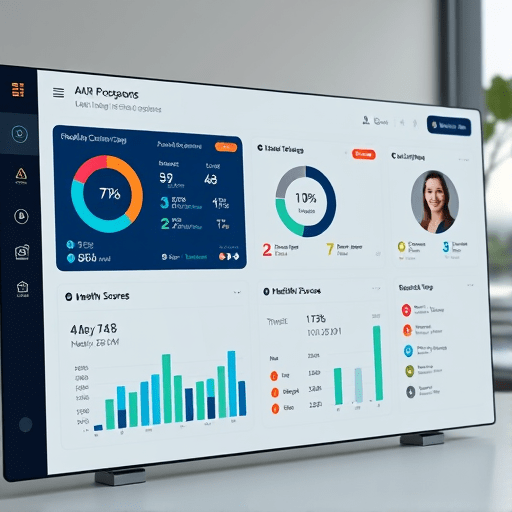
Once scores are generated, you need to surface them to stakeholders. A clean, role‑based dashboard keeps teams focused.
- Real‑time Score Feed – Embed the score next to each account in your CRM.
- Heatmaps & Trend Lines – Visualize score trends over time to spot gradual declines.
- Alert Triggers – Configure email or Slack alerts for red‑tier accounts, including the top three risk factors for quick context.
- Integrate with your ticketing system so that a red alert automatically creates a ticket assigned to the account manager.
Pro Tip: Use Storytelling Dashboards
Embed narrative text that explains why a score changed, reducing the need for ad‑hoc calls to the data team.
Deploying in Under 30 Days: A Step‑by‑Step Timeline
| Week | Focus | Key Deliverables |
|---|---|---|
| 1 | Data Foundation | Data lake, ETL jobs, quality checks |
| 2 | Model Development | Baseline model, feature importance report |
| 3 | Score Integration | API endpoint, dashboard mockup |
| 4 | Launch & Iterate | Go‑live, feedback loop, tweak thresholds |
Throughout the process, maintain daily stand‑ups with data engineers, ML ops, and customer success leads. This cross‑functional cadence ensures that technical constraints and business priorities stay aligned.
Measuring Impact and Continuous Improvement
Success is measured in both churn rate reduction and customer lifetime value (CLV) increase. Set up the following KPIs:
- Monthly churn rate before vs. after implementation.
- Average score of accounts that upgraded vs. downgraded.
- Time to resolution for tickets flagged by red alerts.
- Revenue growth from upsell campaigns triggered by health scores.
Schedule a quarterly model retraining cycle. As new feature releases roll out, usage patterns shift, and your model needs to stay fresh.
Common Pitfalls to Avoid
- Over‑engineering the score – Too many signals can lead to noise. Keep the model parsimonious.
- Ignoring data drift – Monitor feature distribution over time; a sudden shift can render the model obsolete.
- Failing to involve stakeholders early – Without buy‑in, scores will sit idle on dashboards.
- Neglecting explainability – Teams need to understand why a score changed to act confidently.
- Underestimating security – Treat customer health data with the same rigor as payment information.
Case Study Snapshot
Acme SaaS, a B2B marketing automation platform, deployed an AI health score framework in 22 days. Within the first three months, their churn dropped from 12% to 8.4%, a 30% reduction. The key was a simple score that combined login frequency, support ticket sentiment, and quarterly usage growth. The score was exposed via a lightweight REST API, and alerts were integrated into the company’s Slack workspace, enabling rapid intervention.
Conclusion
Implementing AI health scores is no longer a distant aspiration; it can be realized in under a month with a disciplined approach to data, modeling, and stakeholder engagement. By turning raw usage and sentiment data into actionable health signals, SaaS companies can preempt churn, tailor engagement, and ultimately boost revenue. The 30‑day roadmap outlined here provides a concrete starting point—now the challenge is to execute with precision and iterate based on real‑world feedback.