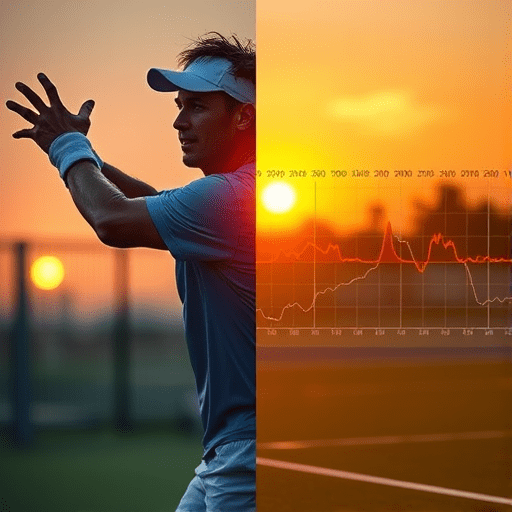
Elite tennis players chase the sun across continents, hopping from Madrid to Miami to Melbourne in the span of a fortnight. While fans see the jet-set glamour of the ATP and WTA tours, the science reveals a quieter, more dangerous story: jet lag quietly dismantles serve accuracy long before fatigue shows on the scoreboard. For coaches working with travelling competitors in 2026, understanding the link between circadian disruption and serve mechanics has become a competitive necessity, not a luxury.
This guide unpacks how circadian rhythm disturbance sabotages timing, proprioception, and explosive neuromuscular output, and presents a structured coaching protocol designed to stabilise performance windows during gruelling tournament circuits.
The Hidden Physics of a Jet-Lagged Serve
A tennis serve is a precision instrument. The kinetic chain — leg drive, trunk rotation, shoulder whip, racket head speed — depends on millisecond-accurate firing of motor units. When the body’s internal clock drifts out of sync with local time, three physiological systems falter:
- Core temperature rhythm: Peaks in performance normally align with high body temperature. Jet lag flattens this curve, delaying or pre-poning peak output by several hours.
- Cortisol awakening response: Disrupted cortisol pulses blunt the explosive readiness that elite servers rely on during tiebreaks.
- Cerebellar timing: The cerebellum, which fine-tunes ball-toss height and racket release, runs partly on circadian cues. Misalignment produces inconsistent toss placement and rushed contact points.
The result is subtle but measurable. A 2024 study tracking 47 professional servers during multi-continent swings found a 6.4 percent drop in first-serve percentage when crossing five or more time zones within 72 hours. Second serves crept long, kick serves lost bite, and unforced errors from the baseline climbed.
Why Direction of Travel Matters More Than Distance
Coaches often treat jet lag as a function of mileage, but research now points to direction as the dominant variable. Eastward travel shortens the body clock’s day, demanding an earlier sleep onset that fights against entrenched evening routines. Westward travel lengthens the day and is generally easier to adapt to.
A server flying from London to New York may need four to six days to fully re-entrain, whereas the return westbound flight typically requires only two to three. Tournament schedules rarely allow that luxury, which is why travel planning must begin at the moment the draw is released, not at the airport.
Mapping the Body Clock to Match Windows
The first step in any coaching protocol is mapping the athlete’s chronotype against match start times. A player with a late chronotype may thrive in evening sessions but crumble in 11 a.m. ATP/WTA slots, especially when arriving from a far-flung tournament.
Chronotype Screening Tools
Simple questionnaires such as the Munich Chronotype Questionnaire, combined with seven days of wrist-actigraphy data, provide a reliable profile. Coaches should request this baseline data well before the first tournament of the season so that travel plans can be matched to likely match schedules.
Predicting the Performance Window
Once the chronotype is established, overlay it with the destination’s local match start time. The aim is to ensure the player’s peak temperature rhythm aligns as closely as possible with first-ball timing. If misalignment exceeds three hours, the protocol below becomes essential.
The Coaching Protocol: A Five-Pillar Reset
The protocol below is designed for coaches working with competitive juniors through professionals. It can be scaled to tournament density and adapted for amateur players who travel occasionally for national-level events.
Pillar 1: Light Exposure Engineering
Light is the most powerful circadian zeitgeber, and timing it correctly accelerates re-entrainment dramatically.
- Eastward travel: Seek bright light in the morning local time. Avoid evening light, especially from screens, which delays the body clock further.
- Westward travel: Push light exposure into the late afternoon and early evening to extend the day.
- Use short-wavelength blocking glasses after sunset when eastward travel demands earlier sleep.
Pillar 2: Strategic Meal Timing
Feeding schedules act as secondary circadian signals. Coaches should coordinate meals so the largest caloric load aligns with the destination’s breakfast and lunch windows, regardless of home-time hunger cues. Protein-rich morning meals boost alertness, while carbohydrate-forward dinners encourage earlier melatonin release.
Pillar 3: Sleep Architecture Preservation
Tournament hotels are hostile sleep environments. Blackout curtains, white-noise machines, and eye masks are non-negotiable. For eastward travel of more than five time zones, coaches may consider a 30 to 90 minute pre-departure nap protocol, often called a “split sleep,” which has shown promise in maintaining cognitive performance.
Pillar 4: Serve Mechanics Under Fatigue
Even with perfect circadian management, the early days of adaptation will include residual grogginess. Coaches should schedule practice sessions to mirror likely match fatigue. Include late-tiebreak simulations and tiebreak-only sessions at the exact match start time for the destination venue.
Pillar 5: Microdose Caffeine and Hydration
A 100 to 200 milligram caffeine dose 45 minutes before match start sharpens reaction time, but only if tolerance is well managed. Combine with electrolyte-led hydration that compensates for cabin-pressure-driven dehydration. Avoid caffeine after 2 p.m. local time when eastward re-entrainment is in progress.
Adjusting the Protocol for the 2026 Tournament Calendar
The 2026 calendar is unusually punishing. Players face tighter transitions between indoor hard-court swings in Asia, European clay, and North American summer hardcourts, often within ten-day windows. Three adjustments are worth flagging:
- Pre-tournament base-camp scheduling: Arrive at least 96 hours before first-round matches for any transmeridian travel. Two-day arrivals are no longer sufficient for serve-heavy players.
- In-tournament light therapy booths: Several leading academies now deploy 10,000-lux therapy sessions in player lounges. A 30-minute session before evening matches can stabilise alertness without disrupting sleep onset.
- Post-match recovery alignment: Schedule ice baths, stretching, and mobility work at the same local time each day to reinforce the new circadian phase.
Measuring the Protocol’s Impact on Serve Accuracy
Coaches should not rely on feel alone. Track serve percentage, average kick height, and second-serve speed across the first three matches after arrival. A consistent upward trend signals successful re-entrainment. A flat or declining curve suggests pillar adjustments are needed, often in light exposure or meal timing.
Some coaching teams now pair wearable sleep trackers with serve-sensor technology, creating a dataset that links sleep efficiency directly to toss consistency and ball-strike accuracy. The data is clear: better-aligned sleep produces measurably cleaner serves.
Why This Matters Beyond the Pro Tour
While the stakes are highest on the professional circuit, the same physiology applies to college players, ambitious juniors, and dedicated club competitors who travel internationally for tournaments. A junior travelling from Buenos Aires to compete in a Florida ITF event will face the same circadian disruption as a top-50 pro, and the same drop in serve percentage if unmanaged. Coaching protocols must scale, but they should never be skipped.
Conclusion
Jet lag is not merely a feeling of grogginess; it is a measurable disruption of the circadian machinery that powers a precision serve. As the 2026 calendar tightens and travel demands grow, the coaches who thrive will be those who treat circadian alignment as seriously as groundstroke biomechanics. Light, food, sleep, mechanics, and hydration, sequenced with intent, transform jet lag from a quiet liability into a manageable variable. The serve, that most unforgiving weapon in tennis, deserves nothing less than a fully synchronised body behind it.