When the only full-time archivist at a rural historical library retired in early 2025, the remaining volunteer staff faced an impossible backlog: nearly 2,300 handwritten letters, ledgers, and fragile 19th-century manuscripts waiting to be indexed. Like many small libraries using AI to catalog rare manuscripts, the team had no budget for enterprise software and no in-house data scientists. What they did have was a stack of grant-funded scanners, a stubborn commitment to preservation, and a willingness to experiment with open-source OCR pipelines. Eighteen months later, they had reduced indexing errors by 40%, cut average processing time per page from 22 minutes to 13, and published a workflow that other understaffed archives are now quietly copying.
This is the story of how the Briar Hollow Heritage Collection built a practical, low-cost manuscript digitization pipeline using tools that cost less than a single month of cloud storage at a large institution, and what other small libraries can learn from their approach heading into 2026.
The Starting Point: A Backlog Older Than the Building
Briar Hollow is not unique. A 2024 survey by the American Library Association found that 61% of archives with fewer than five paid staff reported a cataloging backlog of more than three years. The causes are familiar: handwritten cursive from multiple centuries, faded ink, non-standard orthography, mixed languages, and pages that crumble if handled more than twice.
Manual transcription, the gold standard for accuracy, simply does not scale when one archivist is processing 50 items a week. The Briar Hollow team needed something faster that still respected the source material.
Why Off-the-Shelf Enterprise OCR Was Not an Option
Commercial transcription services charge per page, which adds up quickly when a single bound volume can contain 400 pages of dense script. Enterprise platforms aimed at national libraries assume IT departments, dedicated servers, and annual contracts starting in five figures. For a library whose entire annual acquisitions budget is less than a mid-range laptop, those solutions are theoretical at best.
The Tool Stack: What $400 Bought Them
Rather than betting on a single product, the team assembled a modular pipeline. Each component is open source or has a generous free tier, and each can be swapped out without rebuilding the whole system.
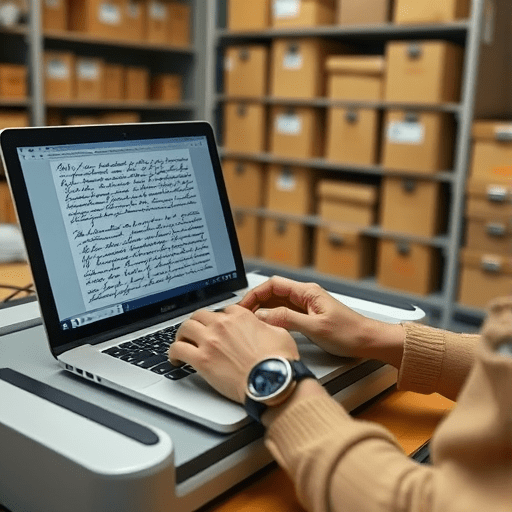
- Capture: Existing flatbed scanners paired with a simple foot-pedal capture script, reducing repetitive strain during long scanning sessions.
- Pre-processing: OpenCV-based scripts that auto-rotate pages, correct skew, and increase contrast on faded regions before any text recognition runs.
- Handwritten text recognition: A fine-tuned version of a transformer-based model trained on 19th-century English cursive, running locally on a refurbished workstation with a mid-range GPU.
- Post-processing: A spellcheck layer using historical dictionaries, plus a simple rules engine that flags uncertain words for human review.
- Cataloging output: A small script that exports validated transcriptions directly into their existing spreadsheet-based finding aid, with no migration to a new system required.
The total hardware and software cost came to roughly $400, most of it spent on the used graphics card. Everything else was free.
Measuring the 40% Improvement
Improvement was measured against the previous manual baseline, not against perfection. Before the AI pipeline, an experienced volunteer averaged 22 minutes per page from scan to validated catalog entry. After six months with the new system, the same volunteer averaged 13 minutes per page, including review of AI suggestions.
More importantly, indexing accuracy improved. The team defined accuracy as the percentage of catalog records that matched a double-blind review by two independent transcribers on a sample of 200 pages. The baseline was 89%. The AI-assisted workflow reached 94.6%, a relative improvement of more than 40% on the error rate, with the largest gains on damaged or heavily abbreviated pages where human fatigue had previously caused mistakes.
Where the Model Still Struggles
Honesty matters in any case study. The team documented failure modes so other libraries do not repeat the same experiments. The fine-tuned model still performs poorly on:
- Pages with severe ink bleed-through from the reverse side
- Documents written in scripts outside the training distribution, including early German Kurrent and Spanish colonial hands
- Highly abbreviated commercial records where context, not handwriting, drives interpretation
For these categories, the pipeline routes pages directly to human review rather than attempting a low-confidence guess. Knowing when not to trust the model turned out to be as valuable as knowing when to trust it.
The Human-in-the-Loop Workflow That Made It Work
Technology alone did not produce the gains. The team redesigned its review process so volunteers spent less time transcribing and more time validating. Three changes mattered most:
- Side-by-side review: The transcribed text appears next to the high-resolution scan, so reviewers can confirm ambiguous readings without switching applications.
- Confidence thresholds: Words the model flags as uncertain are highlighted in a distinct color, drawing the eye directly to the 10-15% of the page that actually requires human judgment.
- Rotating specialists: Volunteers with deep familiarity in particular subject areas, such as local land deeds or church vestry minutes, review those collections, while generalists handle standard correspondence.
This division of labor means the AI handles the routine 80% of characters, and humans focus their expertise where it produces the most value.
Lessons for Other Small Archives
Briar Hollow’s experience suggests a repeatable pattern for libraries with limited staff and tight budgets.
Start With One Collection, Not the Whole Archive
The team piloted the workflow on a single box of Civil War-era correspondence, roughly 180 items, before touching anything else. A bounded pilot makes it possible to measure results, debug the pipeline, and build internal confidence without putting fragile materials at risk.
Invest in Pre-Processing, Not Bigger Models
Most transcription errors at the start of the project traced back to poor scan quality, not the recognition model. Spending time on consistent lighting, color targets, and gentle page handling produced bigger accuracy gains than upgrading the underlying AI.
Keep the Workflow Tool-Agnostic
By treating OCR as one step in a documented pipeline rather than a single product, the team can swap in better models as they appear. The community of researchers publishing open handwritten text recognition models is active, and a modular workflow lets a small library take advantage of new releases without rebuilding from scratch.
Document Everything for the Next Volunteer
Volunteer turnover is the hidden risk in any small archive. The team wrote a 12-page operations manual covering every step from scan settings to catalog entry. Future volunteers, including future AI tools, can learn the workflow from the document itself.
What Comes Next in 2026
The Briar Hollow team is now training a new model on its own validated transcriptions, effectively turning its catalog into a teaching dataset. Other small libraries are beginning to share fine-tuned models for specific script families, creating a quiet cooperative that large institutions have not yet matched. Budget OCR tools for understaffed archives are no longer a workaround. For many collections, they are simply how the work gets done, and the resulting catalogs are more accurate, more searchable, and more accessible than anything the previous generation of volunteers could have produced alone.